(Artwork care of Karen Ramsay (www.karenramsay.com), profile photo care of brianlackeyphotography.com)
Showing posts with label soul. Show all posts

Friday, February 6, 2015

Concert review - The Green, with Through the Roots

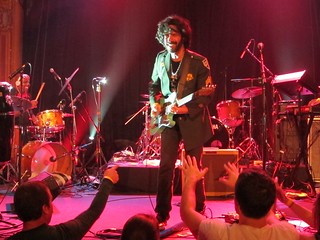
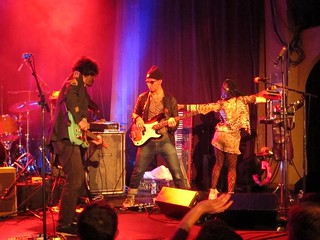
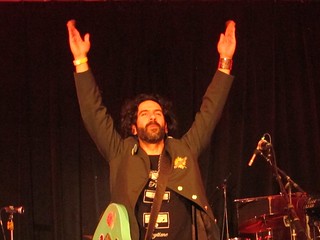
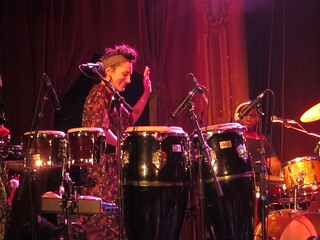
4 February 2015 (Aggie Theatre, Ft. Collins CO, Ft. Collins CO)
3.5/5.0

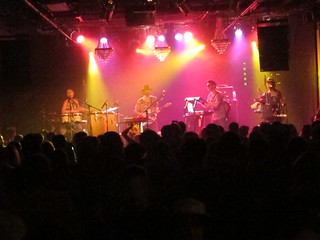
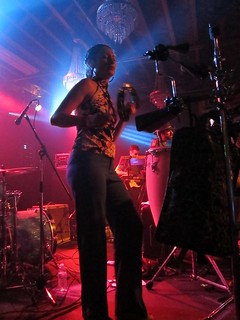
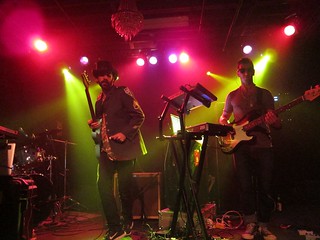
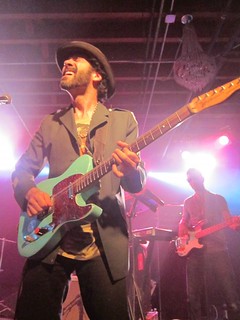
There's no better way to fight the February chill than soaking in the warm sounds of the islands. Hawaiian band The Green brought their pop-flavored reggae to the Aggie as part of their Chocolate & Roses tour. While the venue wasn't packed, the enthusiastic audience was clearly familiar with the band's songs. Their opening act, San Diego's Through the Roots, was a good pairing. Neither band is locked into a slavish interpretation of reggae, but both were able to draw on the power of the one-drop to share their positive messages.
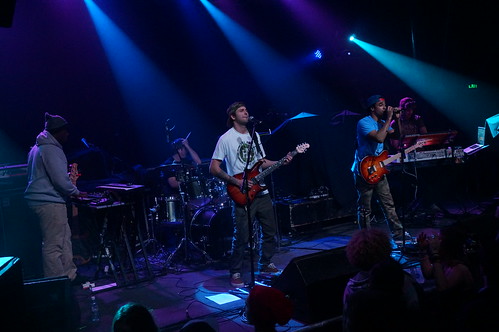

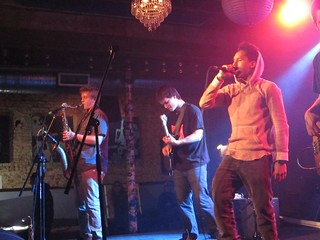
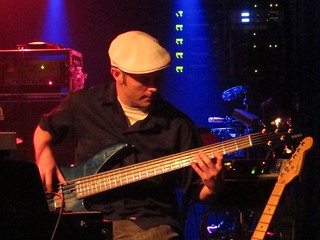
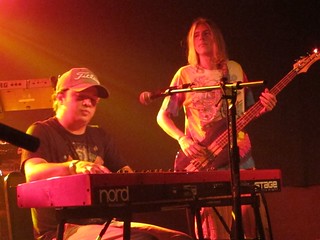
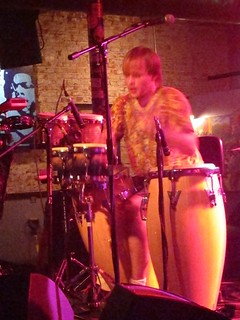
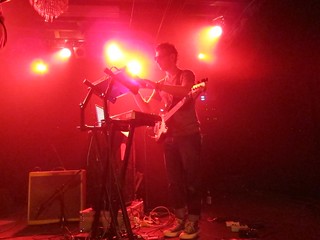
012 Through the Roots Through the Roots made a strong impression with their first song. The electronic intro swirled around a vocal clip of Bob Marley talking about richness, creating an electro-dub vibe before the band dropped into "Dancing in the Rain". The synth element proved to be a big part of their sound, with keyboard driven bass lines, thickly reverbed drums, and lots of toys to warp the guitar tone. Even when bass player Budda Foster switched to bass guitar, it was so heavily processed, that it sounded more produced than his keyboard riffs.
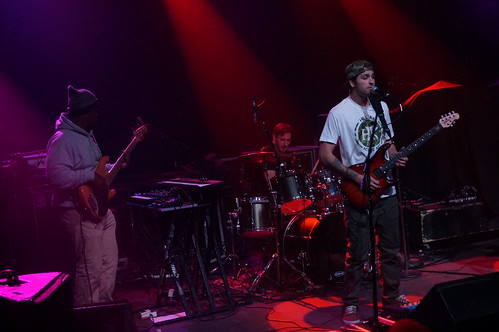
010 Through the Roots
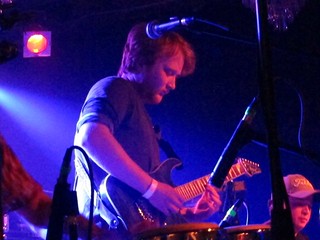
The band moved even further away from the purist reggae ideal on their next tune, which relied on heavier rock guitar. Throughout the set, lead guitarist Scott Curtis rarely slipped into the standard repetitious fill that's ubiquitous in reggae. Instead, he approached the songs from a modern rock perspective. This led to some very interesting interludes, where the whole band fell together on a common melodic theme to break up the flow of laid-back, mid-tempo beats.
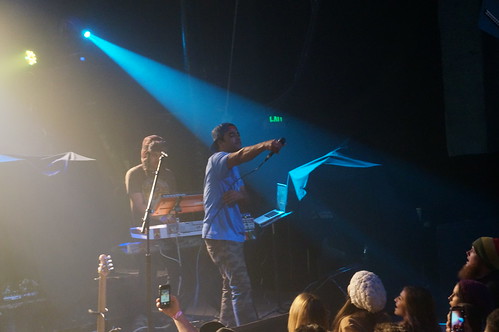
018 Through the Roots
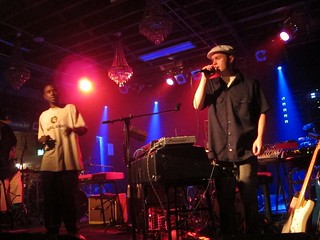
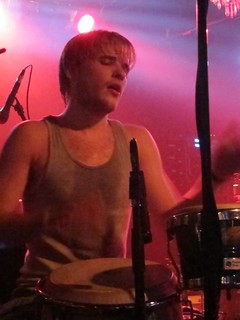
Lead singer and rhythm guitarist Evan Hawkins added the third key element to the band's "Cali-reggae" sound, with a strong R&B vocal style that complemented the positive lyrics. He showed off a good range, but most of the time, his casual stage presence didn't generate as much energy as his shout outs on behalf of The Green. This made their set less about any player's personality and more about the group's tight musicianship. Those coordinated riffs to shake things up were just the start. Through the Roots had clearly polished their arrangements and thought a lot about their song transitions. While they didn't overshadow The Green, they served as a tasty appetizer for the main course.
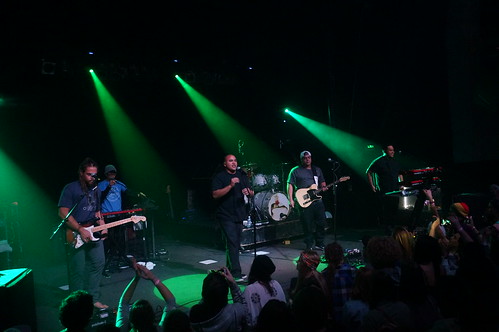

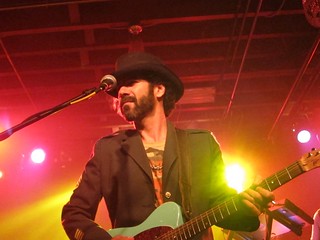
035 The Green
The soulful pop spine of The Green's last release, Hawai'i 13 (2013, review here), combined with the chill set from Through the Roots, had me expecting a fairly relaxed performance, but The Green set me straight right away. A dramatic soundtrack built up the anticipation as they took the stage and they quickly jumped right into the steady groove of "Good One". Where the album version is a soothing philosophical reaction to over-indulgence ("It must have been a good time, baby, whoa"), this take was more immersed in the party mood that preceded the hangover. Charismatic lead singer Caleb Keolanui worked the crowd and radiated a loose exuberance that sold the song.

047 The Green
By the time they had played four or five tunes, the whole front line on stage had taken their turns at lead vocals, That versatility kept the audience engaged, While the singers weren't interchangeable -- guitarist JP Kennedy had a rawer raspy tone with rich, warm character and each tune pulled in the right persona to serve the song -- the handoffs distributed people's attention from one end of the stage to another. Also, when they pooled together on harmonies, it was easy to hear their Hawaiian roots in the sweet mix.
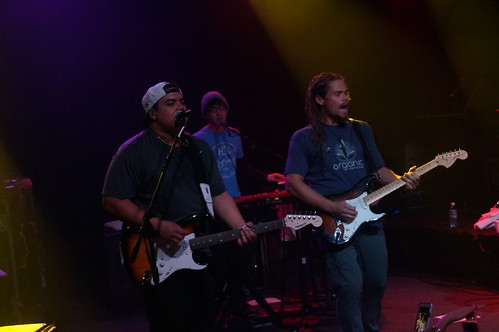
092 The Green
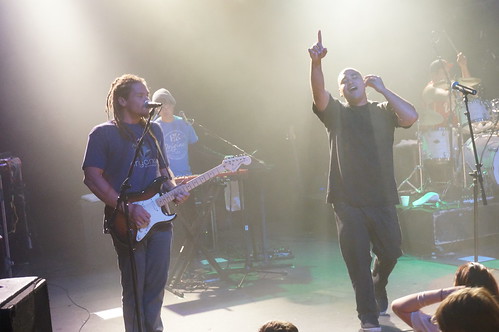
None of that should eclipse the backline rhythm section. BW Watanabe's keyboard bass lines filled out the bottom end and felt organic enough that I never missed a bass guitar in the mix. While he covered backing vocals and assorted keyboard comping above and beyond the bass, he seemed happy to lurk in the background, which didn't do full justice to his contribution. It was a treat watching him cover the fat low end, but still nail the sharp synth stabs or add the understated textures that filled out the sound. Drummer Jordon Espinoza by contrast played large, proving himself a master of fills. This drove the looser live feel, but never compromised the fundamental groove of the music.
074 The Green
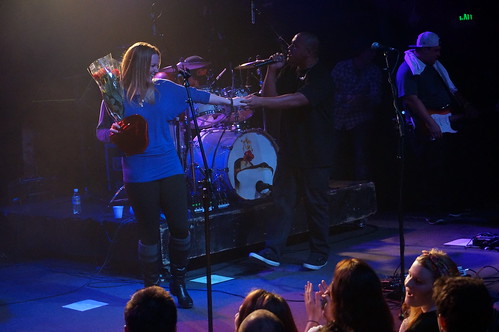
As The Green smoothly flowed through their setlist, it was clear that they had worked out the dynamic progression for maximal impact. Songs found their own climaxes, but they never neglected the tenor of the whole performance. Drop out breaks accentuated the higher intensity moments and lazy grooves led to bigger builds. In particular, it would have been easy for them to lose momentum when they explored a moodier groove, like during "Never", but they maintained a taut focus that served to set up the the big beat funky chank of "Rootsie Roots".
118 The Green
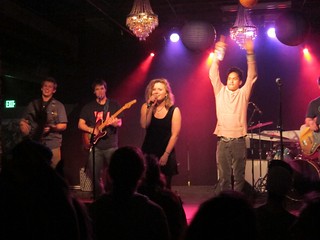
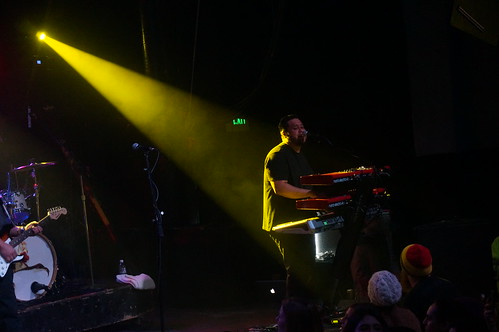
Given that the tour was named after the band's most soulful number, "Chocolate & Roses", the crowd was primed to hear that gem of pop perfection, and it seemed like The Green was ready to deliver it late in their set. Easing into the jazzy soul vamp, Keolanui dedicated the groove to the ladies in the audience and they responded enthusiastically. As the intro stretched out, he riffed on Minnie Riperton's "Lovin' You", "Loving you is easy, cause you're beautiful", but it was all a feint. They wouldn't pull out the tune until their encore, but they made up for it then by bringing a representative woman on stage to serve as a focal point. She danced with poise and graciously received literal chocolate and roses as Keolanui's serenaded her. The arrangement incorporated some bigger dynamic swings that upped the emotional ante, but they avoided any sense of irony and pastiche, preserving the purity of the tune.
054 The Green
Hawaii may be geographically far from Jamaica, but The Green made the island connection work with a high energy, positively conscious performance.

More photos on my Flickr.

Tuesday, January 27, 2015

Recording Review - Dengue Fever, The Deepest Lake (2015)

Retro mod, moody, and hypnotic -- take a sonic dip in exotic waters
4.75/5.0 

Cosmically speaking, three and half years is the tiniest of intervals. Halley’s Comet takes around 75 years to swing by, so a three to four year pause between Dengue Fever releases should be bearable. But given the hothouse worlds that bands live in, the anticipation can be challenging. Last time around, 2011’s Cannibal Courtship (review) reassured fans that the group hadn't turned away from their Khmer rock foundation, even if they had added bits of funk, ska, and soul. Now Dengue Fever is back with The Deepest Lake, and they continue to refine their playing, this time emphasizing the spy music and cocktail aspects of their sound.

Of course, any time you run into old friends again, you compare them against your memory for changes, and the band takes advantage of that to prank their fans a bit. The opening track, “Tokay”, kicks off with a drum machine and synths laying down a Latin dance vamp. The ten measures intro is long enough that I started to wonder if the band had reinvented themselves. But when Chhom Nimol started singing, the keyboards tag-teamed out to let Zak Holtzman’s tremolo heavy guitar come in, connecting with the group's canonical style. Senon Williams still revels in his Latin-flavored bassline and the percussion includes cuĂ­ca accents, but that all fits perfectly with the familiar sounds of Nimol’s haunting voice, echo laden guitars, and Ethan Holtzman’s moody organ solo.

After “Tokay” teases, “No Sudden Moves” offers a strong taste of what The Deepest Lake is all about. The mod, mid ‘60s cocktail vibe is Dengue Fever a go go. Tight horns harmonize the twisting guitar riff and a bass sax blatts out the punches. The chorus softens the edges with sweet pulsing guitar winding around the vocals. The bridge interlude veers forward in time, kicking off with an angular new wave guitar pattern, setting up a slinky bassline to accompany Nimol’s staccato Khmer rap. Then the band drifts into a spy soundtrack interlude to recapture the mod flow of the song and take it home.

That hip retro feel continues through The Deepest Lake, meshing well with the reflective tone of reverb-soaked guitar and hypnotic bass. Nimol’s voice is born for this milieu, sexy and seductive, somehow creating understanding, even if most of the lyrics are in Cambodian. While these songs share DNA with earlier tunes, the group seems to be branching out a bit to explore other cultures. “Ghost Voice” features a distinctly Nigerian guitar, even though the other instruments are anchored in Asian tonality and “Still Waters Run Deep” has an infectious upbeat rhythm that blends Bollywood with “Spy Who Loved Me” chic.

Not all of these tunes are completely new; two were featured on the Girl From the North EP that came out just over a year ago (review). “Taxi Dancer” and “The Deepest Lake on the Planet” are just as good here, but The Deepest Lake is full of great tracks. Probably the best one is “Rom Say Sok”, which features Zac and Nimol’s vocal chemistry and draws on the psychedelic soul the band toyed with on Cannibal Courtship. I can’t help but picture “it” girls doing the frug as the tune spins out. Although this is one of the few songs here with mostly English lyrics, they're trippy and oblique, “French boyfriend will never be wed / Alligator's dried up and now it's dead.” The lines may not form a coherent narrative, but the heady music plays along, with tweedly organ and cool little feedback echoes in the margins. A little over halfway through the tune, the horns come in and pump up the soul to lay down the groundwork for David Ralicke’s raging sax solo.

The Deepest Lake proves that Dengue Fever still have their fingers on the exotic, cross-cultural pulse that has inspired them since the beginning. There are precious few truly original bands out there, and I’m glad to hear that one of my favorites is keeping the faith. We may need to wait another three years for the next album, but this one will tide us over till the comet swings by again.

Monday, August 11, 2014

Recording review: Rene Lopez, Paint the Moon Gold (2014)

Bless his electric Latin soul

My first taste from Rene Lopez was 2010's People Are Just People (review), which celebrated his R & B and soul roots. A year later on E.L.S. (review), Lopez reinvented himself and claimed his own genre, "electric Latin soul".  His most recent release, Paint the Moon Gold, bridges the two sides, picking up on pop influences and toning down the funky club beats, but still holding fast onto Latin textures.

Lopez introduces himself on the opening track, "Purpose and Place". Latin percussion and a restless keyboard vamp provide a background to this autobiographical journey. From Spanish Harlem to his father's record collection, he recounts his influences, casting them as signposts that led him to his calling as a musician. The personal perspective he takes here is a good example of how Lopez approaches most of his songs. Although the arrangements are fully developed, he remains true to his singer/songwriter roots by dressing up his personal experiences with just the right touch of evocative metaphor. "Steal Your Love" is typical, elevating a romantic obsession into a bodice ripping conquest. A flute winds its way through the insistent rhythm, adding an air of exotic tension. The instrumentation is solid but he could easily carry the tune with nothing more than a solo guitar if necessary.

Like People Are Just People, this album is full of retro sounds, this time reaching more for 1970s pop than classic soul. This gives the project a familiar feel, especially on easy flowing tunes like "Just a Man" or "Don't You Change your Heart". That's not a bad thing, but it can become easy to take the music a bit for granted and not get as deeply engaged. Almost as though he recognizes this, "Your Soul Is In Danger" breaks the pattern and refreshes the listening experience. Except for occasionally intoning the title through a veil of reverb, the song is an instrumental, but the mood is unique for Paint the Moon Gold. The shaker beat and weird echoes push the tune into the strange and even when a more focused jazzy groove starts up, the sinister aura smiles in from the edges. It's possible to treat the piece as a bit of camp - his own laughter on the track indicates that he gets the joke - but I could also hear it as a tip of the hat to Dr. John's "I Walk on Gilded Splinters", using horns instead of the choral backing vocals. In any case, the change-up pulls you out of complacency.

Paint the Moon Gold rises from this dark interlude and closes out with a tight, upbeat run of songs: from the soulful sway of "Midnight Love" through the danceable electro-funk of "Come Along Now" to the chill soul-revue of "Hey Papa". Lopez has put together a solid collection that will click for a range of audiences. It blends pop, soul, and funk, all spiced by a generous serving of Latin rhythms. While it doesn't push as many boundaries as his last album, I think that Lopez is finding his most natural voice.

Saturday, March 1, 2014

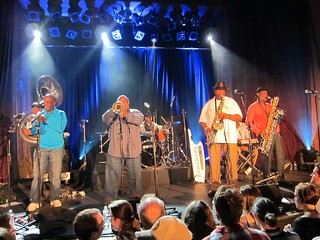
Concert review - Dirty Dozen Brass Band with the Pimps of Joytime

Thursday, 27 February 2014 (Bluebird Theater, Denver CO)

Young and old, from the hopping scene in Brooklyn to way down deep in the Big Easy: this was a great pairing to show off the range of music that can lay a claim to the funk. The Pimps of Joytime and the Dirty Dozen Brass Band are touring together, taking turns in the headliner slot. This was the first of a two night residency at the Bluebird and the Pimps of Joytime were the openers. AXS TV were on hand to film the Dirty Dozen Brass Band - I don't know if they came back on Friday to catch PoJT's headliner or if this was part of their coverage of this year's Jazz Fest. In any case, the cameras were no impediment to a wild night of dancing and celebrating the insistent beat.

075 Pimps of Joytime The Pimps of Joytime were just here this past August (review), but it was great to have them back in town again, this time at a larger, nicer venue. Bandleader Brian J kicked things off by wrenching a funk-blues jam from his guitar. After he anointed the venue with the emotional echoes of this solo excursion, the band fell into place and transformed the tune into a soul review. They followed up with another bluesy interlude before turning up the heat with "Dank Janky". The band really hit their stride with the low-down, dirty jam of "Janxta Funk". David Bailis laid down a wicked P-Funk bass line while the percussion tossed in some light syncopation.

047 Pimps of Joytime
Bailis has a pivotal role in the band, switching between bass, keyboards, and controlling the samples and some pre-recorded backing music. After he set up the bass groove, he layered in a set of keyboard loops that filled out the sound, making a much bigger sonic impression than a five piece can normally summon. Drummer John Staten, though, stole the song with his amazing drum work.

065 Pimps of Joytime
The set shifted mood when the band launched into their new single, "Booty Text". The vocals were soulful, but the heart of the song is anchored to the club dance floor. The chill synth loops channeled classic disco with an aura of electronica over a mechanical beat. Cole Williams and Mayteana Morales provided the sweet femme backing and Brian J put down his guitar to focus on crooning the lyrics. The crowd was game to surrender to the rhythm and boogie down. It was a fun interlude, but Brian J, who is normally a very charismatic frontman, seemed lost at times without his guitar. "Booty Text" transformed the set into more of a dance party than a funk-stravaganza. This meant that Bailis spent more time on the keys than on his bass guitar.

066 Pimps of Joytime
It all came back around, though. The reggae groove of "Stop Wastin' Mine" brought the bass to the forefront. It didn't slow down the crowd from dancing and it hit that sweet spot I have for the band. The groove ebbed and flowed and eventually led to "Hey Mister J", which featured a cool hippy guitar groove and Brian J's best facial expressions of the night. Closing on "Body Party", the Pimps of Joytime didn't have enough time left to perform the ritual of leaving the stage and returning for an encore, but it was a solid set and showed off the band's diversity.

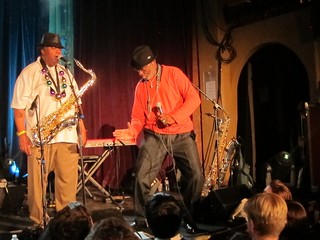
091 Dirty Dozen Brass Band
It took a while to clear the stage and place all the necessary mics for the band, but the wait was worth it. Band members wandered in and out amidst the flurry of setup: Kirk Joseph organized the array of effects pedals for his sousaphone while Kevin Harris scoped out the crowd and connected with a few select people. Eventually, everyone came out and warmed up their instruments. The set opened with a free jazz exploration. Like a bubbling stewpot, the surface was in constant motion: a splash of trumpet rising for a moment before falling beneath the squonk of a baritone sax. After a few minutes of this ritual, the loose flow coalesced into a solid, syncopated groove and the show was underway.

210 Dirty Dozen Brass Band
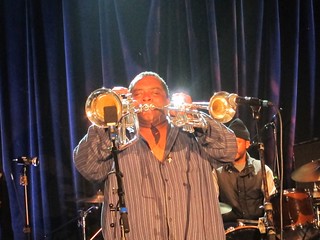
This provided a chance to meet each of the players as they rotated their solos. Trumpeter Gregory Davis balanced his intensely focused playing with a mellow, genial stage presence. Efrem Towns (trumpet and flugelhorn) was more of ham, mugging for the audience and playing his solos with a visible flourish. Kevin Harris alternated a serious demeanor with a touch of clowning as he tore it up on the tenor sax. Completing the front line, Roger Lewis peppered his baritone sax riffs with sly knowing glances, building up for his finale.

123 Dirty Dozen Brass Band
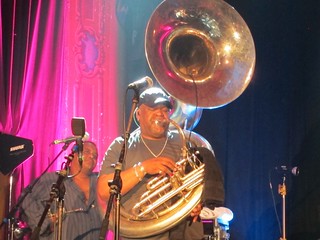
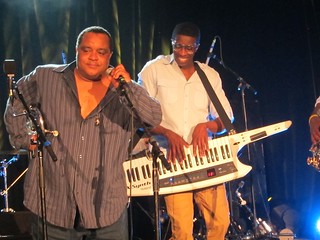
On the back line.Kirk Joseph provided the bass support on his sousaphone, mutating the sound to pop like a funk bass with the wah-wah or warping it with flange into a didgeridoo drone. Drummer Terrence Higgins stayed locked into his drums, but his playing was transcendent. Where a traditional drum solo can often stretch the rhythm so far that the audience is lost and the interlude drifts into the weeds, Higgins could counterbalance the rhythmic exploration with a steady pulse, interjecting any number of flashy paradiddles or stutter beat riffs. Finally, the youngest member of the band, Kyle Roussel laid the rest of the musical foundation with his keys. Alternating between a standard Nord keyboard and a wonderfully retro key-tar, Roussel was shy and unassuming, but his playing was loose and natural and his solos demonstrated a core sense of jazz harmonic theory.

194 Dirty Dozen Brass Band
As you'd expect, the band has its roots in New Orleans jazz and their songs featured plenty of traditional jazz moments. But just as the New Orleans scene they come from has evolved and grown, their set branched out into a rich gumbo of genres, from nasty jazz funk slink to spicy Latin fireworks. The Dirty Dozen Brass Band's goal was to create the right party atmosphere, stylistic niches or generational stereotypes aside. Whether it was Davis leading the crowd in a call and response for "Me Like It Like That" or the blistering layered funk of the Neville Brothers' "Fiyo On The Bayou", the band worked the audience into a dancing frenzy.

220 Dirty Dozen Brass Band
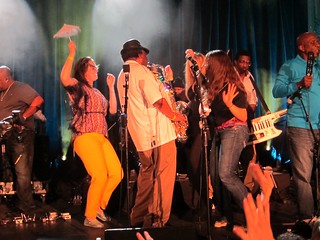
By the same token, though, they had a good sense of flow, letting the dynamic drop into dreamy, meandering solos in order to make the next peak that much higher. They closed out the night with a perfect soul gem, "Dirty Old Man". Roger Lewis summoned the spirit of James Brown and flat out testified. "I'm a dirty old man and I feel like spankin' somebody." Despite his claim, Lewis showed that he had plenty of spunk to keep up with the younger crowd. By the time it was over, they had created a literal party on stage, with girls invited up to join the band and dance til the end of the night.

233 Dirty Dozen Brass Band

More photos on my Flickr.

Monday, January 13, 2014

Recording review - William Onyeabor: World Psychedelic Classics 5: Who Is William Onyeabor? (2013)

A mysterious Afro-funk story with little but musical clues

One look at the title reveals the standard marketing technique: bait the hook with a rhetorical query and hope that people will be intrigued enough to buy the album. But it turns out that it’s a legitimate question without a clear answer. Who Is William Onyeabor? The facts are fairly slim. He’s a Nigerian musician who released several Afro-funk albums starting in 1978. His songs turned up on African music samplers like Nigeria 70: The Definitive Story of 1970s Funky Lagos and Joe Tangari’s Africa 100 bootleg playlist. A few years later, he became a born again Christian and dropped out of the secular music scene. Since then, he’s shown no interest in discussing his past, neither his earlier work nor his post-recording life. When Luaka Bop put this project together as the latest in their World Psychedelic Classics series, Onyeabor refused to participate, leaving them with a fairly vague biographical background. Plenty of tantalizing details have emerged over the years – a Russian film school, a personal recording studio and a village chiefdom – but there’s no real narrative and little corroboration.

If the liner notes can’t resolve the question, then we’re left with Onyeabor’s songs, which graft P-Funk party music onto African roots. The American inspiration is obvious as he demonstrates his love of ‘70s era funk, soul and disco, but his core remains deeply Nigerian, sharing many elements with his countryman Fela Kuti. Lyrically, he borrows from both traditions. Just as George Clinton built extended grooves around short, memorable slogans, Onyeabor bases his tunes on simple statements, chanted repeatedly. But where P-Funk favors a hedonistic kind of humor, with lines like “Get up for the down stroke,” or “Here’s a toast to the boogie/ We’ll funk to that, bottoms up,” Onyeabor’s message is generally more direct and serious. For instance, on “Good Name”, he preaches, “Good name is better than silver and gold,” and warns against ethical compromise. These proclamations are more in line with Fela’s Afro-beat chants.

Onyeabor’s music walks a similar thin line. He assembles his Afro funk grooves under the influence of drum machine beats and analog synthesizers, but the trance-like surrender to rhythmic repetition is very African. The P-Funk and Fela influence is clear, but the songs break from both those sources with a sparse simplicity. There are layers and polyrhythms, but they rarely get more than three or four strata deep. Aside from the female singers, it sounds like he recorded most of these parts on his own.

The opening track, “Body and Soul”, sets the formula for the whole career-spanning compilation. In this case, the basic structure is built around a simple guitar riff, a steady drum beat and synthesizer fills. The keys take center stage, as Onyeabor experiments with a wide variety of synth textures. Aside from the requisite string pads and electric piano, he finds some wilder modulations that come straight from the Mothership. Deeply danceable, this track has the strongest P-Funk vibe, recalling “Chocolate City”. The only drawback is that the piece is a bit long-winded, running over 10 minutes. His musical ideas could have easily fit in half that time, but Onyeabor covers the same ground again and again, hypnotized by his own beat. This aesthetic serves as a litmus test for the album; listeners who can engage with the repetition will appreciate the nuanced meditative vibe.

Over time, I have found myself drifting in and out of appreciation. While I enjoy his basic funk approach, the outlier tracks are the ones that prove most interesting. In particular, the distinctly reggae sound of “Heaven and Hell” stands out. Compared to many of the other songs, it has more lyrical density and the wah-wah guitar fills and horn punches provide a richer set of interactions. Similarly, the Afro-beat feel of “Something You Will Never Forget” offers more diversion with horns, tight guitar figures and more varied syncopation.

I still don’t know who William Onyeabor is, but his music suggests that he’s somewhat obsessive, finding comfort in repetition and subtle details. His lyrics stake a moral ground that’s certainly in line with his later religious conversion. The rest is a mystery. I’d like to think that he’s channeled that same focus to his current contemplation.

(This review first appeared on Spectrum Culture)

Thursday, December 19, 2013

Recording review - The Green, Hawai'i '13 (2013)

Overlapping island perspectives and solid one-drop beats

Let the island rhythms relax you. Let go and surrender to physical bliss of the warm climate and gentle breezes. Dig your toes into the sand and feel for the roots of a rich cultural expression. Hawaii’s premier reggae band, The Green, has no problem drawing the parallels between their island home and Jamaica and encouraging listeners to settle in for some familiar, soothing sounds. More than just a pretty setting or relaxed lifestyle, both places share in the kind of isolation that can nurture their artistss and give them time to bloom into fullness. Various flavors of reggae music evolved from ska, which was inspired by soul and R&B music. The Green respectfully takes in the one drop beats, chanks, and swaying basslines as their starting point, then they reach deeper within to get at the soulful foundation. At the same time, they fully engage with modern R&B and Polynesian sounds. The chants that open and close Hawai'i ‘13 honor their Pacific traditions, but still find a common ground with reggae’s African origins.
While there is no single recipe for authentic Jamaican reggae music, there is a social consciousness that is never far removed. Hawai'i '13 is less concerned with this aspect, with the exception of "The Power In The Words", which preaches a message about the impact our attitude has on the world around us. Instead, the album dedicates most of its attention to love and relationships and,accordingly, invests the songs with a strong pop element. Fortunately, their sincerity imbues the material with a good emotional weight. On "Something About It", they convey the lonely tension that distance brings to a relationship, but they focus on the loving foundation: "I am the island in the middle of the sea/ You are the sunshine, come rise upon me." The verses recall Hall & Oates' charged pop sounds from the late 1970s and early '80s (think "Maneater"), but the busy bounce of the bass and the bubbly fills find the reggae pulse. It's not quite Sly and Robbie, but the foot tapping energy is a treat. The Green continue the retro vibe on the soulful "Chocolate & Roses", which borrows a touch of Lionel Ritchie to try to win over the girl. This piano driven R&B tune is one of the only non-reggae pieces, but it still slides right into the mix for Hawai'i '13.

Their hearts are in the right place, but my favorite track is still "Hold Me Tight". The solid, old-school one drop is moody and sweet, ornamented with a couple of mild dub sections. On first listen, it's another love song, typical for the album, "She holds me tight/ When my heart beats the limit/ And my head starts to swim". Closer attention to the lyrics, though, reveals the party anthem message in this ode to the joys of marijuana, "I want to fire up a fat spliff, pass it all around/ While rolling up another as we're strolling into town." It's a theme that Peter Tosh would be happy to endorse, but the key is the deep-to-the-bones reggae groove that anchors the piece. Another fine moment comes with the dark, 2 Tone ska of "Forgive Me". The pensive piece relies on keys to fill  in the horn lines, but the bass is wicked and throaty. They sing of regret and a break up, but the chorus has a defiant backbone that shows its strength.

The Green first showed up on my radar when they signed with Easy Star Records and contributed to "Baby Be Mine" on last year's Michael Jackson tribute, Easy Star's Thrillah (review). Their innate sense of soul carried that track back to its roots, making the reggae beat a natural extension. It's nice to hear those elements in a richer setting on Hawai'i '13. There are plenty of American bands tapping into the sweet roots of reggae music, but The Green is onto something special, from one island to another.

Monday, November 4, 2013

Concert review - Whiskey Blanket with Dropswitch, Bigwheel Electrosoul, The Quick & Easy Boys, and Rolphy

2 November 2013 (Cervantes Other Side, Denver CO)

Billed as CD release party for Whiskey Blanket's latest, From the Dead of Dark (review), the lineup featured a grab bag of artistic and musical approaches with younger and more experience players. From stripped down rap to multimedia performance art, the opening acts offered wide-ranging contrasts to the headliners, which made for an full-scale evening of entertainment. The CD release itself was understated, although Whiskey Blanket's set was anything but that.

The pickings for photos are a bit thin - note to self: remember to grab the spare battery before you're miles from home.

007 Rolphy
The night started out low key with a young rapper named Rolphy. Backed by simple laptop grooves, he hit the stage with reasonable confidence. His earnest, slightly self-conscious delivery suited his entry-level raps, creating a sympathetic vibe with the audience. Plenty of his friends came out to support him and helped fill out the small crowd. The high point of his set was a female guest singer who added a soul pop texture and gave him something stronger to build on.

016 Quick and Easy Boys
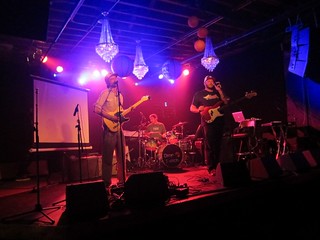
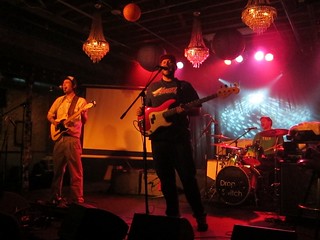
The Quick & Easy Boys were the odd ducks on a slate of largely hip-hop artists. They were a solid blues funk trio without a trace of rap style. Still, their danceable grooves and strong performance made them a good fit with Whiskey Blanket's audience. They've found some success in their hometown of Portland, but they're trying to make their mark in the Denver market, taking any opportunity they can find to build a following. They'll be back again at Cervantes on November 11 for Grass for That Ass, with Whiskey Tango. It'll be worth catching them then to appreciate their funky soul, which owes a debt of gratitude to Joe Walsh and the James Gang.

009 Quick and Easy Boys
All three players are masters of their instruments, adept at finding that balance between show-off skill and nailing the tight arrangements. This is especially important for a trio, where the guitar has to walk the line between lead and rhythm and the bass and drums have to work just a little bit harder to fill out the sound. The Quick & Easy Boys laid down a driving wall of music, packed with back beat and sweaty grind, but the pop-flavored singing contrasted with the grit. Vocal duties bounced around, but the bass player Sean Badders seemed to lead most of the tunes. He was a big guy, but he had a surprising falsetto that gave some of the tunes a BeeGees flavor.

014 Quick and Easy Boys
The band was comfortable on stage, with a great sense of performance. They stayed in motion and sold their joy at playing. Jimmy Russell was especially fun as he flipped the guitar behind his head for rhythm and lead jams or wrenched out a melodic line with his whole body. That said, the band needs to improve their crowd work. The music and show were fine, but more between song patter or direct engagement would help them build the audience connection they seek.

017 Bigwheel Electrosoul
Bigwheel Electrosoul is a performance art project associated with Denver artist/producer DJ Check One (Dameion Hines) that he has described as "guided ambiguous live music." Melding live instruments with pre-recorded tracks, the group started with a foundation of mashed up and mutated music to create the main groove. The tracks sampled both obscure and better-known songs; Hines jammed along on drums while his partner added synthesizer accents.

019 Bigwheel Electrosoul
The projection screen was interesting, especially when it ditched the music videos and took a long graphic exploration of the Mandelbrot set fractals. But after a while I found myself waiting for something more. The idea itself was promising, but it needed to offer more surprises. While it might be an easy step to get more experimental on the pre-fab side , I think that it would be better to take the live component into a wilder space. That might be more effective for engaging the audience for a longer set.

026 Drop Switch
By the time Drop Switch hit the stage, the crowd was swelling and ready to dance. Their opening song set a reggae groove and their rapper, Logistixx, tossed off a speedy toasting style vocal. Song by song, he and the rest of the band showed off their musical range, mixing up styles like a shuffled deck of cards. The one-drop rhythm gave way to a hip-hop beat, which veered into heavier rock punch. The high point came with their cover of "The Distance" by Cake; the band's cathartic thrash on the chorus spurred the audience on. Logistixx did a good job of making John McCrea's vocal line his own.

021 Drop Switch
Drop Switch had clearly spent time working out their arrangements, creating moments of synchronous bliss as the bass, sax, and guitar riffs slipped into lockstep. The upside was the tight coordination between the instruments, but the downside is that the group presented a fairly static tableau. Most of the band's visual appeal came from sax player's humorous mugging and the singer's nervous physical energy. Logistixx stayed in almost constant motion, dominating the band's stage presence with swagger and restless movement. Channeling that tension gave him rapid fire phrasing for his raps.

027 Drop Switch
Near the end of the set, Drop Switch followed Rolphy's lead and brought up a female guest singer. The band played a reggae flavored jam that let her show off a soulful style. She stayed up for the last tune, providing a smooth contrast to the percussive rap lead and jazzy hip-hop beat.

053 Whiskey Blanket
Every time I see this band, they floor me with how much they've progressed as performers. At this point, they're hitting a level well beyond their regional Colorado home crowd, with an innate sense of entertainment. Hip-hop is all about flow, lyrics, and the musical backdrop, but in a live setting, it really demands an extra spark to make it pop. Merely spitting out some solid lyrics to a backing track is not enough to hold a crowd. That's why the big-time rappers develop such large stage personas. They posture and strut; they draw on that image to drive their show.

030 Whiskey Blanket
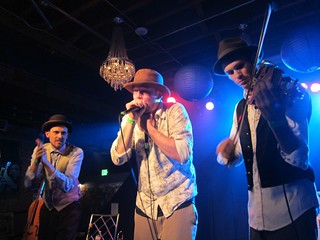
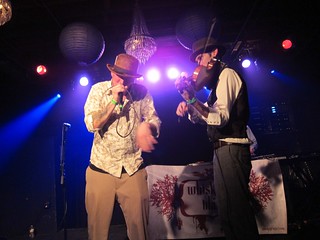
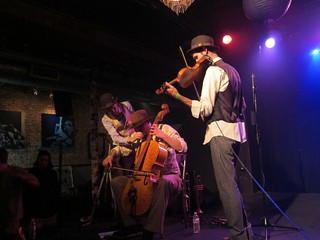
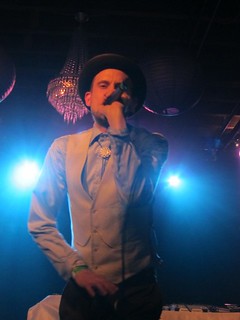
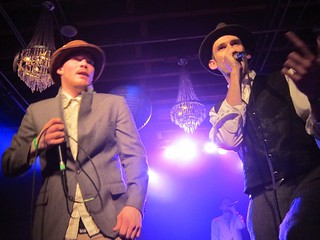
Whiskey Blanket has personality in spades, with each member bringing his own special sauce, but they push well beyond that with inspired musical performance and a unique artistic perspective. Beat boxing, cello, wicked turntablism, and violin come together to create a sonic fingerprint that stands alone. Sloppy Joe, Steakhouse and Funny Biz each have impressive technical skills that add excitement to the show. On top of that, they've honed a three-prong vocal attack that recalls groups like the Beastie Boys or Run DMC.

047 Whiskey Blanket
Saturday night's set showcased the band at the top of their game. Their performance was choreographed with a natural eye to showmanship. Tightly coordinated raps bounced the lead between the three like the Harlem Globetrotters passing the ball. They worked the stage like veteran actors, with every movement blocked for maximum effect. It wasn't just the big motions, like Funny Biz taking a pratfall drop or Sloppy Joe reeling back from a stage slap; even the smallest facial expressions and body language supported the moment. In lesser hands, this could have easily been wooden or overplanned, but Whiskey Blanket made it look effortless with casual aplomb.

050 Whiskey Blanket
The musical twists and turns were every bit as engaging as the acting. The set flowed through new and old material, with spaghetti Western twang giving way to jazzy beats or street classical mashups. Rap sections hit hard and heavy, then transitioned to chamber music inspired instrumentals or bluegrass fiddle riffs. In keeping with the CD release, they led off the show with "The Story Unfolds", filling out the pre-recorded arrangement with live strings and a guest trumpet player. Aside from some sharp turntable work, Steakhouse got into the act with his keyboard. Seeing them integrate the live instruments into the mix was reassuring because From the Dead of Dark didn't showcase that aspect of the band. Whiskey Blanket went on to perform several songs from the album, transforming them for the stage. "Blotto Nox" was stunning, with lyrics whipping by at a pace that made the original's rapid fire rap seem almost stately. "Dinner With Ghouls" kept the slower pace from the album, but also loosened the flow so they could work the crowd a bit more.

046 Whiskey Blanket
They cherry-picked through their back catalog for material to split up the new songs. Even here, they controlled the pace of the show and the ambiance. So, the dark moodiness from "Improper Paradise" (Credible Forces) and the introspection from No Object's "Pound Boom" each found common ground with the newest material. By the end of the show, they were wrung out and ready for the break. The last treat was a Funny Biz freestyle rap. As members of the audience held up objects, he riffed off what he saw, proving that the band's skills weren't just delimited by scripted pre-calculation.

040 Whiskey Blanket
It's worth mentioning that the first time I saw Whiskey Blanket, some unknown Seattle emcee named Macklemore was opening for them. Now, he's earned his spot on the national stage. These guys deserve the same kind of exposure.

More photos on my Flickr


Tuesday, September 24, 2013

Recording review - Black Joe Lewis, Electric Slave (2013)

Sonic change-ups muddle the band's direction

Some things never change. Oh, the record label can change. They can have the band streamline and change their name. They can even bring in a new producer to change the sound. With the opening grunge grind of “Skulldiggin”, Black Joe Lewis makes it clear that Electric Slave is not covering the same old ground of Tell ‘Em What Your Name Is! and Scandalous. The thick acid rock tones still have a taste of blues, but the raw, primal sound of titanic guitars is far from the funk-soul tribute vibe that they cultivated on their earlier albums. Evoking bands like Nirvana, Black Sabbath, and the White Stripes, it makes sense that they’d drop “and the Honeybears” from the band name.

In fact, it’s not until the third track, “Dar es Salaam”, that Joe Lewis remembers to pull out his James Brown impression. The short, declarative verse lines and the song’s soul roots thread back to the band’s older material, but the heavy beat is driven with a newfound psychedelic bass. The horn arrangement adds a touch of Afro-beat, but the guitar riff and Lewis’ singing are the main focus. The tension between the horns and the hard rock guitars makes this my favorite example of the band’s new direction; the coordinated brass accents defy the essentially loose feel of the rhythm section, but the combined jam feels locked into the moment. The only thing that hasn't really changed is Lewis’ slurring vocal style. It’s almost impossible to pick up on all the lyrics.

While there’s plenty of soulful blues and psychedelia, Electric Slave often draws on a thrashy punk attitude to make its musical point. The punches aren't always in synch, but the group doesn't seem too concerned with sonic consistency as long as they find the right level of nervous energy. I appreciate the pacing and it’s good to hear Black Joe Lewis broaden their sonic footprint, but the collection doesn't have a coherent flow to maximize the impact. It just doesn't make any sense to follow the trippy madness of “Skulldiggin” with the hyped up punk-a-billy of “Young Girls.” The low-fi garage production fits, but nothing else meshes. A few songs later, the group blends garage rock and greasy new wave for “Guilty”, which pairs the guitar with a baritone sax in a buzz-saw grind. A tenor coarsely wails over the top for the first solo, borrowing a trick from Romeo Void’s “Never Say Never”. It’s a great song but has little in common with soul funk of the next track, “Come To My Party”, which gets closest to the band’s earlier tunes.

The remaining constant across the band’s catalog is that the studio only captures a shadow of their stage performance. If Jim Eno's production on the first two albums suggested a sweaty soul band fresh in from the Chitlin' Circuit, then producers Stuart Sikes (White Stripes, Cat Power) and John Congleton (Explosions in the Sky, St. Vincent) evoke their own versions of brick echo, heat and jam-packed dives on this project. As Lewis hollers his way through each tune and the band pushes forward with abandon, it’s a cinch to imagine how much wilder it would be in real life. That’s a fitting reaction, given that Lewis intends Electric Slave as a commentary on society’s obsession with technology. Here’s to hoping that they order their set lists better than the track listing here.

{This review first appeared on Spectrum Culture}

Thursday, September 12, 2013

Recording review - Vieux Farka Touré, Mon Pays (2013)

Following in his father's footsteps, reminding Malian's to remember their forefathers

At some point, every kid wants to grow up to be just like his dad someday. When your dad is Ali Farka TourĂ©, known as Africa’s John Lee Hooker, then those are some bigger shoes to fill. The challenge was even harder after Ry Cooder introduced him to a wider American audience with their 1994 collaboration, Talking Timbuktu. Vieux Farka TourĂ© spent a childhood steeped in his father’s music, which found a soulful, spiritual middle ground between Hooker’s ruminative blues and the bright tones and layered polyrhythms found throughout African music. By turns exotic, joyful and haunting, Ali TourĂ© created beautiful music up until his untimely death in 2006.

Perhaps because his own recognition came late in life—he was nearly 50 when he achieved international acclaim — Ali TourĂ© tried to discourage his son from becoming a musician. But Vieux TourĂ© persevered at learning guitar and he eventually recorded his own music. By his third studio album, The Secret (2011), he was already making his own crossover move, playing with Derek Trucks, Dave Matthews and jazz great John Scofield. By contrast, Mon Pays marks a return to his father’s earlier acoustic sound. This time, instead of popular Western collaborators, he’s largely working with other African musicians, most notably kora player Sidiki DiabatĂ©, son of the renowned Toumani DiabatĂ©.

The new album is a response to the current strife in Mali. What began as a multi-faceted insurrection in 2012 has now splintered into chaos. In the regions they control, Islamic rebels in the North of the country have imposed strict laws that include bans on music. A Muslim himself, TourĂ© has spoken out against this kind of cultural genocide, “Music for us is life…Without music, we are robbed of our identity.” So Mon Pays (“My Country”) is an assertion of that identity and a reminder to his fellow Malians about their rich heritage. Despite this somber inspiration, TourĂ©’s songs are uplifting, with a sense of optimism.

TourĂ© evokes his father’s spirit on songs like the meditative “Yer Gando” and the moody “Safare”. This latter track has a more direct connection as a cover of one of his father’s songs, but TourĂ©’s guitar work is spot on. The tune opens with a fluid melodic line that blends DNA from Delta blues guitar with a keening West African kora. The group drops back to a droning blues sound to support the chanted chorus. TourĂ©’s voice is a little rougher than his father’s, but the song serves as a loving tribute.

More than just TourĂ©’s guitar, the songs on Mon Pays showcase the versatility of the kora. The upper register of this harp-like instrument offers delicate chiming tones that have a distinctly Asian character. On the jazzy “Doni Doni”, the timbre is like a harpsichord, but the riffs are more reminiscent of a shamisen. “Future”, on the other hand, begins with a tentative koto sound then balances the kora and guitar into an amalgam of folk traditions: Malian, Japanese and American blues. As a response to the troubles in Mali, this sweetly simple instrumental offers a hopeful vision of peaceful cooperation.

The album closes on a soulful note with “Ay Bakoy”. The song is built on a piano melody by Israeli keyboardist Idan Raichel. The two men met several years ago, but just released an album together last year, The Tel Aviv Session. Despite the differences in their backgrounds, they each bring an open-minded musical approach that thrives on collaboration. “Ay Bakoy” is a fine example of how well they mesh. Raichel’s main theme sounds like a melancholic reworking of “House of the Rising Sun” and TourĂ©’s vocals are appropriately doleful. But the song finds a core of strength and rises from its mournful base to bring a message of encouragement.

TourĂ© speaks more to his own people through these songs than he does to the rest of the world, but his pain, hope and unbowed spirit shine through. Even without the language skills to understand his lyrics, listeners will appreciate the music and vocal expressiveness on Mon Pays and they’ll recognize his earnest vision of a reunited Mali.

(This review first appeared on Spectrum Culture)

Monday, September 2, 2013

Concert review - The Pimps of Joytime, with Mlima and Funkma$ter

31 August 2013 (Cervantes Other Side, Denver CO)

Always pay attention to the details... I was excited when I heard that the Pimps of Joytime were hitting Colorado again. I carefully noted the time and place and made arrangements to come down to Denver for the show. At the last minute, I found out that I could  have saved a drive: they played at the New Belgium Brewing's Tour de Fat party earlier the same day in my town of Ft. Collins. I'm not sure how their set went in FC, but they took their time and banged out a long set at Cervantes. So, I'm not feeling too bad about my choices.

This was the first of two nights for the band, acting as the after-party for the Phish show at Dick's Sporting Goods Park at Commerce City.


Funkma$ter and friends
016 Funkmaster
I seem to catch one-man band Funkma$ter (Matt Grundstad) about once every couple of years and each time I'm more impressed. His 2009 show with That 1 Guy (review) demonstrated his technical competence with his instruments and looping, but lacked a strong stage presence. By 2011, opening for John Popper (review), his technique was stronger and he did a better job of engaging the audience, but he still had trouble managing the flow of building layers and entertaining at the same time. This weekend, he proved that he's overcome these limitations.

009 Funkmaster
In part, he owes some credit to the vocalists that joined him on stage. Three rappers, EZ, Spellbinder, and MCbig House, brought hype and harmony to the show. Their contrasting styles alone added a lot to the mix. EZ had a classic hip hop style, with a smooth cadence and good versatility that allowed for some soul. Standing center stage, he was laid back and balanced the bouncier energy that Spellbinder exuded. Spellbinder favored more of a world riddem style, toasting over reggae grooves and spitting out some speedy lines. MCbig House, by contrast, was a more solid presence. His lower timbre and more serious look added gravitas to the line up. Other contributors stepped in briefly to add their own voices, adding to the show's fluid energy.

027 Funkmaster
But even with surprise guests and loose patter on stage, this wasn't a casual throwdown. The group had clearly developed material that traded on the members'strengths and gave each one some showcase moments. Funkma$ter himself has developed as a performer, too. Even though his posse helped cover during the layering process, he has become adept enough to split his attention between his playing and the crowd. So, a lot more of his personality came through and connected.

014 Funkmaster
As the group ran through a fun mix of hip hop, reggae, and funk pieces, the crowd ate it up. Dr. Dre's "Let Me Ride" had the audience singing along while Funkma$ter mixed his loop like a DJ, picking which elements to emphasize. Another great song was a cover of Don Carlos' "Young Girl".

004 Funkmaster
Funkma$ter and Friends had a solid set, from the sparsely crowded opening to the mass dancing party at the end. They proved to be a stronger match for the headliner than the band that followed them.

032 Mlima
Haters deride jam bands for empty noodling and self-indulgent songs that drag on forever. I've defended bands like Phish and Umphrey's McGee as a modern day take on jazz traditions, pointing out their technical prowess at creating intricate arrangements and deftly controlling song dynamics.

043 Mlima
Given the Phish connection for this show, it probably made sense to bring in a jam band. I don't think that it was a great fit for the Pimps of Joytime, either musically or personality-wise, but the crowd seemed to enjoy the set well enough. To their credit, Denver's Mlima had fine technical chops and managed some tight dynamic shifts. They were well practiced and, unfortunately, they were boring.

040 Mlima
The music itself wasn't lacking; their guitarist, Doug Litvak, is phenomenally talented and his virtuoso playing carried many of the songs. The problem is that the band was too inwardly focused, making it hard to relate to them. Each player was in his own world, locked into his own part. Aside from occasional glances and nods, there was little acknowledgment between the players and almost no interaction with the audience.

050 Mlima
Since the music was all instrumental, the only verbal communication came during pianist Matt Telsey's terse moments of stage patter between songs. After reassuring himself that we were still excited to see the Pimps of Joytime soon, he'd briefly mention the next song's title. Sure, there are plenty of examples of strong entertainers performing solely instrumental music. But in the cases where they aren't big conversationalists -- Miles Davis comes to mind -- they can still radiate an intensity during their playing. For the most part, Mlima only mustered a sense of preoccupation.

038 Mlima
Nick Miller's percussion work was the one standout exception, because he exuberantly attacked each song. He was still primarily locked in his own headspace, but it looked like a fairly interesting place. In comparison, Litvak consistently laid down some jaw dropping riffs, but rarely expressed more than a vague distraction.

053 Mlima
Mlima should take a lesson from Phish. If they set up the songs with stories or, at the least, moved with the music and expressed some passion and personality, then they'd have a much stronger act. They have the talent to milk some acid funk intensity out of a simple four measure looped progression; they should be able to make it more of a show.

110 Pimps of Joytime
If there's one thing that the Pimps of Joytime have going for them, it's personality and passion. Those two things alone would be enough to power a great performance, but they throw in tight arrangements, smoking chops, booty shaking beats, and catchy songs that stick in your brain.

099 Pimps of Joytime
The band came out kicking ass, immediately diving into a solid funk jam with cool Latin percussion. After getting everybody moving, they dropped back into a Sly Stone groove for "My Gold". Frontman Brian J squinched in tight and laid down a sweet falsetto vocal for what turned into a soul funk dance party. When the time came to solo, he launched into a spaced-out psychedelic lead that sparked the crowd. He was an expressive player, posing to match either the sound he's wrenching from his guitar or the mood of the song. Even when he dropped back to let someone else drive, he danced along to stay fully connected.

086 Pimps of Joytime
While the Pimps of Joytime make funky soul their home base, they didn't handcuff themselves to it. Instead, they branched out into other realms, like blues, pyschedelia, and synth-pop. Their aim was to keep the audience moving and engaged with the music. Little tricks, such as sampled vocal snippets and electronic beats, were used to offer up surprises and liven up the songs. So, a track like "Keep That Music Playin'" at first suggested a P-Funk jam, but then keyboard washes and percussive samples took it somewhere new.

079 Pimps of Joytime
It was a show full of great songs, but I think my favorite piece was "San Francisco Bound". It started out mellow, with trippy keyboard riffs and heavily reverbed guitar, sort of like the Doors jamming with soul legend Shuggie Otis. Once the band set their hypnotic groove, Brian J let his guitar go exploring the space they created. Eventually the song evolved into a Zappa-esque jam reminiscent of "Dirty Love" (Overnite Sensation - 1973).

080 Pimps of Joytime
After "San Francisco Bound", most of the band took a break, leaving the bass player to cut loose on his synthesizer set up. After an extended electronic jam, the drummer came back out and joined in. This led to the best visual moment of the show. During the drum solo, the lights shifted color and strobed to match. The tight coordination as every syncopated beat was reflected in the light show was amazing.

067 Pimps of Joytime
As the rest of the band came back out, it was hard to imagine that there was still about another hour left in their set. These guys rocked it non-stop, demonstrating why they are one of the world's best touring bands. After a certain point, there was less motivation to track the individual songs. Instead, it was best to live in the moment, appreciating each punchy bassline, each sinuous percussion syncopation, and each speedy drum fill. Throughout it all, Brian J played ringmaster, raising his hands exultantly or seeing how nasty he could treat his guitar.

104 Pimps of Joytime
It was a long drive back home to Ft. Collins, but I was happy to have found my own joytime that night.

More photos on my Flickr