(Artwork care of Karen Ramsay (www.karenramsay.com), profile photo care of brianlackeyphotography.com)
Showing posts with label moody. Show all posts

Wednesday, May 6, 2015

What's cool? Martin Gore, Europa Hymn

Unscripted reflection

When I was a kid, I loved to go to the natural science museum and look at the dinosaurs. There was something cool about seeing the articulated skeletal fossils next to artists' renditions of how they might have appeared in life. It was a while before I realized that those sketches were basically just guesswork, but that epiphany opened up possibilities in my mind as I imagined alternatives to what had been put before me. Even now, I prefernot to have everything all spelled out. The best books, movies, or music leave a bit of mystery that pushes some of the work onto the audience.


That's exactly why Martin Gore's new single, "Europa Hymn" is so enjoyable, It's more like a gesture drawing than a fully developed song. Even though it's barely more than three minutes, Gore takes his time to place a small set of elements -- synthesizer swells and electronic beats -- and he lets them just reverberate within the sonic space. The track is moody and reflective, but the sparse arrangement doesn't provide much additional narrative direction. It rises from the synthesizer waves, builds up some rhythm to suggest a kind of down-tempo electro-pop, and then sinks back under the lonely surface, leaving room for a world of interpretations: it could represent the arc of a relationship, the ebb and flow of life, or even the sense of a sculptor finding the shape that hides within a block of marble.

Gore is best known as one of the founding members of Depeche Mode, and it's easy to hear the connection between this and his band work. But while the palette is familiar, this song distills synth-pop down to its electronic essence, discarding the urgency and tension to focus on an ethereal sense Zen purity, where the listener project their own meaning.

"Europa Hymn" is one of 16 tracks from Gore's new album, MG, which came out at the end of last month.

Tuesday, April 21, 2015

Recording review - Ambrosia Parsley, Weeping Cherry (2013/2015)


Pervasive sadness is softened into dreamy surrender

3.75/5.0

The timeless, unanchored feel of Ambrosia Parsley’s music reflects the narrative for the reissue of her 2013 solo album Weeping Cherry: both are hard to pin down to a particular moment or linear progression. The former lead singer for the moody Shivaree had plans to release a solo album as far back as 2008, but it never came together. Eventually, she released the tune “Rubble” in 2010, sparking renewed interest, but the album took another three years before it came out on France’s Fargo Records label. Now, another year and a half later, it’s finally getting an American release on Barbes Records.

Parsley has said that Weeping Cherry is rooted in a hard year of loss, which comes strongest in her lyrics. There is a pervasive sense of sadness in these songs, but her arrangements and singing soften the songs into dreamy surrender, rather than outright depression. Even when the undercurrent of loss rises to the the surface, like her line in “Catalina”, “Another tear/ Salt the butter on our daily bread,” the music keeps the emotions from overwhelming the songs.

There’s a lot of her former band’s retro sound in these songs, above and beyond the continuity of Parsley’s ethereal voice. But her writing shows other strong influences, particularly Radiohead and Elvis Costello. Like those artists, she’s more than just a talented singer/songwriter; each of these tracks feature arrangements that add depth and complexity. It’s interesting to hear her swing from retro pop to more modern styles, but she maintains a kind of languid delivery that creates a siren-like seductiveness. At the same time, her voice reminds me of Jill Sobule, with a vulnerable surface around a strongly grounded center.

That Jill Sobule comparison shines on “My Hindenberg”. Part of it is the simple, restrained acoustic guitar that complements the clear, folky vocal. It has a similar historical perspective to Sobule’s “Vrbana Bridge”, but rather than a snapshot story reminiscence, Parsley builds a moving metaphor for her own loss. She ties the iconic images of the Hindenberg disaster, full of helpless impotence, to her lyrics and makes them deeply persona. The bridge is particularly poignant, “On the ground, we almost can’t believe it/ You were out of time and we were all out of place.”

Most the music on Weeping Cherry is more layered than "My Hindenberg". Parsley’s Radiohead side turns up on that first single, “Rubble”. The warm bassline and guitar interjections are tethered to a deliberate drag beat rhythm. Think “Creep” mixed with a stripped down version of “Airbag” from OK Computer. Like “Creep”, Parsley locks into a low sense of self-esteem and fear that is drained of direct emotional weight. The arrangement leaves plenty of space to fit in a host of details. The guitar textures are especially sweet, rawly expressing the feelings that her vocals seem too scared to voice.

The Costello influence is more pervasive. Often, it’s her thoughtful phrasing, like on the title track, or a similarly handled chord run on “Only Just Fine.” But it’s most obvious in the dark, moody music and sardonic lyrics of “Make Me Laugh”. From the very start, the tune is unsettled, with stark percussion and eerie echoed tones. The mood abruptly shifts context, though, when the vocals come in with the evocative lines, “Make me laugh / When it's 'goodbye'/ With a bill and a body count so high." The verses match Costello at his introspective best, full of musing defiance, but the walking bass and Parsley’s breathy delivery cut the creepiness and make it more like a disoriented dream. I love the jazz standard feel to the progression with its tremolo guitar accents. On the original release, this was a perfect ending for the album. This 2015 reissue tacks on “The Answer (Tim and Becky’s Wedding)”, which is more of a love song, albeit with hint of a 'beautiful disaster' vibe. While this bonus is a pretty song, it’s not as powerful an ending for Weeping Cherry.

While most of these songs would be at home on a Shivaree release, they do cover a wide sonic range. "My Hindenberg", "Rubble", and "Make Me Laugh" each show different facets of Parsley's writing style. Fortunately, her voice provides the common thread to tie these disparate pieces together.

Tuesday, March 24, 2015

Recording review - The Myrrors, Arena Negra (2015)

Rich psychedelic details lurk below the desert surface

4.0/5.0

The desert is a potent symbol. It can be unwelcoming and dangerous even as its solitude can be cleansing. In Michelangelo Antonioni’s jaundiced commentary on late 1960’s counterculture, Zabriskie Point (1970), the desert was a haven offering the possibility of a new start. The Myrrors may be from Arizona, not Death Valley, but their desert psychedelia reflects Antonioni’s sense, taking inspiration from the beauty and surreal feelings found in such a stark environment. Their new release, Arena Negra, captures those facets along with the majesty of wide open spaces and vivid backdrops. The music itself is timeless; free jazz and avant garde contributions keep it from being strictly anchored in the retro golden age of head music, but it avoids the intellectual gamesmanship that often accompanies those approaches.

The album opens with the expansive title track. The twelve minute run time gives The Myrrors plenty of room to slowly ease into the song and develop the feel. It’s fitting that the pensive bass motif at the start evokes Pink Floyd’s “Careful With That Axe, Eugene”, which turned up in Zabriskie Point, albeit under a different name. This intro section, with the bassline supporting the sun glare shimmer of violin and flute drone, taps into the mystery of the desert, especially when the unintelligible chanted vocals join in. The dreamy haze slips away when the drums finally punch their way to the front to drive up the intensity. The band slips into a Velvet Underground guitar raga mode, where they tread the same ground repeatedly, layering in all kinds of noise and subtleties without really moving very far from the initial groove. Guitar dominates as the music turns in on itself, but the flute adds a chaotic flutter, like lizards gazing impassively through heat waves of distortion. The song hangs in that dervish whirl without respite until the last minute and a half, when it gradually retreats from the climax to fall back to the sleepy sway that still lies at the root. Then, it fades like consciousness surrendering to anesthesia before finally winking out.

Just as their music wanders without getting completely lost, The Myrrors have passed through their own twists and eddies. They started during high school, recording a 2008 demo that would take another five years to find a wider audience. By that point, the band had drifted apart with college plans and finding their way into adulthood. Against expectations, they’ve come back together, comfortably falling into old habits but their scope has grown to incorporate world music and a mix of other influences.

“Dome House Music” shows off that maturity. Like “Arena Negra”, it starts slow with a meditative repetition, but there’s also a rhythmic complexity that drives the song. The piece is in nine, but the emphasis on the last two beats pulls it off balance, always lurching forward. The track builds inexorably, collecting a buzz of horns that swirl in free jazz riffing and smear together to create a thick wall of tone. When the drums and horns drop away near the end, it’s relief. Nothing of the relentless chaos and tension is left but the resonant hum of guitar, which slowly fades away before the remaining twenty-odd seconds has fully elapsed. Even though “Dome House Music” doesn't conjure a direct set of images, its oppressive sound taps into the darker danger of the badlands, suggesting disorientation and dehydration.

Arena Negra packs a lot into a mere four tunes, but it's a full length release, not an EP. Just as the expanse of the great outdoors is impossible to capture with point and click camera, pop length songs are too short for The Myrrors to paint some of the sonic pictures they want to convey. Instead, they give long play pieces like "The Forward Path" space to evolve and find their way forward. Dewey Bunnell (America) may have said, "In the desert, you can remember your name," in "A Horse With No Name", but The Myrrors don't just find themselves, they discover all kinds of hidden dimensions.

Thursday, March 19, 2015

What's cool? Amanda Palmer, "Bigger on the Inside"

A poignant sense of perspective

The haters aren't all wrong about Amanda Palmer. Of course they're suspicious of her near constant attempts to be outrageous and provoke reaction; Palmer herself drives most of the controversy and her innocent surprise at the fallout seems a bit disingenuous. The Dresden Dolls gave her a theatrical platform and, with the help of her fans, she's erected that into a ziggurat of overwrought emotion. While she sometimes plays the martyr, she is certainly no saint.

But -- and this is the key -- as much as she courts indignation, her image is more grounded in her personal truth than any other pop performer I can think of, especially the queens of shock facade, Madonna and Lady Gaga. I believe that most of the time, Palmer knows exactly what kind of response she'll get and she embraces that. But it's also clear that her own expressions of outrage, pain, and childlike joy are truly sincere reflections of her inner life. That's what makes a song like "The Killing Type" so powerful: she's not afraid to face the contradiction of her pacifist front and her sublimated anger. and the juxtaposition gives both sides equal weight.


Palmer's latest piece, "Bigger on the Inside" has a very similar sound to "The Killing Type" and it also crosses her higher ideals against the reality of her feelings. This time, though, instead of fury, the track is grounded in heartbreak. Her voice skips right along the edge of falling apart as she chides herself for her own bitterness and frustration in the face of real pain, like dying friends and abused children. A big part of the impact is that those examples are specifically grounded rather than generalities. It's particularly poignant that Zoƫ Keating plays cello on this piece, which was recorded during her late husband's illness.

The song starts out a bit defiant, with the hook admonishing Palmer's critics that she is "bigger on the inside" and they're "only hating other people's low-res copies," but by the end, she's comforting us and herself that everyone is deeper than their surface looks from outside. A resonant discord of string buzz builds for the final line, but drops away on the last word to punch the resolution. "Bigger on the Inside" is maudlin and a bit melodramatic, but it touched me because it captures an emotional truth.

Drop by her page on Patreon to download your own copy.

Thursday, February 19, 2015

What's cool - Pussy Riot, "I Can't Breathe"

Power games

Vladimir Putin probably isn't the only one wishing that protest artists Pussy Power would just shut up and go away. The group has just released a new video that will likely have the right wing American rant-o-sphere joining him in decrying the group. What brings together these ideological opposites? Their spiritual brotherhood in hating dissent and feigning outrage. Not content with speaking out against Putin's dictatorship, Pussy Riot uses their latest video, "I Can't Breathe", to draw a direct connection between the leader's state sponsored terrorism against his political opposition and the recent American cases of police overreaction and lethal violence against people of color.

Nadezhda Tolokonnikova and Maria Alyokhina, who spent 21 month in prison for Pussy Riot's church protest in 2012, partnered with Russian bands Jack Wood and Scofferlane to create the song and video. As the two women are buried in shallow graves while wearing Russian riot police uniforms, the lyrics refer to Eric Garner, who was choked to death by NYPD officer Daniel Pantaleo last year. After the opening lines that describe Garner as a martyr, they go on to say "If it's unfair my friend/ Make up your mind./ It's getting dark in New York City." At the end of the song, famed punk icon Richard Hell reads the transcript of Garner's last words on the police video of the incident, inflecting them with frustration and, finally, panic.


Unlike most of Pussy Riot's guerrilla protests, "I Can't Breathe" is actually a very polished and moving piece. While their raw anger and direct confrontations of the past have made their point, this video will probably reach a larger audience and make a deeper impression. The music is stark and powerful and Sasha Klokova's vocals are haunting. The simplicity reminds me of Sinead O'Connor's "Black Boys on Mopeds", which dealt with a similar topic. The video imagery is not all that subtle, nor is their accompanying press statement, but none of that detracts from the song. They draw a clear link between Russia's actions in the Ukraine, Putin's riot police assaulting protesters and the police violence and protests here.

Plenty of people here will say it's an unfair comparison that's disrespectful of police officers just trying to do their job, But just as anyone ambivalent about Russian imperialism would be leery speaking up too loudly, it shouldn't be surprising that people of color, especially young men, have trouble thinking of the police as public servants. It's too much to expect this song to effect a real change on its own, but it can certainly help keep up the pressure.

Tuesday, January 27, 2015

Recording Review - Dengue Fever, The Deepest Lake (2015)

Retro mod, moody, and hypnotic -- take a sonic dip in exotic waters
4.75/5.0 

Cosmically speaking, three and half years is the tiniest of intervals. Halley’s Comet takes around 75 years to swing by, so a three to four year pause between Dengue Fever releases should be bearable. But given the hothouse worlds that bands live in, the anticipation can be challenging. Last time around, 2011’s Cannibal Courtship (review) reassured fans that the group hadn't turned away from their Khmer rock foundation, even if they had added bits of funk, ska, and soul. Now Dengue Fever is back with The Deepest Lake, and they continue to refine their playing, this time emphasizing the spy music and cocktail aspects of their sound.

Of course, any time you run into old friends again, you compare them against your memory for changes, and the band takes advantage of that to prank their fans a bit. The opening track, “Tokay”, kicks off with a drum machine and synths laying down a Latin dance vamp. The ten measures intro is long enough that I started to wonder if the band had reinvented themselves. But when Chhom Nimol started singing, the keyboards tag-teamed out to let Zak Holtzman’s tremolo heavy guitar come in, connecting with the group's canonical style. Senon Williams still revels in his Latin-flavored bassline and the percussion includes cuĆ­ca accents, but that all fits perfectly with the familiar sounds of Nimol’s haunting voice, echo laden guitars, and Ethan Holtzman’s moody organ solo.

After “Tokay” teases, “No Sudden Moves” offers a strong taste of what The Deepest Lake is all about. The mod, mid ‘60s cocktail vibe is Dengue Fever a go go. Tight horns harmonize the twisting guitar riff and a bass sax blatts out the punches. The chorus softens the edges with sweet pulsing guitar winding around the vocals. The bridge interlude veers forward in time, kicking off with an angular new wave guitar pattern, setting up a slinky bassline to accompany Nimol’s staccato Khmer rap. Then the band drifts into a spy soundtrack interlude to recapture the mod flow of the song and take it home.

That hip retro feel continues through The Deepest Lake, meshing well with the reflective tone of reverb-soaked guitar and hypnotic bass. Nimol’s voice is born for this milieu, sexy and seductive, somehow creating understanding, even if most of the lyrics are in Cambodian. While these songs share DNA with earlier tunes, the group seems to be branching out a bit to explore other cultures. “Ghost Voice” features a distinctly Nigerian guitar, even though the other instruments are anchored in Asian tonality and “Still Waters Run Deep” has an infectious upbeat rhythm that blends Bollywood with “Spy Who Loved Me” chic.

Not all of these tunes are completely new; two were featured on the Girl From the North EP that came out just over a year ago (review). “Taxi Dancer” and “The Deepest Lake on the Planet” are just as good here, but The Deepest Lake is full of great tracks. Probably the best one is “Rom Say Sok”, which features Zac and Nimol’s vocal chemistry and draws on the psychedelic soul the band toyed with on Cannibal Courtship. I can’t help but picture “it” girls doing the frug as the tune spins out. Although this is one of the few songs here with mostly English lyrics, they're trippy and oblique, “French boyfriend will never be wed / Alligator's dried up and now it's dead.” The lines may not form a coherent narrative, but the heady music plays along, with tweedly organ and cool little feedback echoes in the margins. A little over halfway through the tune, the horns come in and pump up the soul to lay down the groundwork for David Ralicke’s raging sax solo.

The Deepest Lake proves that Dengue Fever still have their fingers on the exotic, cross-cultural pulse that has inspired them since the beginning. There are precious few truly original bands out there, and I’m glad to hear that one of my favorites is keeping the faith. We may need to wait another three years for the next album, but this one will tide us over till the comet swings by again.

Tuesday, November 11, 2014

Recording review - Alain Johannes, Fragments & Wholes, Vol. 1 (2014)

Time-boxed creativity yields pearls of improvisation

Sometimes, it can be be excruciating to bring all the pieces together. Scattered and disjoint, they may not quite fit together into a coherent whole, but leave some out and some important facet is glossed over and missed. Fragments and Wholes, Volume 1, the latest solo project by multi-instrumentalist and producer Alain Johannes deals with this explicitly, drawing on roughed out sketches and nicely framed pieces alike. Where his 2010 release, Spark, sculpted the dynamic tension between genres and tone to create a beautiful love letter/eulogy to his late wife, Natasha Schneider, Fragments and Wholes sacrifices coherency in the interest of jump-starting creativity. Each of the 12 tracks rose out of small pearls of improvisation, fleshed out as much as possible in the short amount of time Johannes allowed himself to record the album. Like Jonathan Coulton’s Thing A Week series, the tight time constraint means that not every piece achieves the same impact, but the trade-off is that the momentum demands a quick, instinctive approach to writing and supports a feeling of immediacy.

Given Johannes’ work with Queens of the Stone Age, Them Crooked Vultures, and Eleven, along with his studio work with Chris Cornell and Soundgarden, it’s not surprising that several of these songs serve up some heavy drive and grungy darkness, but the twist is that he channels his other big influence, The Beatles, through a chain of psychedelic touchstones shared with Lenny Kravitz, Eric McFadden and Robyn Hitchcock. In fact, his vocals and arrangements often seem modeled on Kravitz, down to the DIY multi-track construction of auteur clones recording each instrumental nuance.

The first couple of tracks on Fragments and Wholes, “All the Way Down” and “Whispering Fields”, work that softer side with an airy folk-pop and a simple, late night acoustic moodiness. Like most of these tunes, they’re both relatively tiny morsels, but each packs a lot of flavor into the small space, with plenty of layers to support repeated listenings. While these two pieces show off Johannes’ lush side, he follows up with “Saturn Wheel”, which dives deeply into the shadows. Ending all too soon without real resolution, this is one of the “fragments”, but the brooding tension evokes Jethro Tull’s “Locomotive Breath” as interpreted by Soundgarden. The thick guitar and restless bass snake together, allowing glimpses of Dick Dale surf guitar fills to add some sinister glints. Even when the song slips into a dreamier interval, the relentless drive never sleeps. The solo is brief to help keep the song under three minutes, but it offers a hint of wicked depravity, barely contained within the pentagon that Johannes summoned it in.

In general, Johannes does a good job of filling out the smaller sketches, often creating miniaturized versions of the song ideas that trade off running time for packed plies of detail. Of these, the best may well be "Petal's Wish", which reminds me of Elvis Costello's classic jazz experiments blended with a taste of "Shipbuilding". Still, it’s the longer running tunes offer the most satisfaction. “Kaleidoscope” is a rich Beatlesque pastiche that manages to cross-pollinate elements of “Baby, You’re a Rich Man” with Led Zeppelin’s “Kashmir”. The reedy melodies meander against a solid drone. At the same time, Johannes is able to bridge his influences here, bringing in grungy processional feel borrowed from “Black Hole Sun” and then dipping deeper into darkness with the chorus. The vocals are detached and dreamy, but the music has an obsessive immediacy that made it my favorite track on the album. The dynamic drop for the close is just icing to seal the deal. Later, the four minute “Jack of Wands” offers a sense of Queens of the Stone Age trying to tap into the disquiet of Jethro Tull’s "Aqualung", The bridge slides into a Lennonesque disorientation and the lyrics remain oblique and poetic, leaving little more to grasp than the dark mood and the threatening sense of totality, "From stick to leaves."

Spark was one of my favorite albums back in 2010, and while Fragments and Wholes doesn't achieve the same heights, it's clear that Johannes is working to push his creativity to its limits. Time-boxing his work on this project forced him to make tough artistic decisions and live with them, and I think the experiment was a success.


Tuesday, March 11, 2014

Recording review - Be Forest, Earthbeat (2014)

Dynamic tension between beat and breath

Be Forest pulls against themselves, fighting their own nature. The vocals float above everything, wrapped in gauzy wisps of flickering reverb, but the dreamy atmospherics are anchored by insistent, earthly rhythms. Like an ethereal saint tempted by pleasures of the flesh, the beat challenges all attempts to disengage. The band’s aspirations of reaching a higher plane are dashed time and again, whether it’s the dance-friendly beat of “Colours” or the tribal drumming behind “Airwaves”, but that conflict is what makes Earthbeat worth seeking out. Moody dithering alone can be mildly interesting, but adding tension and resistance lays down the bones of a story. And story is particularly important here because the lyrics offer little connection, even on the non-instrumental tracks where the vocals are hard to distinguish.

The conflict at the core of Earthbeat becomes immediately apparent on the opening track, “Totem”, whose heartbeat beginning asserts the physicality of the project. The guitar comes in, so swaddled in echo and soft-focused flange that the texture resembles a keyboard wash. Multiple layers weave together over a blur of bass, building in tempo and energy. The melody is thoughtful but the simple tom and stick-work are implacable, asserting that some things are unchangeable.

Aside from the dynamic tension between beat and breath, Be Forest is adept at painting different sonic landscapes. Where “Totem” is reflective, “Ghost Dance” harnesses a more nervous energy. The stark rhythm and reverb-soaked guitar riff evoke the wide open Western skies. A Native American flute echoes the earnest line of the guitar and sets up Costanza Delle Rose’s dreamy voice. The piece could work like a soundtrack item from “Twin Peaks”. The echo-laden melody sounds like something Angelo Badalamenti would write and Della Rose neatly fills in the Julee Cruise vocal part. As a guitar spins in place around itself like a dancer, it becomes a focal point, absorbing all of the wishes and regret that a life could contain.

That interpretation is fully based on feel, rather than lyrical details. For the most part, it’s hard to tease out specific phrases. “Captured Heart” offers an exception, with a great opening line, “I would like to fall in love/ And then have a broken heart.” Delle Rose sings her lines like a thoughtful goddess daydreaming of the allure of surrendering to mortality. Her tone is soft and cottony, but it’s undercut by tight drum loop syncopation that indicates the trap of that thinking. After some ambiguity and hints of darkness, the chorus concludes, “We saw far and now we’re dust.” The overall feel of the song is danceable post-punk, but I really liked the opening riff that fittingly recalls the Smithereens’ “Behind the Wall of Sleep.”

The best track on Earthbeat, “Airwaves”, also makes a vintage reference, this time to Joy Division’s “Transmission”. Be Forest borrows their inspiration’s melodic bass, tribal drums, light keys and guitar accents to drive the upbeat post-punk dreaminess. Shards of guitar create a mirror maze that draws the listener into a hypnotic groove. But it’s a Sufi-style head trip; the drums propel the piece and encourage a dervish dance of capitulation. This Italian band may long for an escape to otherworldly, utopian planes, but the visceral attraction of rhythm will always have some hold over them.

(This review first appeared on Spectrum Culture)

Tuesday, December 3, 2013

Recording review - Dengue Fever, Girl From The North (2013)

Auditory tapas: rich and exotic morsels to savor

Dengue Fever keeps fairly busy with international tours and running their label, Tuk Tuk Records. Aside from reissues of their earlier albums, Dengue Fever, Escape From Dragon House, and Venus On Earth, they've recently released a special collection, In The Ley Lines, which includes new arrangements and live versions of several of their classic tracks. All that is great, but where the new work that their fans crave? Cannibal Courtship (review) came out two years ago and we need another new fix. Wait no longer, relief is on the way. The group has a new EP, Girl From The North and it serves as a rich reminder of everything to love about the band. There are only three tracks, but every one is a gem.

The album leads off with "Taxi Dancer", the most straightforward selection of the set. It rides in that Cambodian rock sweet spot as surf and ska lock together with a retro pop twist. The call and response between lead singer Chhom Nimol and the band makes the verses sway, but her voice on the chorus is haunted and lost.

"Deepest Lake On The Planet" begins with a rich, Doors-style vamp: the slinky bassline weaves around Ethan Holtzman's moody organ, evoking "Riders On The Storm". The guitar tosses out a few delay-box mirrored riffs to intensify the trance-like feel. Nimol joins in and weaves a spell of sweet paralysis. The seductive beauty of her voice is first wistful, then calculating. Like their earlier work, this song demands that the listener surrender their will, but promises a lotus-eater's peace in return.

The title track pushes deeper into mind-expanding spaces. The band layers jazzy horns over an introspective jam creating a psychedelic raga. The organ and guitar engage in a tug-of-war for our attention until Nimol's voice slides in and takes center stage. The exotic sound of Khmer syllables is intoxicating. The solos that follow offer no respite. Zac Holtzman's guitar starts with a rippling waterfall phrase that eddies and mutates as it repeats. This is followed by echo-laden sax riffs from David Ralicke that climb ever higher before Nimol comes back in. Much like their classic "Seeing Hands", this tune begs for another ten minutes of exploration.

It's reassuring to see that Dengue Fever is still adept at creating these expressive tapestries of sound. Girl From The North is a small, flavorful treat like a delicious auditory tapas plate: deeply intense, but a small enough serving to whet the appetite as you savor the moment.

Thursday, August 9, 2012

Recording review - Friend Slash Lover, The Grey Area (2012)

Dynamic tension and rich arrangements drive this emotional album

On their last EP, As American As Ones and Zeros (review), Friend Slash Lover had a lighter feel with clever titles and some witty lines.

The new EP, The Grey Area explores the band's moody, emo side. They still casually drop some great lyrical lines, especially in S2PD HMN, but the songs have a darker undertone as they're weighed down with worry and loss. Despite the heavier feel, Friend Slash Lover still has a great sense of dynamics and rich arrangements.

The lightest tracks, The Grey Area and Carry Your Weight offer some pretty musical moments, but they're still shrouded in regret. The instrumentation on Carry Your Weight is especially nice. The electronic intro serves up a nice arpeggiated verse. Strings filter in as the bass line starts.
Up and away, that's how I am in my dreams
I'd stay awake, if it meant that I never had to
Sleep and pretend to be
Flying when I don't believe
The bridge brings a frisson of threat that expands the scope of the track, even as it builds in volume. The song structure doesn't worry about a standard verse chorus approach but still creates its own ebb and flow.

By contrast, S2PD HMN starts out dark and moody and retains that feel. The heavy staccato punch creates an immediate tension. I love the opening line:
I couldn't secure the rights to sing about love tonight.
So I've been forced to plagiarize...
There's still a strong sense of dynamic tension, but the stakes stay high. The title is a reference to frontman Josh Mintz's earlier stage name. The modern rock crescendo of the chorus, "I know just what you want: what everybody seems to want" is anthemic.

The Grey Area also includes a cover of XTC's Dear God. While the vocals are a fairly straight rendition of the original, the music's electronic elements and heavy bass beat update the track to modern aesthetics. It might have been interesting to push the arrangement further in that direction. It's amazing, though, how the song seems so much less controversial than it did back in 1986, despite the wider religio-cultural divide we have today.

Friend Slash Lover still indulge in overwrought, emotional vocals, tempered by thoughtful dynamics and subtle arrangements. The Grey Area may reflect more pressure, but the band still has a core of musical strength.

Sunday, April 3, 2011

Concert review - Wye Oak with Callers

2 April 2011 (Larimer Lounge, Denver CO)
Sonically, Wye Oak and Callers have staked out different ground. But even though Wye Oak offers more raw energy and catharsis than Callers, both acts feature a heightened truth in their performances. The subtle intensity of Callers contrasts with Wye Oaks enthusiastic drive, but fans of either band can appreciate the dynamics and depth of the other.

The house was fairly sparse when Callers took the stage, but filled out well by the end of their set. With no local opening act, the music didn't start until a little after 10:30.

Callers
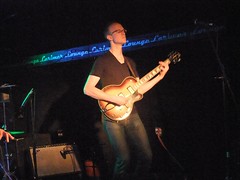
I've been excited to catch Callers since reviewing their latest album, Life of Love. I was curious to hear how they would translate their rich, yet subtle studio sound to the stage. Life of Love is dreamy and introspective, so the risk is that their stage presence might be too inwardly focused. They dispelled any fears of that with their first song, by showing that they could channel their internal, centered energy without slipping into a shoe gazer performance.

They led off with Fortune, the title cut off their 2008 debut album. The song starts with drums and a bass line that recall the tightly controlled tension of Talking Heads' Psycho Killer. But instead of David Byrne's overly tight, edgy vocals dialing things up, Sara Lucas' voice soothed and caressed.

Throughout their set, Callers exploited the contrasts in their music. Their subtle playing hinted at a deeper power under its surface. The loose flow of the music fell out of the tight coordination of their parts. Each musician brings a vital element.

Don Godwin's drum playing framed the space of the tunes. His tom and kick work were thoughtful and intuitive, keeping the beat without needing to play each one. This jazzy approach allowed every stroke to decorate the open feel of the songs.

Ryan Seaton provided both the bass lines and much of the guitar for the songs. Seaton's finger style technique was amazing: his left hand stretching to lay down arpeggios while keeping the bass line moving and his right hand flurrying across the strings to pick both. Despite the heavy technique, Seaton's nuanced playing seemed to reflect his internal grasp of the music's soul.

That soul took shape from Sara Lucas' singing. Sounding like a succession of strong women singers from the past, Lucas went from lazy Phoebe Snow to powerful Joan Armatrading moments to give the songs a special depth. She brought a well deserved confidence to her parts as she also added keys or guitar to some of the songs. Her guitar playing meshed well with Seaton, accenting and filling out the sound on songs like Glow.

Together, the three assembled an elaborate balance of pieces into an effortless whole. A world of sonic textures and a loose, natural rhythm were ever present.

Their live sound showcased an even richer sense of dynamic than their studio work. Their Wire cover, Heartbeat, had a strong foot tapping start and then set up a tremendous sweep from dreamy mantra to a swirling wall of beautiful dissonance and back.

I also had a chance to talk with the band before the show and find out how down to earth and interesting they were.

Wye Oak
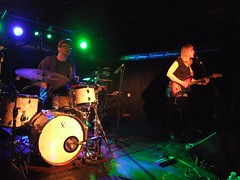
Wye Oak was a strong draw in Denver. The front row of the crowd were dedicated fans who sang along with every song. Like Callers, Wye Oak built a complex sound that seemed far larger expected from just a couple of musicians. Drummer Andy Stack usually reserved his left hand to play keyboard based bass lines and accents while he covered the rest of his rhythm parts. Guitarist/singer Jenn Wasner had a large dynamic range and dissonant approach that sometimes sounded like a couple of guitar parts at once. Wasner's singing style was different than Sara Lucas', but there was a similar expressiveness that fit well with the Callers' set.

Dissonance was a key element of Wye Oak's sound. While some of the songs began with an indie folk feel, by the second verse or so the distortion kicked up into a thick wall of sound. But this stayed in service to the music: the point was never to shock but rather express the inner turmoil or conflict of the song. Importantly, it wasn't over used. Wye Oak had a good sense of dynamic that allowed for raw, cathartic purging and earnest, confessional singing. The over all balance was more post punk than indie folk.

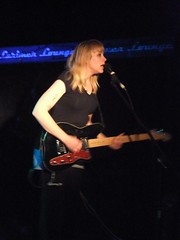
Jenn Wasner brought a brash energy to her playing and a deep honesty to her singing. She had a great stage presence: not chewing through the scenery but creating an electric spark as she bounced to her guitar slashes. Fully immersed in every song, Wasner was a master at using droning echo-laden guitar to set the mood. Her voice was strong and a little dark as she shifted from wistful to aching to assertive. She reminded me a bit of Chrissie Hynde from the Pretenders.

Andy Stack's versatility was astounding. With his left hand tied up playing keys, his other three limbs had to work extra hard on drums. His right foot worked the kick drum to cover some of the tom parts and his right hand covered cymbal and snare work. This wasn't quite the same as Rick Allen (the drummer from Def Leppard who lost his left arm) drumming approach, but it seemed similarly inspired by necessity. Stack was much more focused on playing rather than interacting with the crowd, but he and Wasner communicated well.

After Wye Oak's emotionally powerful show, I now plan to check out their studio work. They have a new album, Civilian, that came out last month.

It was a great couple of sets -- like a smoky scotch followed by brighter shot of rye whiskey.

More photos on my Flickr.

Monday, February 7, 2011

CD review - The Luyas, Too Beautiful To Work (2011)

The Luyas' Too Beautiful to Work (due out Feb 22), is a study in atmospheric textures. Jessie Stein's waifish vocals permeate the album with a dreamy vagueness, fitting in well with the quavery, quirky backing music. Flanged, rotating synth sounds meld with fluid, electronic washes, and echoed orchestral horns. With help from Arcade Fire's Sarah Neufeld, Owen Pallett (Final Fantasy), Colin Stetson, and others, the Luyas have created a moody exploration of experimental space.

On the upbeat, poppy side, Too Beautiful to Work, lays out an indie pop vibe, with an underlying dance aesthetic. The dreamy undercurrent is propagated by the off beat phrasing of Stein's sweet voice and the odd collection of supporting sounds. This yields to to the spacey psychedelic pop of Tiny Head. Here the sparse, echoed start works against a steady pop beat. The song fills up with busy percussion. Ultimately, it evokes a dream state where nothing quite fits together on a rational level but somehow it all makes sense at the time.

The tension of Canary, adds depth to the album. Here, the dreams shift to the uncontrolled edges of nightmare. The lyrics about sacrifice and the sonic mood are disquieting, contrasting with Stein's childlike voice to create a macabre feel. The threatening vibe is heightened by the single sustained chord in the background at the start. A bit like a missing tooth, I came back to this track again and again. The cotton swathed horns in the middle and the pulsating tones at the end further the sense of chaos for Canary. Too Beautiful to Work would have been a shallower experience without this darkness.

A smoky fire, a touch of brandy, and a room filled with candles provide the perfect listening room for the Luyas. Keep an eye out as they start their US tour in March.