(Artwork care of Karen Ramsay (www.karenramsay.com), profile photo care of brianlackeyphotography.com)
Showing posts with label avant-garde. Show all posts

Wednesday, May 20, 2015

Recording review - Chui Wan, Chui Wan (2015)

Fringe music from the Middle Kingdom

3.75/5.0

From skewed savants like Roky Erickson and Syd Barrett to modern mystics like Jim James and Wayne Coyne, psychedelic artists thrive out in the borderlands where the rules are flexibly vague and no one expects explanations. Beijing's Chui Wan has set up their own camp out in the fringes and, listening to their latest self-titled release, they've been raiding the ruins and scavenging from a host of influences to create their unique blend of experimental, new wave neo-psychedelia. Call it crypto-psych, where bits of avant garde Pere Ubu coexist with the Velvet Underground and Beatlesque musing drifts past Gothic new wave moodiness. Like steampunk fashion, it’s intriguing to encounter familiar things in unusual settings, but this album digs deeper than mere aesthetics. Psychedelic music is often invested in capturing a mood and Chui Wan’s music seems to reflect the uneasiness of change in their native country.

At its most positive, that nervous energy can be tied to opportunity and the most upbeat track, “Vision”, seems intent on grasping the chance even as it continually mutates and slips away. The tight rhythm and jungle beat drums are fixtures, along with the guitar pushing simple melodies to the forefront, but the song evolves in several directions. Initially, despite the guitar, it has an electronic feel that reminds me of the programmed rhythm on the.Clash’s "Overpowered By Funk". By the time the vocals come in, the tone has shifted into a Bauhaus cum Krautrock groove. Chameleon-like, the focal riffs come and go in waves, until the piece transcends the relentless reinvention to reveal that the true answer can be found in the hypnotically syncopated drum jam. It seems to say that, faced with constant change, the best thing to do is move with it. It would be easy to imagine a 20 minute extended version rattling the walls in a dark, trippy basement club, but the four minutes on Chui Wan is merely a tease.

After this restless drive of “Vision”, the band shifts gears for “On the Other Ocean”. If the former was strongly directed, the latter offers fun house reflections of a hallucinogenic expedition. The jangling new age start suggests a spacy milieu somewhere between Star Trek and music from the “Hearts of Space”. Once the vocals come in, the context becomes more overtly psychedelic but retains the unanchored feel. Chiming melodic harmonies suggest a more traditional Chinese influence, but the detuned and watery, off-kilter vibe adds a spacious decadence. If this is the start of a journey, it’s hard to tell what it might be in search of. Ultimately, the track slips into an even looser jazz interlude before faltering and melting into a puddle. That ending isn't a disappointment, though. Rather, it’s just a natural waking from the dream.

The rest of the tracks on Chui Wan find still stranger worlds to visit, from the off-balanced Pere Ubu carnival of “Seven Chances” to the nervous new wave tension of “Only” or the Velvet Underground folk-psych pop of “Silence” (think of Nico singing, “I’ll Be Your Mirror”). The weirdest is the hot mess that closes out the album, “Beijing is Sinking”. The metal flake guitar intro gives way to an odd poppish bounce. Imagine bits of Pink Floyd's "San Tropez", John Lennon's "Number 9 Dream ", and maybe a touch of OK Go coming together in a mulligatawny stew. Some three minutes in, there’s a solo section that develops a nice meandering riff. Enjoy it while it lasts, because, all too soon, it’s overwhelmed by chaotic guitar and transitions into an extended psychedelic outro that’s longer than the initial structured interval.

But the stylistic mashups and nomadic song development are hardly detrimental to Chui Wan’s mission. Out where they play, landmarks shift -- Beijing is still sinking, after all -- and the point is to step beyond the maps.

Here's a taste from the album:

Thursday, April 9, 2015

What's cool? Moodoïd, Heavy Metal Be Bop 2

And now for something completely different...

If Fark.com has taught us anything, it's that the Japanese are the masters of WTF video. Other countries may throw their hats in the ring, but they seldom offer any threat to the reigning kings. Now Parisian Pablo Padovani (AKA Moodoïd) has risen to the challenge with "Heavy Medal Be Bop 2". To be fair, his video lacks the innocent inscrutability that is the hallmark of Japanese TV, but it's such a hot mess that it overcomes that hurdle with ease. It's become a truism that things can be "so bad they're good," but there's never any doubt that the word "good" is always in air quotes. This video is a veritable double rainbow of campy perfection. I flip-flopped from bad to good so many times during this song, that my sense of irony got whiplash.


Imagine if Andy Warhol, Devo, Lady Gaga, and John Waters went off on a drug binge and had a contest to make the most absurd music video ever. Even if you have trouble with that, Padovani not only imagined it, but he took notes, threw their ideas into a blender, and then made the damn thing. Bizarre fashion, twisted sci-fi surrealism, '80s pop video deconstruction -- "Heavy Metal Be Bop 2" has it all and then some.

The tight, uptempo abstract jazz section at the start doesn't just reference his father, saxophonist Jean-Marc Padovani, but it even bolsters the younger Padovani's essential French credibility. That interlude doesn't last long, as he abruptly pulls an about-face to lay down a chill pop-funk groove. The jazz elements come back later to support a stylized sax solo later in the song. That, along with the muddle of the two genres, suggest why he named the piece in tribute to the Brecker Brothers' Heavy Metal Bebop, but despite the juxtaposition of outside jazz and pop, music is fairly tame compared to the imagery he's chosen. Truth be told, I enjoy his guitar work with Melody's Echo Chamber more than "Heavy Metal Be Bop 2", but the video is so entertaining that all is forgiven.

Tuesday, December 2, 2014

Recording review - Ought, More Than Any Other Day (2014)

Art punk intensity and choreographed primitivism

Ought was formed in the politically charged crucible of Montreal's "Maple Spring" with genetic material borrowed from David Byrne, David Thomas (Pere Ubu), and Gordon Gano (Violent Femmes). Exposed to the clashing drone of the Velvet Underground and new wave synthpop radiation, their sound solidified into a quirky, experimental space with a driving edge. More Than Any Other Day delivers their psychedelically intense art punk as a wake up call to the world.

They toss out a direct challenge with the jarring notes that open the first track, "Pleasant Heart". Those give way to clashing guitars that fill the bandwidth with contrasting splashes. Like  Byrne, Thomas, and Gano, Tim Beeler's voice defines his band's personality. Unpolished, utterly unguarded, and only loosely controlled, it quavers as he skirts the edge of melody. The initial tension remains constant as the piece evolves, and the uneasiness leaves the groove completely unsettled. The angular guitars and tripping rhythm get more involved, but the nervous vocals offer a new focal point. Eventually, the dense layering picks up enough complexity that there no hope of balance. Suddenly a chasm opens up, leaving a small void of breakdown before the linked loops are triggered all over again. It feels like a tribal rite crossed with some flavor of primal therapy as Beeler locks into repetition, "Say what and how we are." The song then staggers to a halt, leaving a reedy collection of droning keyboards, arrhythmic pings, and lazy bass tones that provide a chaotic interlude. This free jazz floating barely holds together as music and, glancing at the remaining time for the track, it's hard to guess where it might lead. Ought surprises us by bringing back the looping, rhythmic jumble from earlier, but now it's even more insistent. The chanting, "Say what and how we are," returns and is finally allowed to bring the song to a conclusion.

After that sprawling six minutes of overload, the hesitant beginning of "Today, More Than Any Other Day" feels like a respite, a gift from the band. This song is what first attracted me to this album, and it's even stronger in context. The random, detuned notes that melt and fall from the guitar provide an oasis of calm after the chaotic thrash of "Pleasant Heart". When the drag beat and diffident bass come in, they impose a loose and disjointed order that slowly coalesces into a moody, twanged groove, where the bass notes define the structure. The tempo slowly increases and Beeler dreamily repeats, "We're sinking deeper, we feel like..." The song begins to accelerate, though, and Beeler's repetition becomes unhinged as the guitar strum flails like Velvet Underground's "European Son". The song is halfway through, rest time is over, and the track finally finds its raison d'être as a manic affirmation. The flow from the initial amorphous noodling to the rapid-fire, slightly deranged title sloganeering is incredibly engaging. The track has the patience to grant ample time to the free form start, but then it carries out the culmination of its vision with a beautiful economy. Of course, the increasingly frantic pace can only lead to breakdown and the band eventually delivers on this as the song cartwheels to a stop.

The rest of the tracks on More Than Any Other Day go on to expand on these opening tunes, from the Television new wave chop of "The Weather Song" to the tamped down Talking Heads anxiety of "Around Again". The music always manages find the fulcrum point between stream of consciousness primitivism and neat choreography, while the lyrics often come from somewhere out in left field, whether it's the stark Zen koan anchoring  "Around Again" ("Why is it you can't stand in the sun, but you could stick your head into a bucket of water and breathe in deep?") or the frustrated confusion of "Gemini" ("I retain the right to have an end in sight/ I retain the right to be absolutely mystified"). The album holds together though, because they transcend their artful influences and find their own perspective. Plenty of other bands in their position fall prey to the temptations of distraction, nihilism, and stilted experimentalism, but Ought remains grounded and connected even as they deliver the unexpected.

Wednesday, November 27, 2013

Recording review - Yamantaka // Sonic Titan, UZU (2013)

Artsy zen perfection of fire and space

Songs or albums? For most people, it’s no contest. Picking and choosing single tracks lets them winnow the pearls from the crappy packing material that some bands use to pad out their albums. Through playlists or iTunes shuffle, juxtaposing bands and songs provides novelty and synchronicity, satisfying the need for variety. Then a band like Yamantaka // Sonic Titan (YT//ST) comes along and negates the whole question. On UZU, the Montreal art and music collective pitches the viability of the concept album, but they also deliver strong songs drawn from a multidimensional sonic palette. In classic concept album form, tunes smoothly meld into one another and many exhibit similar strains of melodic DNA. But while the pieces share a mood, they aren’t overburdened with a ham-fisted storyline. As a complete set, the songs offer a genre-jumping wild ride but each can also stand alone.

On paper, YT//ST embodies an artsy stereotype that could easily fall into parody. As much performance artists as musicians, they’ve mixed media from rock operas about rival drag queens (33) to video games (YOUR TASK//SHOOT THINGS) along with their album releases and they usually perform in stylized Kabuki-like makeup. Their self-proclaimed musical style is not merely descriptive, but asserts an artistic statement: “Asian diasporic psychedelic black stoner synth opera.” Since that’s a bit of a mouthful, they’ve coined the term “Noh-Wave” as a shorthand descriptor, crossing Japanese Noh Theater with a reference to the no-wave music scene of the late ‘70s. It’s all very precious, but in a refreshing surprise, their music successfully avoids the kind of pretentious self-indulgence that usually comes with this stereotype.

Noh-wave is a cute bit of wordplay, but the band isn't abrasive enough to sell the no-wave half of the term. Instead, their musical foundation is rooted in progressive rock, especially the stylized sound of bands like Renaissance. Ruby Kato Attwood’s singing never quite rivals Annie Haslam’s warm purity, but the strong femme vocals enrich the songs. Often draped with echo and chorus, they fit well with the orchestration that varies from simple piano to heavier rock guitar. While the band’s sweet spot is centered on prog rock, YT//ST takes small steps into art rock and larger leaps in symphonic metal, experimental music, psychedelia and electo-pop. Like the artistic stereotype, this mish-mash of styles shouldn't be a recipe for success either, but the band traverses the list with fluid grace, smoothly transforming from one to the next, even within a single song.

UZU opens with a Chopinesque piano on “Atalanta”. When the ethereal vocal joins in, the track slips into that progressive, theatrical Renaissance mode. The song itself stays stripped down; Attwood’s trained voice, backed by the simple piano, suggests prophecies delivered on open dream-plane. But it picks up power and momentum when the song transitions into the symphonic metal start of “Whalesong” with the addition of pounding drums and a driving bass line. Angular guitar riffs, crunching chords and keyboard backing contribute to the intensity, but the singing remains distinct and distant. It’s an eerie effect, pitting an ice princess inside a glass shell against the fiery music. Dynamic drops allow elements of the last song’s piano peek out from under the insistent power ballad. The sound builds into a thick, trippy swirl before letting the Sturm und Drang dissolve completely to take us back to the uncluttered soundscape of “Atalanta”, this time overlaid with the sound of a flowing river. The watery ripples melt into a chaotic sonic collage for the next track, “Lamia”. Here, the tension builds into a precise math-rock crunch. The drumbeat is insistent, with paradiddle riffs and cymbal washes beating against the methodically steady guitar and bass. If the ice princess was spooky in “Whalesong,” now she’s taken on the title’s demonic persona, shrouded in swirling echo. Simultaneously wicked and ethereal, her advice has a threatening subtext, “If you have a heart/ Keep it in your body.” Reverberations overlap and interfere and the repetitive cycle of distortion is hypnotic, pulling you under her spell. There’s a sense of continuity from the first tune, distant foreboding is finally realized.

Although UZU is full of strong tracks, YT//ST chose their first single well. “One” touches base with the band’s appreciation of cross-cultural exploration and starts with an Native American flavor. Chanting vocals and an infectious double-time tribal beat set the stage and then mutate into an acid-washed garage grind. Retro psychedelic guitar weaves it way into the groove and the message kicks in, “Ever wonder what it’s like to live in America?” The melting pot sound incorporates myriad essences of American music: Amerind tones, surrealistic San Francisco textures, rock intensity, an electro-beat breakdown and even a bit of free jazz chaos. This is exactly the America I want to inhabit and this is the tune I want to build a whole playlist around.

In keeping with the Asian themes that YT//ST incorporates, a yin-yang balance is at play. Songs of heady intensity are immersed together in the swift, twisting current of the playlist while a concept album bears its theme lightly. Stylized artistic gestures create powerfully concrete music. As a result, UZU sits like a perfect Zen koan: Is it the songs or the album that connects? Not songs, not album, the mind connects.

(This review first appeared on Spectrum Culture)

Friday, April 26, 2013

Concert review - That 1 Guy with Captain Ahab's Motorcycle Club

25 April 2013 (Hodi's Half Note, Ft. Collins CO)

It's a safe bet that Hodi's offered the most interesting bit of entertainment in the whole city Thursday night. Both acts offered distinctive performances far outside the normal fare, which is exactly what the crowd was looking for. The two have a history of collaboration dating back to a band, The Billy Nayer Show, led by Captain Ahab's Cory McAbee. Mike Silverman (AKA That 1 Guy) was in the band when they provided the soundtrack for McAbee's film, The American Astronaut (2001).


When Cory McAbee took the stage, it looked like Captain Ahab's Motorcycle Club was just a fancy name for a solo act, but he immediately clarified that the band is a musical collective and we had all been inducted. On its surface, it was a cheesy act: a guy who looked like an insurance salesman singing karaoke with pre-recorded backing tracks. But McAbee's stage persona -- a mix of P.T. Barnum, Andy Kaufman, and Anthony Hopkins -- transformed it into performance art.

As each song kicked off from the playlist on his phone, McAbee braced himself, then invested himself into the right character with rabid intensity. Whether channeling the sad love interest "Penny Jane", the braggart "20th Century Man", or the quirky "Man Who Swore at a Rainbow", he shifted his body language with an actor's zeal and dove into melodramatic interpretation. While there were moments of true madness or at least unaffectedly strange mannerisms, the overwhelming feel was campy fun. The biggest crowd-pleaser was his cover of A Flock of Seagulls' "I Ran (So Far Away)", which he pitched as the world's oldest "space-cowboy" song.

While the musical collective idea seemed like a fine conceit, McAbee was serious. The project's website includes downloads of all of his tracks and pieces and requests remixes and other contributions. During his set, he even identified whose remixes he was using when it was relevant.


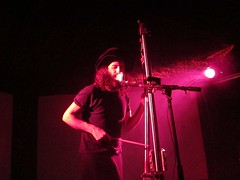
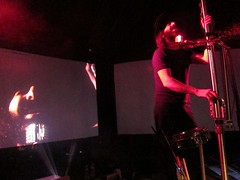
Honestly, if you don't already know who That 1 Guy is or haven't seen his custom instrument, the Magic Pipe, take a moment to research his solo work and Frankenstein Brothers, his project with guitarist Buckethead. Last night's performance demonstrated that his showmanship continues to be top notch as he transformed his strange collection of hardware and computer tech into a musical extravaganza. Sleight of hand flourishes, pantomimed sound effects, and butt shaking grooves continue to be the mainstay of his act, but he must not believe that he's blown his audience's minds enough.

For this tour, he's expanded into multimedia, adding two screens to his stage setup. In keeping with the playful nature of his music, he didn't settle for passive video accompaniment. Instead, he integrated the animations with his playing. Early in the set, the screens just presented music visualizations. Then, he upped the ante by letting the music distort a web-cam video feed of himself. Soon enough, he showed off the full interactive behavior, using trigger buttons on the Magic Pipe to control the animations. This let him play peek-a-boo with cartoon characters in one song and make his puppet image dance in another.

That 1 Guy hit many of his classic tracks, from the silly trippiness of "The Moon Is Disgusting" to the wicked, greasy funk of "Buttmachine". Throughout the set, it was a participatory rite as we all joined in to sing, dance, and echo his rising wolf howl punctuations. The flow of his setlist showed off the range of his material, where the electro-groove of "Mustaches" flowed smoothly int the acid-bluegrass sound of "Step Into Striped Light". His encores continued the mutating drift, from Tuvan throat-singing "acapella dubstep" to a stunning cover of Cameo's "Word Up".


It was also nice to see how well he connected with his audience outside the main show. At the end of the night, he warmly greeted the long line of people at his merch table, dispensing almost as many free hugs as CDs. This tour also offered another new feature, a pre-show for "Magic Mustache Club" VIPs.  The package included a private close-up magic show, a tour tee shirt, and download of his full discography as well as time to hang out with That 1 Guy. I ran into a couple of people who bought the package that really appreciated the time and effort that he took with them.

More photos on my Flickr.