(Artwork care of Karen Ramsay (www.karenramsay.com), profile photo care of brianlackeyphotography.com)

Wednesday, November 27, 2013

Recording review - Yamantaka // Sonic Titan, UZU (2013)

Artsy zen perfection of fire and space

Songs or albums? For most people, it’s no contest. Picking and choosing single tracks lets them winnow the pearls from the crappy packing material that some bands use to pad out their albums. Through playlists or iTunes shuffle, juxtaposing bands and songs provides novelty and synchronicity, satisfying the need for variety. Then a band like Yamantaka // Sonic Titan (YT//ST) comes along and negates the whole question. On UZU, the Montreal art and music collective pitches the viability of the concept album, but they also deliver strong songs drawn from a multidimensional sonic palette. In classic concept album form, tunes smoothly meld into one another and many exhibit similar strains of melodic DNA. But while the pieces share a mood, they aren’t overburdened with a ham-fisted storyline. As a complete set, the songs offer a genre-jumping wild ride but each can also stand alone.

On paper, YT//ST embodies an artsy stereotype that could easily fall into parody. As much performance artists as musicians, they’ve mixed media from rock operas about rival drag queens (33) to video games (YOUR TASK//SHOOT THINGS) along with their album releases and they usually perform in stylized Kabuki-like makeup. Their self-proclaimed musical style is not merely descriptive, but asserts an artistic statement: “Asian diasporic psychedelic black stoner synth opera.” Since that’s a bit of a mouthful, they’ve coined the term “Noh-Wave” as a shorthand descriptor, crossing Japanese Noh Theater with a reference to the no-wave music scene of the late ‘70s. It’s all very precious, but in a refreshing surprise, their music successfully avoids the kind of pretentious self-indulgence that usually comes with this stereotype.

Noh-wave is a cute bit of wordplay, but the band isn't abrasive enough to sell the no-wave half of the term. Instead, their musical foundation is rooted in progressive rock, especially the stylized sound of bands like Renaissance. Ruby Kato Attwood’s singing never quite rivals Annie Haslam’s warm purity, but the strong femme vocals enrich the songs. Often draped with echo and chorus, they fit well with the orchestration that varies from simple piano to heavier rock guitar. While the band’s sweet spot is centered on prog rock, YT//ST takes small steps into art rock and larger leaps in symphonic metal, experimental music, psychedelia and electo-pop. Like the artistic stereotype, this mish-mash of styles shouldn't be a recipe for success either, but the band traverses the list with fluid grace, smoothly transforming from one to the next, even within a single song.

UZU opens with a Chopinesque piano on “Atalanta”. When the ethereal vocal joins in, the track slips into that progressive, theatrical Renaissance mode. The song itself stays stripped down; Attwood’s trained voice, backed by the simple piano, suggests prophecies delivered on open dream-plane. But it picks up power and momentum when the song transitions into the symphonic metal start of “Whalesong” with the addition of pounding drums and a driving bass line. Angular guitar riffs, crunching chords and keyboard backing contribute to the intensity, but the singing remains distinct and distant. It’s an eerie effect, pitting an ice princess inside a glass shell against the fiery music. Dynamic drops allow elements of the last song’s piano peek out from under the insistent power ballad. The sound builds into a thick, trippy swirl before letting the Sturm und Drang dissolve completely to take us back to the uncluttered soundscape of “Atalanta”, this time overlaid with the sound of a flowing river. The watery ripples melt into a chaotic sonic collage for the next track, “Lamia”. Here, the tension builds into a precise math-rock crunch. The drumbeat is insistent, with paradiddle riffs and cymbal washes beating against the methodically steady guitar and bass. If the ice princess was spooky in “Whalesong,” now she’s taken on the title’s demonic persona, shrouded in swirling echo. Simultaneously wicked and ethereal, her advice has a threatening subtext, “If you have a heart/ Keep it in your body.” Reverberations overlap and interfere and the repetitive cycle of distortion is hypnotic, pulling you under her spell. There’s a sense of continuity from the first tune, distant foreboding is finally realized.

Although UZU is full of strong tracks, YT//ST chose their first single well. “One” touches base with the band’s appreciation of cross-cultural exploration and starts with an Native American flavor. Chanting vocals and an infectious double-time tribal beat set the stage and then mutate into an acid-washed garage grind. Retro psychedelic guitar weaves it way into the groove and the message kicks in, “Ever wonder what it’s like to live in America?” The melting pot sound incorporates myriad essences of American music: Amerind tones, surrealistic San Francisco textures, rock intensity, an electro-beat breakdown and even a bit of free jazz chaos. This is exactly the America I want to inhabit and this is the tune I want to build a whole playlist around.

In keeping with the Asian themes that YT//ST incorporates, a yin-yang balance is at play. Songs of heady intensity are immersed together in the swift, twisting current of the playlist while a concept album bears its theme lightly. Stylized artistic gestures create powerfully concrete music. As a result, UZU sits like a perfect Zen koan: Is it the songs or the album that connects? Not songs, not album, the mind connects.

(This review first appeared on Spectrum Culture)

Sunday, November 24, 2013

Front Range recommended shows, 11/25

Thanksgivikah is coming, but there's still music!

Tuesday, 26 November (Fox Theatre, Boulder CO)
Black Uhuru

Back when I played in Colorado Springs' most fun reggae band, Cool Runnings, my favorite covers were the Black Uhuru tunes. "Spongi Reggae", "Guess Who's Coming To Dinner"... these were great songs to jam to and they just begged for heavy dub treatment. Colorado is quite supportive of reggae, which must be why Black Uhuru makes it through here on a fairly regular basis. "Bounce over here/ Then you bounce over there" Bounce over to the Fox and get warmed up.

Wednesday, 27 November (Marquis Theater, Denver CO)
Discount Cinema

Hard-rocking drive with metal-tinged edges, this local Denver band throws themselves headlong into their music. They've got a solid sound and, by all accounts, their stage show is equally impressive. I'm looking forward to seeing them open for Skyfox this week at the Marquis. Come out and support a strong up and coming group.

Friday, 29 November (Boulder Theater, Boulder CO)
Saturday, 30 November (Boulder Theater, Boulder CO)
Leftover Salmon

It's hard to say who invented jam-grass, but Leftover Salmon has been stalwart on the scene since 1989. Their genre-hopping improvisations made them one of the most loved regional bands here in Colorado. Last year's new release, Aquatic Hitchhiker, showed that the band can overcome losing members, dropping in and out of hiatus, and hitting the road yet again. Work off all that pie you eat at Thanksgiving by dancing to Leftover Salmon for a homecoming couple of nights.

Concert review - Sleepy Sun, with Glowing House and déCollage

22 November (Moe's Original Bar B Que, Englewood CO)

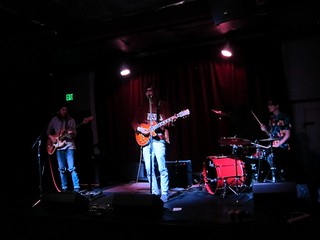
I will never understand how a venue selects their lineups for a given night. They have a particular national act coming in, maybe with a fellow touring band, and they need to pick the local opening band(s) to fill out the bill. Looking at the list for last night, the best thing I can say is that the band's were in alphabetical order. The first local band, déCollage, fit reasonably well with the headliner, but the middle act, Glowing House, didn't deserve their awkward juxtaposition. Their new folk earnestness was a weird side trip for the evening's entertainment. Partnered with the right set of acts, their set would have been perfect...


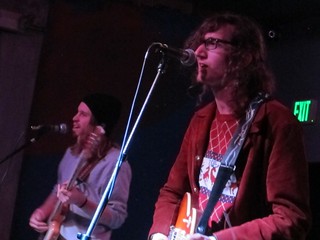
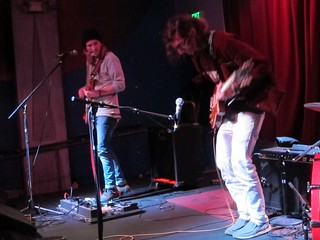
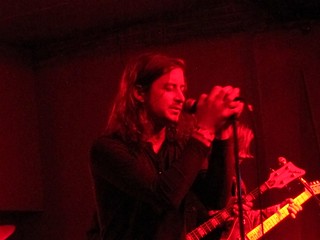
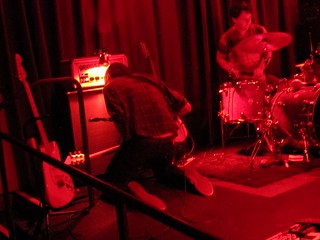
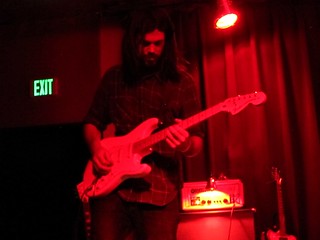
003 déCollageOpening act déCollage took the power trio into realms of artsy, modern psychedelia. The sound was thick with reverb and somewhat muddled for the room, but it was a harbinger for Sleepy Sun's upcoming noise ritual. The vocals were quirky enough on their own, but frontman Reed Fuchs strained them through a hall of echoes.

008 déCollage
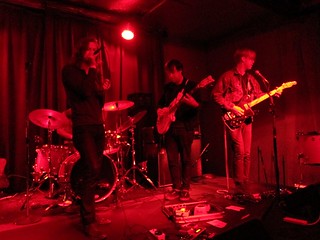
The sounds wound their way along a surrealistic path, wandering from deconstructed acid blues to experiments in bizarre, looking-glass pop. Despite the loose flow of the set, the arrangements were remarkably well-planned and executed. Like most power trio's, the bass had the added responsibility to cover the ground between bass and rhythm guitar. Melodically busy, the bass stayed anchored in the groove,  tied directly to the drums. If the bass , provided the sonic glue, the other two carried their weight just as well. The drums supported the sharp time signature shifts and punches while the guitar walked a thin line between chaos and order.

021 déCollage
The next to last piece was the most interesting as it delivered the set's wild climax. Starting with a strange loop of baby's laughter, the heavily syncopated tribal beat held down the song while the synth-sounding guitar screeched for freedom. Earlier, the audience had swayed along in lazy surrender to déCollage siren song; now, they writhed along with the insistent drive of the music. déCollage left the stage in perfect form: with a happy crowd wanting more.

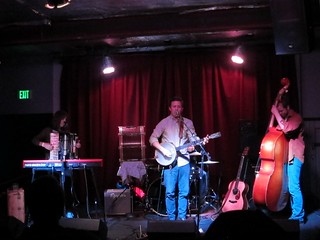
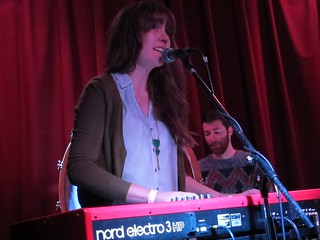
055 Glowing HouseI'd love to catch Denver's Glowing House in their natural habitat. Their dark, moody folk sound belonged in a warmer, more intimate venue. Steve Varney acted as the focal point, switching between guitar and banjo. He clearly invested himself in the songs, often delivering them in more of a singer/songwriter style. His wife, Jess Parsons provided strong support on keys and accordion. The band's real strength were the vocal arrangements. Varney took many of the leads with earnest power, but Parsons' bruised vulnerability gave many of the pieces their emotional center. That male-female mix is a staple in folk music, but their harmonies and personalities really made it click.

038 Glowing House
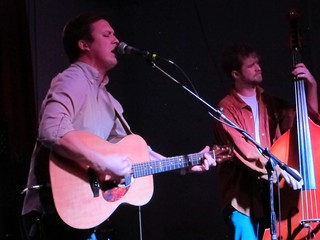
The set rolled along from rootsy country through bluegrassy twang to proclamatory folk. The songs in this last category evoked a bit of Mumford & Sons, with drummer pounding a second bass drum while the stand up bass player dead-panned his way through the changes with a theatrical flair. It was a polished performance that showed a lot of planning and practice.

044 Glowing House
Since the crowd was packed with their loyal fans, Glowing House basked in the respectful attention, but it was clear that this wasn't their venue. They lacked the fire or charisma to work the audience like the other two bands. Their band persona was more geared towards a more subtle emotional depth than flash, making them the odd group out.

078 Sleepy SunI missed Sleepy Sun when they passed through Denver last month supporting City and Colour for two nights at the Ogden, but I was happy that they made a final loop back through town to close out their current tour. It has clearly been a long slog; leader Bret Constantino seemed a bit weary when he told us that this was their next to last show for this run.

068 Sleepy Sun
All the touring has paid off with polished arrangements that flow into perfect alignment while still retaining the cathartic chaos that defines their sound. The solos all feel expressively spontaneous as Matt Holliman wrenched the howling notes from his guitar, but the set list as a whole seemed to run like dominoes, with each song transition clicking into place effortlessly.

087 Sleepy Sun
The band has undergone quite a few changes in recent years. Two albums ago on Fever (review), the group was centered on the yin-yang dynamic of Constantino and singer Rachel Fannen. Last year, touring behind Spine Hits (review), Sleepy Sun shifted more towards alt-psychedelic intensity after Fannen left. Now, on the eve of a new album due early next year, the band has taken back full ownership of the Fever songs and started looking forward. This show split its attention between material from Fever, their first album Embrace, and a couple of new tunes. Oddly enough, only one track from Spine Hits, "Martyr's Mantra", made the list this time.

067 Sleepy Sun
Regardless, all of the songs tapped into a similar heavy sound: Led Zeppelin haze, poetic intensity like the Doors, and raw Velvet Underground madness, tempered by a hedonistic Jane's Addiction thrash. Sleepy Sun launched their sonic assault and the audience soaked up every swirling, feedback-infused decibel. It was a beautiful orgy of noisy intensity. Throbbing grinds of doom kicked out broken-mirror reflections. Whale songs turned into ghostly moans. Ringmaster Constantino presided over the whole circus of acid-washed echoes like a reincarnated Lizard King.  In short, the structured cacophony erased a week of work and daily concerns like a hurricane cleansing the coast.

More photos on my Flickr.

Thursday, November 21, 2013

Interview - Mashup Artist Summit

This is a mashup interview. I conducted separate interviews with five of my favorite mashup artists, some by phone and others by email. Afterwards, mirroring their creative approach, I created this collage interview as a Mashup Artist Summit. None of these artists were aware of how their interviews would be combined, but rather than warp their words for surprise or humorous effect, I've attempted to keep their ideas intact while recognizing their related perspectives on mashups.

For those interested in getting all the context behind these quotes and learning more about these five artists, please browse the source interviews.
Tom Compagnoni (Wax Audio) – interview
Bob Cronin (dj BC) – interview
Eric Kleptone (The Kleptones) – interview
Max Tannoneinterview
Mark Vidler (Go Home Productions) – interview

Jester Jay: Thanks for virtually joining me. How did you all get started?

Eric Kleptone: I've always made music. I played in bands when I was in school. I kind of fell into doing sound engineering and lighting and I got the bug and learned how to DJ.

Max Tannone: I deejayed for a while growing up in middle school and high school.

EK: I wanted to do live shows, so I taught myself how to DJ.

Bob Cronin: I made mix tapes in high school. In college, I made sort of pre-DJ music. I would play a tape and flip the tape over after 45 minutes. Doing those gigs made me always want to have something that was new, that somebody hadn't heard before.

Tom Compagnoni: I created my first digital “Cut & Paste” project in 2004, a 5 track EP called WMD …and Other Distractions. I cut up speeches from politicians of the time and mixed them with various beats and multi-track components.

Mark Vidler: I had been doing similar experiments on a Tascam Porta One 4-track recorder back in the mid-‘80s by overdubbing a cappella tracks from 12″ vinyl with instrumental sections from songs.

When I first started, I played in a band called Chicane between 1987 and 1995. I left the band in 1995, but by 2002, I was missing the action. The whole bootleg scene suddenly rose up overnight, and really pulled me back in. We called them bootlegs in the UK back then, “mashups” as a description came a couple of years later. I was convinced that I could use bootlegs or mashups as a vehicle to getting back into the music business. I set about doing my own bootlegs and knocked up Eminem’s “Without Me” vs. Wings’ “Silly Love Songs” (called "Slim McShady").

TC: It wasn't until about 2007 that I did my first mashup, Black Sabbath’s “War Pigs” and Led Zeppelin’s “Whole Lotta Love”, called “Whole Lotta Sabbath”.

BC: I started making my own music and doing hip hop and electronic music in the studio with a four track. I went online and I found this website called GYBO – Get Your Bootleg On. At that time, it was mashup oriented. I was a lurker there for a long time before I posted anything. I needed to start doing it. It was like I had come home. It was a totally natural medium for me. I made some tracks and people seemed to like them and it was really hip hop based.

EK: The mashup thing… I've always been totally into samples. I used to make pause button edit tapes, just trying to get things to juxtapose, to make really good mix tapes. If somebody asked me for a mix tape, they didn't just get a bunch of tunes thrown on a tape; they got little interludes, little bits and pieces. The whole mashup thing, when it exploded, which was like 2001/2002, immediately I knew, “That’s exactly the sort of thing that I've been waiting for.” The first tune I did, the mashup happened in my head, which rarely happens. It was a mashup of “Ray of Light” by Madonna and “Cannonball” by the Breeders.

MT: I knew what a mashup was. I was familiar with The Grey Album, but I never tried it.

EK: Dangermouse’s Grey Album is okay, but it was very hip hop. It’s very American.

MT: One night, I don’t even know why, I just looped the Radiohead song, “I Might Be Wrong” from Amnesiac. A few years later I was listening to Jay Z’s American Gangster album and those a cappellas had come out. They were easy to find on the internet. So I just grabbed the a cappella to his song, “Pray”, and put them together because they had the same vibe going. It was just called “Wrong Prayer Remix”. A few weeks later, I did another Jaydiohead track, what became Jaydiohead, called “Ignorant Swan”. I chopped [Thom Yorke’s] “Black Swan” up and looped some pieces from that and put on another Jay Z vocal.

BC: There have been so many Jay-Z mashup albums, with lots of Jay-Z a capellas available.

MT: There’s a lot of rap a cappellas, so there’s a lot of source material to work with.

BC: I did a record with Phillip Glass and different hip hop artists and I was like, “All right, I want to do a mashup album.” A friend of mine posted a YouTube clip of the song, “Another Day on Earth” by Brian Eno and I had never heard that specific record. I really liked the progressions and the sound quality and the rhythmic sense of it. And I thought I could use this.

So that’s how you came up with Another Jay on Earth?

BC: It was so natural and fit so well and so easily. The cool thing about Another Jay on Earth is that Jay-Z’s vocals sound almost plaintive. The bluster sounds a little bit thinner. The music might have sort of a melancholy or sad vibe to it and it makes it sound like Jay-Z’s being introspective about his situation, about what it’s like to be a black male in America and getting mistreated and those sorts of concepts. Or when he’s doing the bragging thing, you’re kind of like, “Well I can see that this is a device he’s using to protect himself.”

MV: The best tracks are the ones that the choice of tracks is so disparate that you are not expecting them to work. I’m not a fan of ‘rap’ vocals being placed over a hip-hop track because you’d expect them to work without little or no additional creativity being needed by the remixer in question. The best mashups are the ones that contain a big surprise element in the choice of tracks used and the way in which they are put together.

EK: I like the big ideas. That’s the thing that inspires me. It takes quite a lot of effort to make a mashup that can grab people’s attention because people like novelty. There was a band about 20 years ago or so, Dread Zeppelin. I saw them. We were like, “Can they actually do this live?” “Heartbreaker Hotel” — there’s a mashup — a bit of “Heartbreaker” and a bit of “Heartbreak Hotel”. They were fucking unreal.

MT: I was super into an album of Bob Marley and Mobb Deep mashups that was hosted by Swindle [note: it was Jon Moskowitz and DJ Swindle]. There’s a lot of extra stuff happening and I really like that project. Anything that makes you thing “Wow, I never heard this song in this context.”

BC: “Call Me A Hole” is a perfect example of that.

TC: By Pom Deter. I thought it was a brilliant mash.

BC: You can say he’s making fun of Carly Rae Jepsen by playing Trent Reznor’s vocal over it, but it’s so much more than that. It sounds like its own song. It makes you say, “Maybe I was wrong about Carly Rae Jepsen.”

TC: A former member of Nine Inch Nails called “Call Me A Hole” an insult.

MT: Everyone likes what they like. It’s cool if some people don’t like it

TC: I've not had any negative feedback from any of the artists I've mashed so far.

MV: I tackle the mixes with a healthy dose of respect for the artists. On several occasions, my unsanctioned mashups led to the artists getting in contact with me to set about having them officially released.

EK: I put out A Night At The Hip-Hopera. I found a double Japanese CD of Queen karaoke. It took on a life of its own — all this stuff about copyright, it was self referential to the whole mashup thing. Brian May, from Queen, notoriously hated it, because he didn't get any money for it.

I think he’d argue that you and other mashup artists are taking advantage of his art instead of making something new.

EK: It’s based on other people’s music, so you’re never going to get away from people saying that. It’s just collage and appropriation and a means of expression, as much as picking up a guitar and playing the same three chords that 80% of guitarists play when they pick up a guitar.

BC: Fine, it may be a lesser, derivative art. You know what? That’s been said about so many forms of art over the years that it’s not even worth worrying about those folks.

MT: I see the argument, but sampling can be really interesting and inspiring.

TC: Most people are dismissive of lots of styles of music and art; it doesn't bother me at all.

MT: To invalidate it just because it goes against your viewpoint, that’s like saying anyone who plays guitar isn't a real musician. It’s the same argument in a new era.

MV: I used to staunchly defend mashups and what they represented in interviews 10 years ago. Saying it was the new punk in terms of attitude. It felt like mashup culture or attitude was at the forefront of something new.

BC: You can say that punk rock was the same way. It was primitive and used basic structures and therefore it was a lesser form of music. People said that about the blues and African music.

MV: All music or art borrows from the past, whether it be using a few blues licks or Beatles chords to create a new song. Hip-hop was the first to physically borrow little bits of other people’s works.

MT: I think that if John Lennon or Jimi Hendrix were alive today, they would be super into sampling and remix culture.

MV: There was a period of years when artists and labels were more than happy to have mashup remixers plunder their material; the mixes were free viral promos for their back catalog!

EK: I've got to remind myself that Brian May is plenty rich. You can see the different ways that artists handle their legacy. For example, the way that the Beastie Boys just put their a cappellas on their website: “Here they are, have some fun with them. You can’t possibly duplicate what we did. But you might come up something really cool.” Queen would only do that if there was a financial gain involved.

BC: It’s not like anybody can get rich off it.

That’s a good point. So, maybe you have to focus more on artistic success. Each of you has created some distinctive work. Can you give us an inside look at your creative process?

EK: I’m really proud of 24 Hours. I can’t remember exactly where the sort of eureka, moment hit, but I kind of sketched out the day, the 24 hours. Put it on a massive piece of paper, a flip chart on the wall: so this is the wakeup bit, this is the going-to-work bit. I’m going to come home from work, go to the pub, go to the club. I had a folder with 50 tunes in and I’d work a little bit on each tune. I think it took me about six months, but it nearly sent me insane doing it. I got so locked into the idea that I thought that, even if nobody else likes this, I've created something I’m proud of.

TC: I decide in advance what the grand vision is, usually a concept for a complete work like an album. The piece that I’m proudest of is 9 Countries. It’s an album I produced by taking the skills I developed as a mashup artist and applying them to a huge archive of sounds I recorded whilst traveling across Asia. A single looped beat would comprise sounds from a procession in Indonesia, temple drumming in India, the bell hanging around a goat’s neck in Tibet, monks chanting in a monastery in Laos, street hawkers in Myanmar, etc. The whole project took me about 4 years to produce. It’s probably the least heard work that I've created, but the few people who have taken the time to listen have told me how much they like it

BC: It’s much more than sticking A over B. There’s a lot of thought that goes into it, tweaking, and additional elements brought in and fragmenting the sound source. I did one that used a lot of new avant-garde electronic, early electronic performers and composers. That was kind of like using something more abstract and being able to use them as samples, with a beat, to create something really groovy out of something a little more far out.

EK: The challenge now is to come up with something that I think is artistically viable, that’s a good idea. But a good idea now, as opposed to what would have been a good idea ten years ago. Ideas are now the most valuable currency. It makes artistic judgment more important.

MT: I start the projects from an idea coming from sounds. So, I want to do a project with… then insert some kind of music: “punk”. That [note: Mic Check 1234!] was definitely the most challenging of any of the mixes that I've done. The main issue is that you have all these songs that are 120 or 130 beats per minute. Obviously, you have to worry about tempo.

TC: The vast majority of mashups posted on YouTube and elsewhere are poorly produced and amateurish. If rhythm and pitch are not perfectly synched, it makes the result sound painful to listen to.

MT: Yeah, I had to find fast rap songs to use or a slower punk song. That really narrows your scope of a cappellas that you can use.

TC: The only clash I want to hear is a clash of genres.

MV: Splice Captain Beefheart with Abba and I’d definitely give it a listen!

BC: The humor makes it healing to people and makes them smile or pay attention for a second. But in the end, the track has to be good.

EK: I find it really hard to listen to other people’s mashups because I can’t help but pick them apart technically. Particularly if you've got two whole songs and one goes up into a chorus and the other one doesn't change. To me, that’s a killer. I want the changes to kind of work perfectly.

BC: I like stuff that’s really structurally coherent: verse-chorus-verse-chorus-bridge-verse-chorus or intro-verse-chorus. It sounds right to me to attend that sort of a structure.

EK: I like that structure. If you have two tunes and they both go into the chorus at the same time and the change in key and the change in pitch is perfect, you just sit there and listen to it and go, “That doesn't need anything done to it, does it?”

MV: I like to think that I've always delivered mashups with a healthy dose of humor. A big smile-factor…

EK: I’d like to see Mark do an album. I know he’s got a real love of psychedelia and I’d love to see him really cut loose and make something really quite extreme with his style. I would love that.

MV: I have a fairly wide-ranging taste to be honest, but my main focus & love has to be psychedelia. I just loved the extreme experimentation at the time from these bands who were obviously dropping acid or pretending to drop acid!

Thank you all for your time and for being good sports about letting me mix you.

(This mashup first appeared on Spectrum Culture)