(Artwork care of Karen Ramsay (www.karenramsay.com), profile photo care of brianlackeyphotography.com)

Monday, October 31, 2011

CD review - MUTEMATH, Odd Soul (2011)

Diverse sounds and stark contrasts, but rooted in soulful, old school rock
MUTEMATH may have some roots in Christian rock, but the band has made efforts to distance themselves from the segregated market niche that implies. On Odd Soul, the occasional lyric may reference spiritual matters, but the message is more about the music than the Good Word.

That musical message on Odd Soul is rooted in a contemporary interpretation of bluesy soul. While MUTEMATH hasn't abandoned all electronic elements here, the bulk of the album has a retro vibe and saturated, lo-fi vocals that beg for comparison to the Black Keys. But they're not so much derivative as mining some of the same influences.

What makes the album click is the diversity of sounds, even within a single song. Stark contrasts, like the grinding beat and updated Bad Company vibe of Odd Soul against the electro pop, artificial sound of All or Nothing, can be jarring. But the tracks generally feature enough sonic shift to provide a larger context.

The arrangements are well crafted to setting a solid mood while showing off the band's technical strengths. A short interlude like Sun Ray conveys a reflective, jazzy vibe, but attentive ears will appreciate Darren King's impressive drum work and how it balances against the slinky guitar line. Similarly, the warbling organ on Cavalries sets up a psychedelic soul groove. The opening bounces before sliding into a breakneck drive that suggests Edgar Winter's Frankenstein. Once again, the drums are phenomenal.

Blood Pressure, a great choice as one of Odd Soul's singles, features a stripped down start. Tightly wound, the verses sound a bit like Depeche Mode's Personal Jesus, but the chorus splits the song wide open. The dynamics create a delicious tension. This is begging for the drawn out jam of a live version.

The last three tracks orchestrate a perfect flow. Equals balances retro funk rock with a floating chorus before melting into the sprawling jam of Quarentine. Here, the funk riffs veer into prog rock territory and back before wrapping up with an electro-mechanical sound. This nerve rattling finish drags out before finally dropping into the reprieve of In No Time. It's gently comforting, but subtly builds into an hopeful anthem:
Where's your heart gone and where's your soul?
When did all of your faith go?
And where's that old spark, a failure stole?
Well, I'll bet we'll find it in no time at all
Spiritual, but not particularly preachy. MUTEMATH alludes to their origins and keeps moving forward.

Friday, October 28, 2011

October singles

It's time again to collect some music that caught my ear this month. Check out some funk, a couple of very different lo-fi retro songs, and some synth pop flavored rock. Pick your poison.

Greedy Cherry - No Excuse (from EP)


Bass player Michael Conrad recorded his EP under the band name Greedy Cherry. After graduating from the Berklee College of Music, he assembled a talented crew of musicians matched to each track of the project. Conrad took an experimental approach on the EP, jumping from style to style. The flow, especially on the first three tracks, is surprisingly coherent.

Lead off track No excuse was my favorite song from EP. The solid funk groove opens with a Temptations style bass line, but once it gets underway, it incorporates tasty guitar work and beautiful organ lines.

Funk often plays with a tight rhythm by slipping a little behind the beat, then catching up to create a kind of hang moment. Greedy Cherry extends this into a suspended hold. Check out the dub drop at 0:19. Everybody drops out except the keys for a full measure. As the organ holds a chord, the next 4 seconds float long enough to sound like a track glitch before slipping back in. It's all in the timing.


Bare Wires - Back on the Road (from Cheap Perfume)


I can't click through my inbox without tripping over yet another band strutting out their lo-fi, garage tone trying capture some retro cred. All too often, the band is just a muddy mess or, worse, they're somehow pretentiously sloppy. Yes, garage rock is lo-fi, reverbed, and twangy, but the real thing bottles lightning and can raise the hair on the back of your neck.

Oakland's Bare Wires understand this in their DNA. Not only do they hit that sweet fuzzy sonic spot, they get that live, all-at-once energy. Where their competition can sound right if the playback volume is high enough, Bare Wires sounds righteous at any volume.

Back on the Road starts out like the Animals with a dash of Who. The high tension beat and formal rhythm guitar evoke Roky Erickson - not when he's battling his demons, but when he's exultant. The hardest thing about listening is not picking up my guitar to play along.

Bare Wires just dropped their latest album, Cheap Perfume, on October 18 (Southpaw Records).

Mark Sultan - In Future Worlds (from the double release, Whatever/Whenever I Want)


Before you even watch the video, you owe it to yourself to read Mark Sultan's rant declaring war on rock 'n' roll. It's as heartfelt as any classic SubGenius rant, begging us to kill rock'n'roll to save it. This is how Sultan pulled me into his sphere. Reading about him, I figure he's some kind of snake-oil selling genius, but he's wormed his way into my brain.

In Future Worlds bridges garage psychedelia and doo-wop. Unlike Bare Wires, Sultan's version of the garage is anything but effortless. But the quirkiness is still compelling. The lyrics play with abstract imagery, and Sultan's voice shifts between intoned verses and the Del Shannon style chorus. Like the song itself, the video romps in joyful excess.

Continuing the complexity, Sultan has released two vinyl albums, What ever I Want and Whenever I Want, along with a compilation CD, Whatever/Whenever that pulls 7 tracks from each album.

The Gift - RGB (from Explode)


The Gift is a four piece band out of Portugal. They've made their mark back home, but now they're ready to grab some attention here in the States. Their latest album, Explode, released here last month and they had a quick cross country tour before heading down to Brazil.

RGB shows off their lush synth pop infused sound. The synthesizer riff and washes set the hook, but a solid rock beat kicks in to shift the feel from electronica to pop. The interlocking guitar lines and heavy drum work mesh smoothly with the synth underpinnings. Sónia Tavares' voice is strong, deep, and fluid.

Grab the free download and enjoy the Gift's polished sound.

Wednesday, October 26, 2011

Concert review - Anvil, with several openers

25 October 2011 (Casselman's Bar, Denver CO)

Most of the hard hitting shows I've seen have been in dives. The Anvil concert at Casselman's Bar proved that an upmarket ambiance doesn't stifle a gritty rock experience. The venue had a comfortable front bar and a concert hall in back. Sure, the candlelit tables at the back of the hall were out of place for a metal show, but the roomy stage, high ceilings, and clean sound were a treat.

Between the incoming snow forecast and a slow Tuesday night, the turnout didn't begin to fill the big open hall. Opeth playing at the Ogden probably didn't help, either. Still, the smaller crowd was enthusiastic for the packed line up. A total of four bands warmed up the crowd for Anvil. The variety among the acts meant that fans could enjoy several flavors of metal in short 25 minute sets.

Side Effect
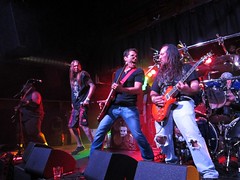
Side Effect kicked off the show a little before 8pm. It's all a matter of taste, but they were my favorite of the four opening acts. Their sound meshed best with Anvil's, with a good mix of grinding rhythm and throbbing bass. Their stage energy fit well, too, with a mix of fun and metal pose.
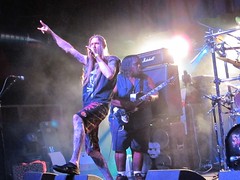
The lanky lead singer draped himself around the stage: perching a leg on a monitor to lean into the crowd or stalking back and forth. He worked the crowd, egging us on and sharing his enthusiasm for the music. The bass player tried to grab his share of the spotlight, goofing around and flashing his Gene Simmons-like tongue. That didn't stop him from keeping a constant drive going.
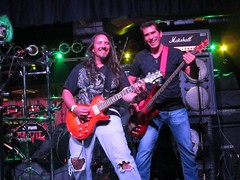
The two guitarists had the standard split of rhythm and lead duties, but they were well coordinated. They covered some good twinned rhythm parts to fill out the sound and also paired up on lead once in while. The main lead player had plenty of flash and great tone, while the rhythm player had a more focused sound, even on his occasional leads. The dual guitar sound was a bit like Judas Priest. Rooted in a classic heavy metal sound, their progressions were interesting.
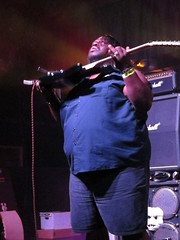
The drummer was hidden back in his cage, but laid down some great double kick rhythms. Side Effect played hard and focused but their stage vibe was relaxed and fun. That combination was a winner.

Elete
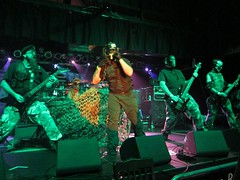
Elete took the stage with a strong visual presence. Paramilitary outfits and masks created a depersonalized stage presence. As the singer swaggered around the stage, the rest of the band focused on posing and projecting a strong, harsh attitude. It was a very theatrical vibe that matched the industrial metal sound of the music.
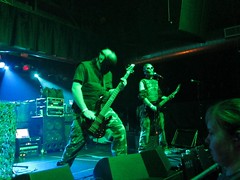
The band played along with a backing track of synthesizers and other electronic sounds. The dark grind of the music formed a setting for the singer's raspy voice and screamy punctuations.
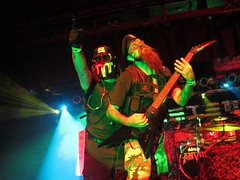
Live keyboards would have helped, but aside from the masks and makeup, Elete needed more show. The high point was when the singer came out into the audience to hector the people lurking back at the tables and the rhythm guitar player lip synched to his vocals.

The Threatened
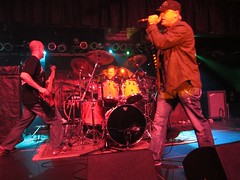
The Threatened dragged the audience back to classic heavy metal. The smooth vocal arrangements featured tight harmonies that pushed the sound to a more radio friendly direction. In stark contrast to Elete, the Threatened took the stage in their street clothes.
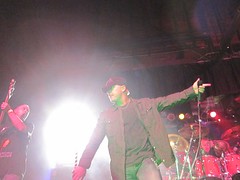
The opening song, Savior featured a strong, chunky rhythm and a great bass solo. Later, the guitarist switched to a seven string guitar to shred out. Aside from the vocals, several of the songs had an early AC/DC grind.
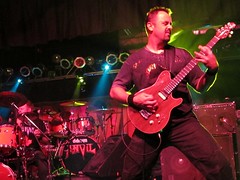
The best song of the set, though, was Lose Control, which burst out with a great drum riff. While the band's playing was great, the drum work took it over the top. The verses featured some strong tom work, but the kick drum rolls were incredible.
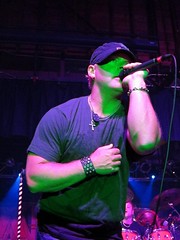
The Threatened had a decent stage presence, moving around a bit. They needed more visual spark and more audience engagement to stand out in this crowd of bands.

Pressure Point
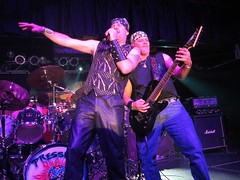
Pressure Point knew all about visual spark. Rather than relying on their own charms, they brought in reinforcements. The show started out with a bit of theatre. A hot, bikini-clad babe walked the bass player onto the stage on a leash. Then another played roadie for the guitar player. The girls stayed on the stage to dance and act as eye candy. This explained Pressure Point's self-description as a rock a GOGO band.
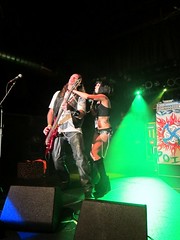
The bass player actually looked like he was having fun, but the rest of the band kept more serious expressions most the time. The guitar player pulled out some strong chops and the drummer kept up an assault beat driving the songs.
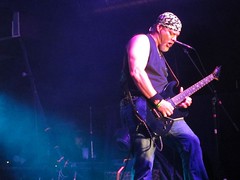
In spite of the pretty dancers and solid playing, Pressure Point's focus was the political message of the lyrics. Front man Kirk Young rapped and ranted his way through the set, raging at the government and conspiracies. He was more of a demagogue at a rally than a metal band singer. The vibe was mostly libertarian with a touch of tea party mixed in. I'll admit that I was a little uncomfortable with the swastika in their logo.

The unrelated mix of media and message made the set feel like propaganda.

Anvil
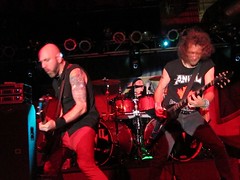
Before Anvil took the stage, the lurking crowd finally filtered forward, filling out the front of the stage for the first time. A stronger turnout would have been nice, but Anvil seemed pleased as punch to play for us. That attitude is a big part of what made Anvil! The Story of Anvil a successful documentary. It's clear that these guys truly love to play and perform. Their set showed off their strong personalities and featured a good balance between the theatrical and the music.
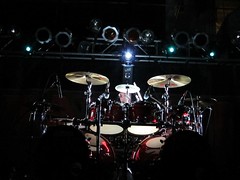
Drummer Robb Reiner spent the show hidden behind his immense kit, but he imposed his personality through his playing. The beats were heavy and in-time, but he never settled for simplistic. Instead he threw in constant fills and syncopation that provided a strong foundation for the guitar and bass. Late in the set, he finally got his chance for a real solo and was amazing. Double kick rolls and driving toms provided power, but his rhythmic change ups and dynamic shifts kept the solo interesting.
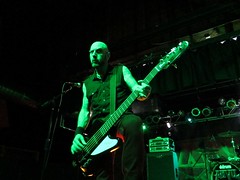
Bass player Glenn Five mostly maintained a serious look that wavered between disdain and maniacal, but every now and then he broke character and grinned at the crowd's enthusiasm. Even if his pose seemed aloof, his bass work was fully engaged. His spider fingers ran through the bottom end, then switched to a fist pound on the bass. Amazing chops, wicked stage persona, and charisma -- he had it all.
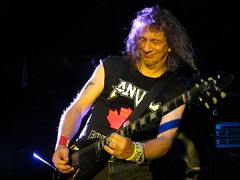
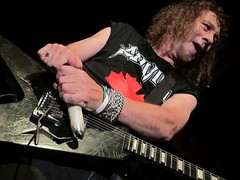
Guitar player Steve "Lips" Kudlow was the goofy counterpoint to Glen Five's attitude. Above all, his joyful stage presence made him seem boyish. He mugged for the crowd, taking every opportunity to strike a pose. His clowning had the perfect degree of self deprecation to invite the audience into his world. As the only one who really spoke, he provided the face of the band: a regular guy who's amazed to be doing what he loves.
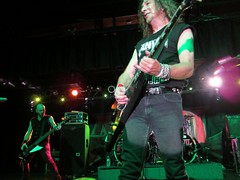
At the same time, Lips' playing was always exactly what the song needed from precise chops to bombastic leads. Like his clown persona, his flashy moves added to the show. Whether he was controlling feedback with precision or talking into his guitar like a microphone, he provided a show to match the music. During the extended solo on Mothra, he pulled out a vibrator and used it to drive the pickups and then play slide guitar.
Anvil's sound was rooted in old school heavy metal. You could hear echoes of Black Sabbath and Motörhead, along with occasional flashes of Metallica. Most of all, it was just fun. They ended their set with a powerful version of Metal On Metal. After a brief encore of Running, the night was over all too soon. After Anvil!, Anvil was sometimes called the real Spinal Tap. Last night's concert proved that they were much more than that - warm hearted, hard playing, and ass kicking.
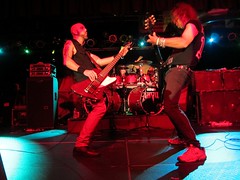

Many more photos on my Flickr

Monday, October 24, 2011

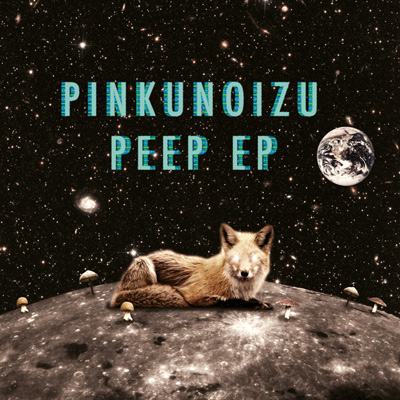
CD review - Pinkunoizu, Peep (2011)

More dreamlike than dreamy...how did I get here?

Pinkunoizu's EP, Peep, is not so much dreamy as dreamlike. The band manages to create and capture the sense of a free ranging subconsciousness throughout the course of the EP. Like any night's dreamscapes, Peep doesn't start out that strangely.

The fade-in intro of Time Is Like a Melody suggests a thousand other dreamy pop bands. The drifting vibe blends bubbling synths, washes, and a simple guitar strum. As the song finds its structure, this is where other dream pop bands would settle into the groove. But Pinkunoizu takes it further. Swirling around, they build a rich rhythmic complexity as the tune circles. Jarring shards of guitar are just as welcome as water drop kalimba tones.

These looping layers jumble together. When the song fades down into an a capella finish, the vocal stratas maintain the interwoven rhythms of the main song. A little outside the box for dream pop, Time Is a Melody serves as the first step down into dreamland.

The second track, Everything is Broken or Stolen, takes us further afield. It establishes a poly-rythmic groove as initial passing sounds give way to a meandering synth melody. There's a great moment where the trippy music drops out briefly to accent the beginning of the detached and disconnected vocal.

Soon, though, the song falls back into an instrumental exploration that starts collecting unrelated sounds over the main groove. After a number of twists, a new set of repetitive vocals comes in. It seems unclear how we've arrived here, but, as in a dream, we accept it. The theme mutates and is slowly overtaken by the earlier meandering keyboard line. Eventually, the track settles back into polyrythm before collapsing into a strange clockwork finish.

Now that we're deeply anchored in sleep, Pinkunoizu lays out the strangest track. Dairy Queen's ominous start -- a tone and a tolling beat -- sets up a feeling of powerlessness. Sounding like parts of The Wall, the song moves forward. But it opens up and shifts into a more reflective mood before dissolving into surrealism.

This is where Peep crosses into the seemingly random logic of dreamspace. Like the slow unwinding of the subconscious, the flow is not so clear. One moment slides into the next, but cause and effect seem suspended. This surrealistic meltdown proceeds until, out of the void, an element emerges.

The classic Irish folk song, Red is the Rose, provides a touchstone for this dream to latch onto like a lifeline. The melody becomes an organizing motif as the track becomes more song-like. As the psychedelic jam extends the theme, it's hard to remember just how we got here.

The end of the song is a confused awakening, The tatters of the last 22 and a half minutes slip through the fingers and any summary is elusive.