(Artwork care of Karen Ramsay (www.karenramsay.com), profile photo care of brianlackeyphotography.com)
Showing posts with label theatrical. Show all posts

Thursday, April 10, 2014

Concert review - ...And You Will Know Us By The Trail Of Dead, with La Femme, Silver Snakes, and Git Some

3 April 2014 (Summit Music Hall, Denver CO)

Good intentions and all of that... I wanted to make it down to Denver in time to catch all of the acts, but I ran quite late, arriving just in time to catch La Femme's extended soundcheck. I was disappointed to miss Silver Snakes and Git Some, but I wasn't alone; most of crowd showed up sometime during La Femme's frantic set..
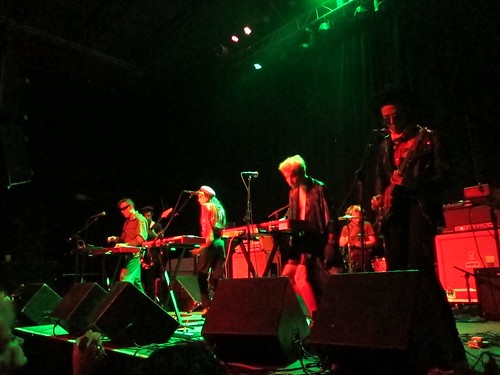
032 La Femme
It seemed to take a long time for La Femme to get their monitors and mics correctly set up, but that gave us plenty of time to take in the band members and appreciate each one's unique style, from pseudo-vaquero panache to metrosexual boxer chic. Think Adam Ant, but organized by an ADHD costumer. But the random mix of looks was central to band's artistic sense of theatre: it's not a show unless it's a spectacle. It didn't matter, though, whether the band's appearance aligned because they played in such close formation.
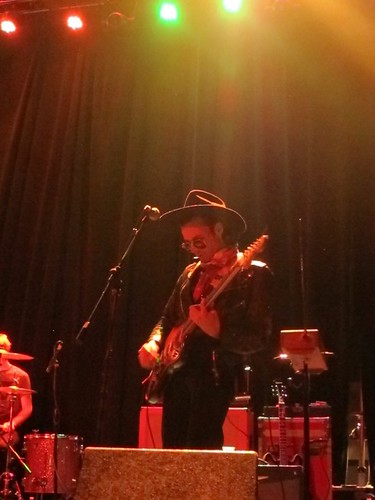
031 La Femme
Back in 2010, I reviewed La Femme's EP, Le Podium # 1, appreciating the way they grafted surf guitar tonality onto new wave. Over the last several years, they've honed that style, pulling in punk and synth pop influences. The blend of reverbed surf twang and synth textures -- call it noir wave -- occasionally recalled bands like The Cure, but generally La Femme was in a class all their own. The dark energy was great and, although almost all the lyrics were in French, everyone could appreciate the side trips into Krautrock trippiness and Velvet Underground psychedelic drone.

011 La Femme
The music worked, but the band's visuals were even better. The front edge of the stage was fenced with keyboards, with only the guitarist going without. His consolation prize accessory was a wonderfully retro theremin. They engaged the audience with stylized dance moves and ironic poses. Frontman Marlon Magnée was chaotically charismatic, whether offering a campy come-ons
to the crowd or sexually assaulting his keyboard. It was crazy fun, but also a little bewildering for some in the audience. Afterwards, I heard someone asking, "What the hell was that?"

024 La Femme
By the time their set ended in a trainwreck celebration of noise and dancing, they had played enough punk thrash to lay the groundwork for Trail of Dead’s set.
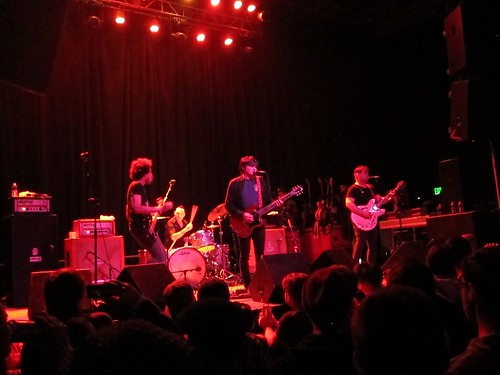

092 Trail of Dead
Contradictions are at the heart of what powers …And You Will Know Us By The Trail Of Dead. They ambitiously create rich, concept-heavy post-rock albums that are executed with raw punk rock intensity. Their music spans from fragile, wispy psychedelic patterns to peaks of roaring chaos. But the biggest contrast is between the serious, focused tone they find in the studio and the unfiltered range of emotions they bring to the stage. This tour is all the more intriguing because it’s a brief pause before resuming work on a new album that’s scheduled for later this year. With their most recent release being 2012’s Lost Songs, they may have thought it would be hard to motivate a good turn out, so this tour reaches back to what is regarded as the band’s breakout album, Source Tags & Codes.
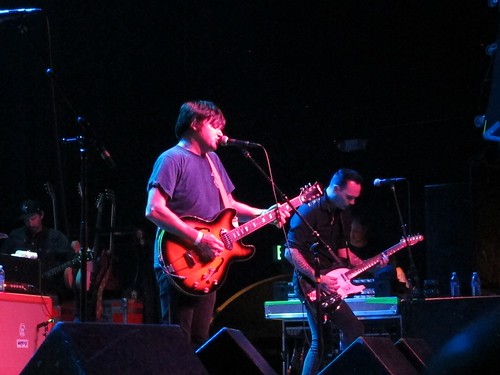
099 Trail of Dead
After La Femme's wild finale, it didn't take long for roadies to clear their equipment and power up Trail of Dead’s gear. So, after this brief break, the band came out and launched immediately into “It Was There That I Saw You”. The opening vamp passed quickly and they soared into the driving swirl of the song. The dynamics of the album version were preserved, but the band was wired and pounded through the tunes. Conrad Keely seemed to swap out guitars for almost every song and Jason Reece often traded instruments with Jamie Miller, but these transitions never slowed the flow of their performance.

078 Trail of Dead
Even stripped of their studio production nuances – like the ambient crowd sound and free jazz noodling at the end of “Baudelaire” – the tunes lost none of their power or presence. Trail of Dead nailed the punk foundations of the songs and made them as cathartic and moving as ever.
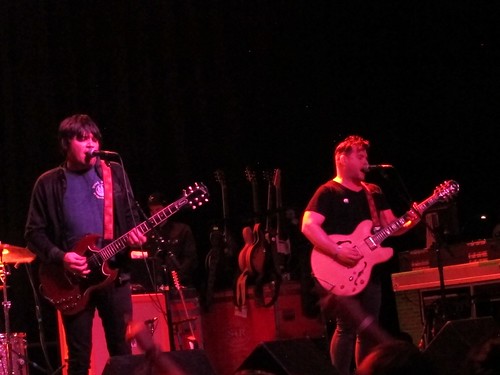
089 Trail of Dead
It was clear that the crowd was intimately familiar with Source Tags & Codes, sometimes feeling torn between singing along and surrendering to the visceral punch of the music. For all the meaning that we imbued these songs with, Keely and Reece were even more invested. They played like they were tapping into their younger selves with the hindsight of all the changes they had seen. The personnel shifts and bulkier configurations of the past seemed to melt away and this four piece group channeled the epic scope of that earlier incarnation. Like guitarist/drummer Miller, bass player Autry Fulbright II has only been with Trail of Dead for three years, but his charismatic presence was a strong part of the stage chemistry. Both men seemed just as committed to these songs as Keely and Reece.
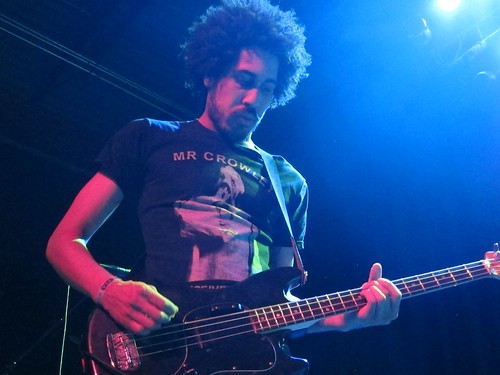
059 Trail of Dead
All too soon, Keely marked the end of the series, noting “This is the last song,” and then he sighed, “It’s a short album.” The wistful sound of “Source Tags & Codes” was perfectly appropriate and it was even shorter without the string coda of the album version. As the final notes faded, the audience seemed drained for a moment before the band kicked into “Mistakes & Regrets” from 1999’s Madonna. It captured the retrospective mood in the wake of Source Tags & Codes and then dismissed it.
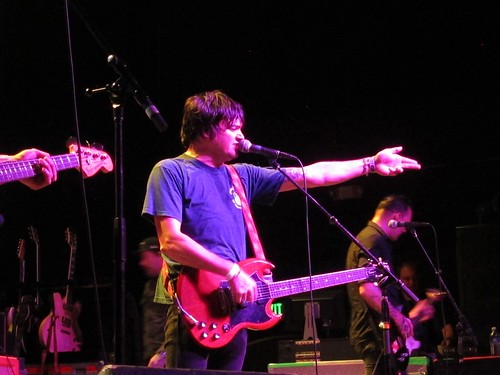
115 Trail of Dead
The crowd settled in as Trail of Dead wandered through another five songs from their back catalog, with particularly strong performances on “Catatonic” (Lost Songs) and “Would You Smile Again” (Worlds Apart, 2005). For this latter tune, Reece reached into the crowd, giving people a chance to sing along and participate in the ritual. After wrapping up the main set, they came back out for a single encore, a version of “Richter Scale Madness” from the band’s first album. The nihilistic flail of the tune energized us all for the late night ride home.

More photos on my Flickr.

Tuesday, January 7, 2014

Recording review - Beats Antique, A Thousand Faces - Act 1 (2013)

Every taste offers another intriguing melange

Beats Antique may let their guest artists step up front and show their faces, but the exotic blend of Gypsy flavored electronica reveals the band behind the mask. The songs may vary quite a bit, but there's an open minded aesthetic and familiar sonic predilections that will satisfy long-time fans. That established audience is the target for A Thousand Faces - Act 1. The self-released album spawned a Kickstarter project to create an innovative stage production that would show off the new music and their fans quickly responded to support the vision. It's hardly news for a band to turn to crowd-funding, but many of their supporters may not directly benefit from the show if they live off the tour route. Beats Antique overcame that challenge because their fan base appreciates their cross-disciplinary artistic vision and can buy into the thrill of patronage.

Like their other releases, A Thousand Faces is as influenced by Zoe Jakes' choreography as it is by musicians David Satori and Sidecar Tommy Cappel. The sinuous and exotic "Kismet" is inseparable from Jakes' dancing. Sarod player Alam Khan begins the song with sly glances and calculated deliberation. The song quickly picks up an Arabic belly dancing tonality. As the tune feints forward and then retreats, it's easy to imagine the accompanying dance that weaves along with the spidery creep of the rhythm. "The Approach" also reflects a strong physicality. The Latin horns follow along behind a stalking beat. Like a ritual march or parade, the piece has a heightened theatricality, but it's powered by an aura of nervous excitement. The first half plays larger than life, but it slides into a sparser section full of bass menace. Squiggling electronica weaves around a slide banjo riff for a short interlude before the track returns to the opening pursuit.This has all of the elements that make Beats Antique great. A cultural stew of influences come together, expressed through acoustic and electronic instruments with a rhythm that demands movement and engagement.

A Thousand Faces has its stranger facets as well. "Doors of Destiny" is tossed out as a surrealistically comic interlude. The game show conceit is amusing, but the wonderful Eastern European Gypsy vamp lets it stand up to repeated listening. About two minutes in ("You chose door number two" *meow*), the tune melts down and turns into a dark, dubsteppy roller-coaster. Whooping highs inevitably give way to stripped gear lows. I only wish this musical interlude was longer. The other oddball is the Les Claypools collaboration, "Beezlebub". Claypool's distinctively glitchy bass style is blended with bass grinds and bubbles. The piece captures his off-beat funk and quirky vocals but fits them into the Beats Antique sonic universe, almost as if they're remixing Primus.

The songs evoke a host of different moods and flavors: Balinese-tinged anticipation on "Charon's Crossing", momentous electro-pop with "You The Starry Eyed", and a cinematic turn featuring a sly alien presence on "Viper's Den". Despite all the costume changes, though, it's unequivocally a Beats Antique project and among their finest.


Tuesday, May 21, 2013

Recording review, The Indelicates, Diseases of England (2013)

Provocative attitude and dystopian snark

Julia and Simon Indelicate follow a capricious muse, one less concerned with musical consistency than with attitude. Their projects may not sound alike beyond a love for the theatrical, but each one trolls for audience response and hopes for a certain degree of outrage. 2011's David Koresh Superstar introduced me to The Indelicates, impressing me with their surprisingly nuanced perspective and strong narrative voice. It was a provocative work, which seems to be the band's forte. Diseases of England has a similar musical theatre vibe, but it differs in a couple of key ways. DKS tells an American story and the music reflects that nationalistic sound. The new album fittingly jumps the pond back to the band's home turf and samples a wide swath of British music, ranging from Morrissey to Mumford and Sons. And rather than taking DKS's soundtrack approach, Diseases of England drops the constraint of a story, serving more as a melodramatic concept album. The Indelicates dish up a jaundiced view of modern England, highlighting cynicism, vulgarity, and disconnection as the titular diseases. Fortunately, it's no whining, petulant screed; they dodge that sin with their clever, satirical lyrics and solid musical execution.

The album opens with a great electro-rock track, "Bitterness is the Appropriate Response". Like a modern dance remix of Bauhaus, Gothic synth-pop vocals float over a beat-heavy rock mix. The band excessively packs the track with ear-catching flair: DJ-style transformer chops, grungy guitar, and shimmery keyboard layers. This sonic rejection of DKS's aesthetic makes it clear that they aren't concerned about consistency between the two albums. With that point out of the way, they really hit their stride on the second track, "Pubes", a cynical run-down of temptation and vice:
The places you'll go, the things you'll get
For a couple of pubes on the internet
The message is nothing new, everybody knows sex sells, but the tune catchy as hell. Updated power pop seasoned with a taste of David Bowie, the music holds you captive to the crass lyrics. The breakdown bridge serves up a wicked descending bass and dial-up modem chirps. I have to wonder, though, whether people even recognize that sound any more.

A couple of songs later, the Indelicates have dropped their harder musical edge to channel an emotional Morrissey vibe on "Le Godemiché Royal". The piano and bassoon initially cast the piece as a reverie, albeit one of obsessive love:
How can they hate you when you're beautiful?
And make a sewer from your scent?
How sour, how loveless these people are
How cruel, disfigured, and unspent
The track develops a lush layered sound, but the love curdles as the obsession darkens and takes on a disturbed edge. Think of this as the flip side of "Pubes". Both songs deal with allure's shadow, although the lyrics here are more circumspect (despite the title, which translates to "The Royal Dildo"). If "Pubes" warns the audience that they're being played, this piece's voyeuristic stalker perspective and his slipping control sketch out how sexual power games can go wrong.

The band continues their catalog of societal disease with a drag blues take on class warfare ("Class") and a moody gypsy blues story of ill use, packed with jaded cliches and bitter irony ("All You Need Is Love"). Their dystopian view finds its nadir with "Everything Is Just Disgusting". It starts out with a blues organ playing a saturated descending riff. The stark, echoed vocals remind me of a host of Brit-wave bands. They sound detached, loaded with ennui and a touch of contempt. As the song expands, the singing picks up intensity until the raging disdain comes to dominate. As Simon Indelicate spits out his loathing, the accompanying sweetness of the strings is like a fake smile that never reaches the eyes.

The last two tracks, "Not Alone" and "Dovahkiin", close out the album with the same kind of unsubtle earnestness that Mumford and Sons are prone to. Showing better judgement, the Indelicates show some moderation and the tunes form a nice wrap-up. "Dovahkiin" is the stronger of the two, painting its portrait of Britain as a pathetic loser in the unkindest terms. The ringing guitar solo transforms the mood into a redemptive ending that sounds beautiful, but I'm not so sure their subject deserves that closure.

Ultimately, Diseases of England is a simpler artistic statement than David Koresh Superstar, taking fewer chances. Koresh may be a bit obscure for the Indelicate's British audience, but their send-up was fairly transgressive for most Americans. Railing against modern culture, even with vulgarity and wit, is inherently less challenging. Still, it's an enjoyable romp across a wide variety of styles, with plenty of memorable songs.

Thursday, September 27, 2012

Recording review - Amanda Palmer & the Grand Theft Orchestra, Theatre Is Evil (2012)

A beguiling mix of artifice and art

If I was in the New Criticism camp (a la John Crowe Ransom), I'd listen closely to Theatre Is Evil but ignore any real life distraction about Amanda Palmer and her Grand Theft Orchestra. There would be plenty to ignore: her history with the punk-cabaret Dresden Dolls, her almost compulsive interaction with her fans, her groundbreaking success on Kickstarter, and her penchant for controversy, including the recent fight over paying volunteer musicians. Ransom would say none of that is relevant; the songs are independent of Palmer's intent or personality.

That kind of review would completely miss the point of an album like Theatre Is Evil. More than a singer, Palmer presents herself as an artist, specifically a performance artist. And in that mode, her new album is beguiling mix of artifice and art. Much like her public persona, the songs are often over-the-top. The bipolar energy sweeps from manic highs to devastating lows. But despite the occasional sense of caricature, Palmer invests each song with absolute raw commitment. Whether open, bleeding, and vulnerable or brash, knowing, and lusty, each song is presented as a piece of truth. The album is rich and theatrical, her public life is full of theatre, and her ironic message is "theatre is evil". But that subversive move doesn't rob Theatre Is Evil of its emotional impact or exuberance.

The album's showy trappings begin with a cabaret introduction of the band auf Deutsch. The Grand Theft Orchestra fills out Palmer's sound significantly, yet still retains some of the dark groove of her work in the Dresden Dolls. Want It Back offers a typical sample of the mix of synth pop and new wave that Theatre Is Evil favors. Keyboard washes kick it off, but the staccato pop bounce of piano and bass drive the song forward. The arrangement is rich as it supports Palmer's chanting lyrical flow. Bottomfeeder hits a moodier synth pop groove. But even at this slower pace, the band makes it feel lush.

Palmer also shows off her rock side. On Do It With a Rockstar, Her intro fades in then collapses into a solid Pat Benatar punch:
Do you wanna dance?
Do you wanna fight? 
Do you wanna get drunk and stay the night?
Once the song is underway, it turns into an indie rock reworking of David Bowie's classic sound. Like Bowie's self-referencing lyrics, Palmer presents a stylized view of herself as a partying rock star, albeit with a touch of desperation. The larger band provides a strong guitar and heavy drumming, which sells the song's rock credibility. But the cock-rock bluster crosses with Palmer's lonely edge: "Are you really sure you want to go?"

Palmer's songwriting is as strong as ever. She finds subjects and perspectives that stray beyond the typical. On The Killing Type, the music feels a bit like XTC's post punk pop as she presents her pacifist ethical position. After drawing her clear boundaries, the song shifts from the philosophical to a sharper response, rooted in relationship issues:
I'm not the killing type...
But I would kill to make you feel
I don't mean kill someone for real
I couldn't do that, it is wrong 
But I can say it in a song (a song, a song)
And I'm saying it now
I'm saying it so
Even if you never hear this song
Somebody else will know
The contrast between her calm, reasonable pacifism and bubbling anger is a powerful example of repression.

Then on the moody Grown Man Cry, she's worn down by the emotional blackmail of a crying lover. She's frustrated, cynically seeing his tears as passive aggression:
For a while it was touching
For a while it was challenging
Before it became typical
Now it really isn't interesting
To see a grown man cry
It's an ironic followup to the sentiment on The Killing Type. The gender role reversal is also interesting, largely because Palmer doesn't let her perspective to slip into a stereotypical chauvinist response.

It's also nice to hear Palmer strip down to piano and voice, like on the pensive, haunted Tori Amos style of Trout Head Replica or the tragically beautiful The Bed Song. Sounding like Regina Spector covering Simon and Garfunkel's America, this latter tune starts out sweet and wistful as a couple begin as friends sharing a sleeping bag. The couple moves closer together then drift quietly apart without ever splitting. Eventually the gulf is too wide and it's heartbreaking:
And I still don't ask you, "What is the matter?"
Is it a matter of worse or better?
You take the heart failure, I'll take the cancer
I've long stopped wondering why you don't answer
The waltz rhythm and expressive piano melody keep the song from becoming too maudlin.

Without considering Palmer's background, Theatre Is Evil might seem scattershot: flashes of wit clash with emotion, sparse arrangements next to thick walls of sound, shallow pop and depths of feeling. But taken in context, Palmer's art is all about messy complexity. At its heart, her work is a celebration like Walt Whitman's Song of Myself:
Do I contradict myself?
Very well then, I contradict myself,
(I am large, I contain multitudes.)

Thursday, August 23, 2012

Recording review - Naama Kates, The Unexamined Life (2012)

A unique aesthetic of theatrical vignettes, piano pop, and some deep retro sounds

It seems appropriate that Naama Kates' debut, The Unexamined Life is rooted in theatricality. I get the sense that her musical taste is thoroughly integrated with her background in acting. The album pulls a lot from early Kate Bush (like There Goes a Tenner) and Tori Amos' artier songs. But unlike most of the women influenced by Bush and Amos, Kates doesn't affect the twee vocal stylings. If anything, she has more of an edgy pop voice. It's really that mix of storytelling, theatrics, and piano accompaniment that begs the comparison. It wouldn't surprise me if Kates has a full length stage musical opus hiding somewhere in her portfolio.

For much of The Unexamined Life, she settles for songs that unfold like little vignettes, with stylistic shifts to indicate scene changes. Price of Company is a great example. It starts out as a moody, descending bass jazz-blues. The track establishes a standard song structure, but the feel and imagery suggest a video, perhaps with a rain splattered window and a glimpse of Kates pacing in her room. But the bridge shatters that mood with a manic energy. The frantic beat has an amphetamine soaked 1920s sound.

Those sonic shifts can be a touch unnerving, but plenty of the other tracks maintain more consistency. The opening track, Before You Lose It has a more conventional arrangement. The earnest piano beginning is one part John Lennon's Imagine and three parts Ben Folds. Kates voice has a feigned weariness. About the time the chorus should drop, the rest of the band kicks in. The relaxed beat supports the sparse lines of a singing slide guitar and a warm caress of string. The music conjures the feel of a stroll through the past, taking stock of chances lost and fine choices made. The lyrics don't fit the mood, though. This musical interlude mutes the impact of lines like "Wash that blood off your hands/Before you stain them". Turmoil coalesces in the tail end of the track, finally bringing the music in line with the lyrics. While it might have been better to hint at this earlier in the song, it a powerful finish.

Kates' piano work throughout The Unexamined Life is strong. Her playing hits its peak on кошмары, which lays down a nice retro Eastern European sound. She's accompanied by a small, rich orchestra that provides an ominous Tom Waits vibe. While the main piano line is fairly repetitive, Kates opens up during the chorus. Then, on the bridge, she improvises off the melody to slip a little outside.

Naama Kates has a unique aesthetic that stands out from the crowd. The Unexamined Life shows a fine musical range. Dropping by her site, I was surprised to see that she's done a set of Radiohead covers as well. Such an intriguing artist should do well if she can reach the right audience.

Monday, October 11, 2010

CD review - The Gay Blades, Savages (2010)

Savages has a touch of "snotty boys with guitars", especially on the first track, Rock N' Roll (Part I), but it's infused with an overwrought expressive pop. That first track, which has nothing to do the Gary Glitter song, has rich wailing guitars and a heavy grind. It's dirty rock and roll. The vocals have the perfect amount of sneering attitude: "I'm gettin' while the gettin's good."

Then the Gay Blades don't so much drop the ball as decide they want to change the game. Try To Understand is much more typical of the album. It took me a while to figure out why it sounded so familiar. They've effectively reworked Thin Lizzy's Vagabond of the Western World. The music is retro pop, with a straight rock bounce. But the vocals are affected and over the top.The effect is like a stage musical piece; there's a disconnect between the fraught vocals, the bouncy pop, and the light weight lyrics.

The songs thrown in some surprise moves, with genre jumping bridges and a few good dance beats. There is also a moment of cognitive dissonance with November Fight Song, which lays down sado-masochistic lyrics to the changes of Gentle On My Mind. Throughout Savages, the vocals are overly emotional and heavy. At their best, it's a bit like Freddie Mercury if he fronted a more straightforward rock band. Or maybe what the Violent Femmes could do if they'd had a better ear for pop.

Despite the vocal affectation, Savages is still quite listenable. The tunes are catchy and the drummer has a really nice touch for propelling the songs forward. If the singer were as subtle, the Gay Blades would be a better band. To my ear, the harder edged songs stand up the best: Rock N Roll (Part I), Why Winter in Detroit?, and Burns and Shakes. Drop by their site and give them a listen. Wine coolers all around!