(Artwork care of Karen Ramsay (www.karenramsay.com), profile photo care of brianlackeyphotography.com)
Showing posts with label looping. Show all posts

Monday, March 16, 2015

Concert review - Beardyman with Shank Aaron and Sureshot

13 March 2015 (Beta Nightclub, Denver CO)

3.75/5.0

I've been to my share of nightclubs, but I'm much more a denizen of the bar show and concert hall. Unfortunately, DJ sets and electronic acts are always a bit out of their element at concert venues when they try to recreate the dance club/rave feel. It's hard to overcome the wrong geometry, the lack of a real dance floor, and a very different atmosphere.

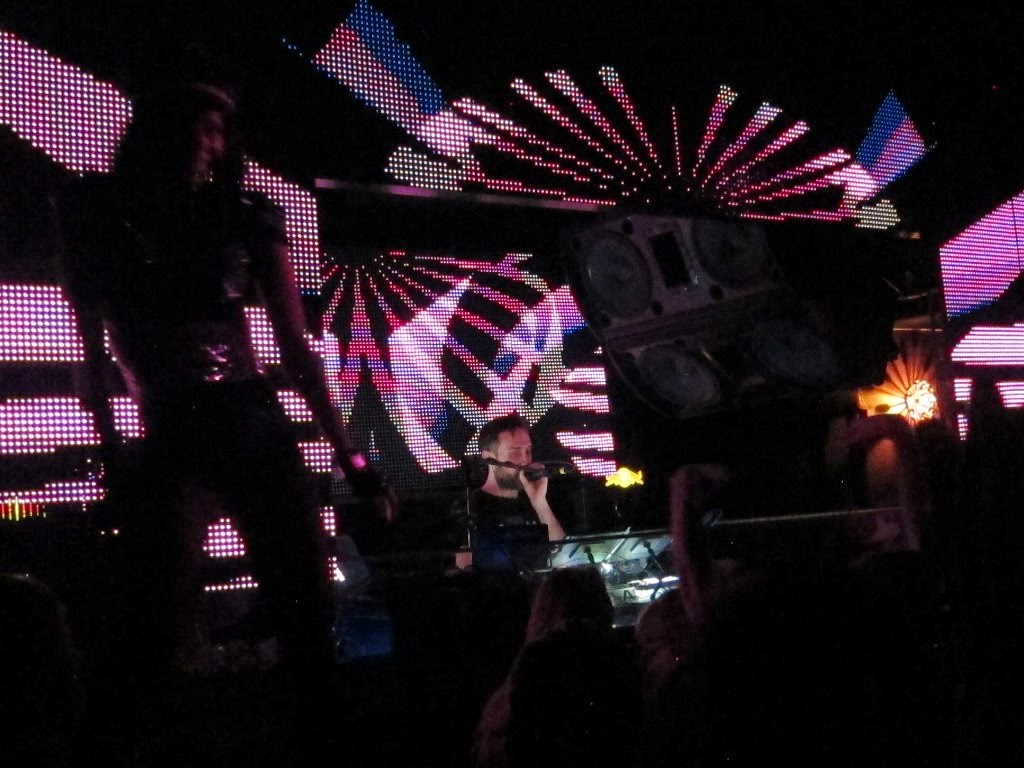
By contrast, catching Beardyman at Beta delivered the genuine dance club experience. They had the lighting setup, including lasers and a pixelated display around the DJ, not to mention a sound system capable of massaging internal organs with bass throb. While the show never caught the wild rave feel of a Beats Antique or Glitch Mob show, Beta was a decent venue. Unlike most of the clubs I've been to, the space was voluminous and could have accommodated a much larger crowd; the dance floor was fairly full, but the back and edges offered plenty of room to move around.


The first thing to remember is that this evening was all about the club vibe rather than a concert. So, there were no breaks or rests as one DJ melted into another. Sureshot led off with fairly standard set of electronic mood music, but he never even spoke to the crowd. The transition to Shank Aaron picked things up a bit, with a harder edge bass and a buddy on the mic, but the emphasis remained on driving the insistent beat and keeping people moving.

Soaking in the experience on the dance floor, it reminded me about the power of variable-interval reinforcement schedules. Okay, I lost a few of you there. This is what makes gambling, email, and Candy Crush Saga so addictive: a stable pattern interrupted with tiny rewards. The DJs provided this by constantly manipulating the sonic signature with grinding bass or free-fall washes, all without dropping the beat. Each novel twist -- is that the sound of industrial robot mating calls? -- triggered a new wash of dopamine and flush of satisfaction. In the club sensorium, where the volume dominated and the visuals provided pseudo-random shifts, the effect was electric. The only real way to react was to move and dance, and there was joy in that surrender.


Beardyman slipped into the booth at the end of Shank Aaron's set and did his systems check while the final changes propagated through the mix. But once he took up the reins, the difference was huge as he demonstrated the difference between mere DJ and performer. It wasn't just how he layered his vocal loops to create an order of magnitude more complexity; it was his playful sense of improvisation and the amount of personality he injected. He warmed up by showing off some of his musical chops, then he got on the mic and riffed for a while on Denver, mentioning his last tour through here that ended early when he got sick. Then, apropos of nothing, he shot off on a tangent. He mentioned, "I probably shouldn't have taken that acid 30 minutes ago," which pulled its comic effect from the vocal mutation that added the requisite disconcerting echoes and pitch shifts. It was a cheap gag, but it worked to loosen up the crowd.
EXPLAIN

It was interesting to contrast this nightclub experience with his more concert-oriented shows. He never got quite as antic or creative because he kept the set in full service to the dance floor, but the performance element distinguished Beardyman from his more prosaic competition. It's not just that he was live looping the mix and tweaking vocal samples on the fly to create his grooves, it's how he toyed with the electronic dance structure and kept his audience off balance. If the normal dance club formula builds on short attention span twists on the beat, Beardyman upped the ante by whipsawing his set between inciting the crowd with intensely powerful rhythms and then shattering the mood with comic or surprising side trips. So, he broke up the heavy pounding beat with an introspective instrumental piano interlude that was disrupted yet again when it picked up a grinding dubstep bass. Later, a bouncy pop song was deconstructed and deformed into weirdness. But he never forgot his milieu, pushing the dancers into constant motion. He also handled these shifts organically as he flowed between them.

Throughout the night, he made it clear that all of his set was relatively improvised, sometimes with subtle moves, like lyrical riffing specific to Denver, but just as often by overtly bragging about it and explaining what he was doing in a sing-song dancehall style voice.  This looseness meant that he could build up some elaborate ideas, but then abandon them if they didn't connect as well. Having seen some of his other performances, there were some familiar bits, although they had their own flavor here. One of these, "Ghost Town" by The Specials, reworked  the uneasy darkness of the tune until it unwound into glitched out blocks of tone.

This show at Beta wasn't as polished or clever as that Seattle show linked earlier, but it was exactly what the venue called for. It was a full night of tribal dance rites powered by visceral bass and tight syncopation, and Beardyman's special touch made it something to talk about afterwards, trading memories of odd references and riffs.

(Note: Lighting and logistics made it hard to get any other usable photos) 

Thursday, May 22, 2014

Concert review - Zoë Keating

3 May 2014 (Boulder Theater, Boulder CO)

For someone like me who’s used to rock arenas and noisy bars, this show was a completely different experience. With an older, less casually dressed crowd, reserved seating and respectful audience silence during the performance, it was more of a night at a string recital than at a rock concert. But the symphonic set wasn’t quite at ease either; Zoë Keating’s music didn’t really belong to their world. While her cello would have been at home in the concert hall, the technology she harnessed for looping and layering her parts challenged their comfort zone, and her sonic palette was likewise unconventional. To the warm, organic sounds of strings, Keating added percussive slaps, harsh bow scrapes and light feedback resonance to shape her motifs. But she connected to the divers crowd because she is a phenomenal player whose music carves out its own niche. Modern, new age, minimalistic, experimental, jazzy; it’s hard to nail down exactly what she does, but her music is easily recognizable as the components offset and support one another, building into obsessively layered structures.

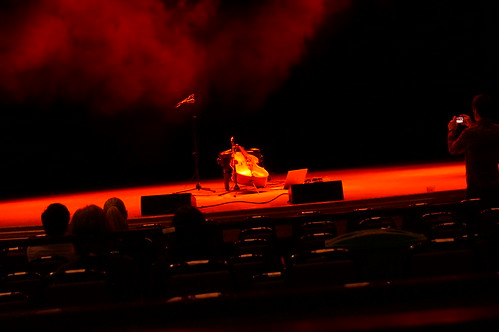
003 Zoë Keating
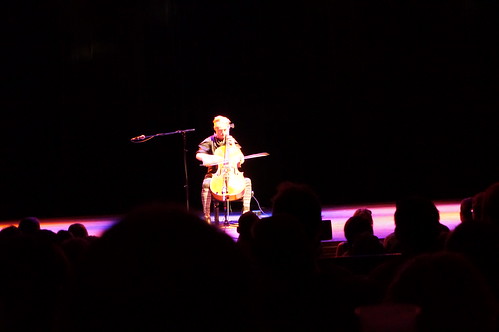
Before she even emerged, the mood was set. The stage was stark, with nothing but her cello, loop controller and seat underneath the hot red lights, softened by a light fog. Red remained the central color, and the lighting tech did a good job of connecting with the music, supporting the accents. Keating started with an older piece, “Seven League Boots”. The initial smear of layered cello gave way to pizzicato raindrop notes that coalesced into heavier flows and rapid cascades. Aside from the beautiful precision of her playing, the stereo separation added depth. Whether directly or via programming, she controlled panning so notes were spatially located, casting the performance into a cool, in-your-headphones experience. Most impressive was that, although you could hear the looped structure, that wasn’t the most salient element of her performance. Her thematic explorations were the center of attention. Her control yielded moments of delicate beauty and intervals of stormy power. In the end, it didn’t matter whether you could follow the subtle dance of her feet guiding the loops or not; the music hypnotized and distracted. Like a master magician, she led the audience’s focus where it needed to go.

011 Zoë Keating
More than just a talented player, Keating has a genuine, if self-conscious, stage presence. Whether filling us in on the challenges of looping (“If you play that first thing wrong, then you have to play everything wrong”), reminiscing over her career (“Rasputina was my rock and roll finishing school”) or talking about her creative process (“I’d rather just give my pieces numbers than titles”), she reached out and overcame the formality of the concert-hall setting. That kept a wall from forming between her and her audience. The crowd showed restraint while Keating played, but her likeable persona made it easy for them to express their enthusiasm at the end of each song. After the show, she built on this with an open-ended meet-and-greet session that gave people the chance to ask questions and make a personal connection. l could hear her answer the same questions over and over, but she was patient and happy to talk with her fans.

008 Zoë Keating
One of the more common queries was about her upcoming album, due to be released this summer. It’s been four years since she released Into the Trees, although she’s worked on soundtracks and commercials since then. During her set, she provided a wonderful taste of her new work, but she took great pains to explain that this was the original improvised idea, rather than the “cello” epic she built in the studio. Keating plans to tour widely in support of the new release, so take advantage of the opportunity if she makes it to your town. It will be mesmerizing; be prepared to sit back and enjoy.

(A version of this review first appeared on Spectrum Culture)

Tuesday, November 13, 2012

Recording review - El Ten Eleven, Transitions (2012)

Duo creates a rich sonic world, flowing like a set of evanescent thoughts

You can't turn around without tripping over hipster duos going for a full band sound. Bands like Best Coast and The Raveonettes produce albums with dense arrangements, but the live show experiences often simplify the sound or rely on touring musicians. In rare cases, a duo can match their studio work, but this is more common with electronic or DJ oriented groups. El Ten Eleven shatters those preconceptions.

With Kristian Dunn playing a double necked guitar/bass and Tim Fogarty on drums and electronic percussion, the band performs dynamic shows featuring live looping, heavily processed sounds, and a large stage presence. Their latest release, Transitions, is another strong album with an eclectic mix of post-rock, indie rock, atmospheric film score sounds, and electronica flavored grooves.

Listening to El Ten Eleven's music, it's easy to forget that that there aren't four or five players building these songs. The illusion of multiple musicians is driven by Dunn's remarkable technical ability. He simultaneously plays bass and guitar using a two handed tapping technique. The parts are repeatedly layered into loops until the track is dense with detail. These elements fit so smoothly that the music transcends the technology.  It would be easy to assume a lot of studio editing and overdubs, but Dunn's live performance delivers all of this combined with a dynamic, dancing stage presence.

Fogarty's contribution is equally vital. His rhythm picks up on the subtleties of Dunn's progressions, pulling in the right balance of cooperation and contrast. On "Thanks, Bill", the guitar sets a tick-tock, clockwork feel, which Fogerty emphasizes with a mechanical 16th note beat on the kick and then the high hat. Once the song gets moving, he layers in a slower beat that propels the song with the perfect snare hit. When the song opens up into a power chord punch, his bass drum rhythm is almost irregular, leaving plenty of holes in the beat to match the more expansive feel.

Transitions flows like a set of evanescent thoughts or daydreams. Ideas blossom, develop, and then lose focus as new musical elements overtake them. As instrumentals, the songs leave themselves wide open for interpretation. This is clearest on the title track. "Transitions" has a series of musical vignettes that balance between meandering exploration and purposeful direction. The full collection seems to reflect a creative process culminating in a sense of satisfaction. The first segment feels anticipatory. Dunn expands on that with a twinkling flicker of notes that sound almost electronic. Then a dirty, distorted bass note pushes through and recontextualizes the interlocking complexity as rock overture worthy of The Who. The next section is more reflective, as if it's assessing a set of options. E-Bowed swells of notes mesh with a post-rock bass line. Later sections create moods of quiet certainty, focused direction, surprised contrast, and inspiration. The song comes full circle as it revisits the first section, but with a new urgency that concludes the long track with wonderment and pride.

The other musical journeys on Transitions aren't as extended, but El Ten Eleven infuses them with a wide range of styles: "Yellow Bridges" crosses progressive rock with a bit of film score expansiveness while "No One Died This Time!" relies on a choppy bass line to create an exhilarating electronic vibe.

My favorite track was "Tiger Tiger", which starts out with a simple bass line cribbed from Lou Reed's "Walk on the Wild Side" but slowed to an opiated tempo. This sparse intro is punctuated with a set of trippy guitar arpeggios, twisted with echo and flange effects. The main groove of the song has a King Crimson feel; a smooth guitar line snakes through the interlocking flicker of backing notes with psychedelic shimmers along the edges. Eventually the track is densely packed with details, creating an image of a wild, verdant jungle. Dunn's playing is very reminiscent of Adrian Belew's expressive guitar work.

Transitions' biggest weakness is the short 36 minute running time. But El Ten Eleven mitigates this with moments of quiet beauty, staggering complexity, and gut-grabbing power, sometimes all within the same track.

Thursday, May 17, 2012

Recording review - Simon Little, [un]plugged (2012)

Live looped improvisations from a master bass player


Simon Little plays his bass at the cusp of organic and electronic. The emphasis is on the human element with warm tone, natural phrasing, and a bit of finger squeak. But Little peers over the edge, using looping and occasionally mixing in more heavily processed tones to challenge his listeners.

The chemistry of live looping is inherently different than the interaction of a band. At its worst, the player can get so distracted by the technology and thinking ahead that the music loses its spark of creativity. But the best loopers seem to naturally sense how to set a foundation and evolve a piece into a complex, beautiful construction. Even as [un] plugged shows off Little's skilled looping, it's his rich sonic palette that allows the tunes to find their own musical spaces.

Little's jazz sensibility infuses the pieces, but a pervasive dreamy vibe, electronic sounds, and modal playing gesture towards some New Age influences as well. One of his more interesting decisions was to rely solely on a Breedlove acoustic bass. Like a cross between a standard acoustic guitar and an electric bass, this instrument has a unique tone and feel: a little thinner than an electric bass, but breathing with resonance.

The chill wash of tone with a slight tremolo starting frostbite was a good opening for the album, but it was the second track, into the out that really spoke to me. It starts out with a simple, sparse melody. The song gets underway with a tight rhythmic loop that sets a tabla-like beat. Little works through the melody, building a suspenseful mood that recalls In the Hall of the Mountain King. After working his theme, Little steps out into flashier playing. Speedy, treble toned riffs rattle and then the section is repeated in reverse, back masked notes sucked out of the air. Rather than stay locked in this mode, Little's improvisation roams further afield and finds a more peaceful resolution.

This is what I love so much about [un] plugged - the fluidity of the playing matches the elasticity of the pieces. Songs develop and find themselves far from where they began, but the transitions flow smoothly.

On repetition is a form of change, the song begins with a classical guitar style approach, but a simple line becomes a set of looped arpeggios that create a more staccato accompaniment. Parts are added, evolving the progression into an ambient loop. Little's frequency shifted bass flits in and out like a darting bird. The song ends with a more crystalline structure.

Looping aficionados can analyze and appreciate Little's skill, but his evocative instrumental music transcends the technology. Listen to [un] plugged below, then drop by Bandcamp where you can name your price for the download (₤5 or more).

Wednesday, June 29, 2011

CD review - Sagan Lane, Funambule (2011)

Sagan Lane pushes duo into duality on a host of levels. On Funambule, Marley Butler and Sarah Bilodeau stretch their tightrope across the chasm between electronic and acoustic, looped structure and ambient accent, and sweet folk ballad and electronic beat. Like most strong art, Sagan Lane is more interested in presentation than resolution. Listeners can decide for themselves which elements are ascendent.

Throughout Funambule, Bilodeau's voice is chameleon like, taking on the appropriate color for each piece, from Margo Timmons (Cowboy Junkies) to Suzanne Vega to Liz Phair. This flexibility gives the songs room to come into their own space. Similarly, the electronic sounds offer their own mix of moderate beats and ethereal shimmers.

The well named opener, Trip Under the Entrance, is an experimental piece that is dissociatively dreamy. When I was in school, we sat through anti-drug propaganda that tried to present the sensory disorientation of being high. Like their version of an acid trip, Trip Under the Entrance, has swells of sound, twitchy, punctuated beats, and lurches of incomprehensible vocals. This loopy, backmasked start forces the listener into the same choice of how to interpret all that follows and how pleasurable the experience will be.

The following track, Mikodeau, provides a balm to the first track. The soothing indie folk emphasizes the folk side with added mild, electronic texture. Halfway though, the song transitions more fully to the indie side, with a stripped down Liz Phair kind of vulnerable honesty.

The rest of the album proves just as eclectic. Transcience contrasts an electro pop beat with stately strings and a Suzanne Vega vocal. Another lengthy track, Script, holds long vocal tones over a tight punchy melodic loop. Despite erecting a set of looped elements, the overall sound is sparse. The end opens up into a lushly vocalized, ethereal sound that exaggerates the sonic space of the piece. Isolated Opposites pairs a laid back electro beat with a moody track. The beat balances the snaky bassline and the sway of the hypnotic vocal.

Funambule offers a set of choices. Which aspects of Sagan Lane's sound will appeal or repel? Which songs offer the deepest meanings? The album lays it out before you...sip on a tart, strong margarita while you ponder.

But remember, not deciding is itself a decision.

Wednesday, July 8, 2009

Catching up and staying in the loop

I'll split this post into a couple of sections: catching up on news and a little bit about my latest musical obsession. Neither of the topics is that lengthy, so it makes sense to combine them.

Catching up
On the review side, I've posted the new things I want to write about. Los Amigos Invisibles is the only CD that I didn't write up. I decided not to write that one because it's mostly a '70s pop/disco thing, which is not very interesting to me. On the other hand I do have a couple of new things coming in: Sonic Youth and VNV Nation. A friend recommended the VNV Nation, so that should be interesting. Another friend recommended Chris Joss, so I'll look into that too. Finally, I'll be writing up the story of my recent copyright conflict once it's resolved.

As far as playing goes, I'm still on my own. The reggae band did not pan out. We never got together. Also, they were talking about 12 hours of rehearsal a week spread over 4 nights, which isn't workable. So, I've got several solo shows coming up and I'm still in the market for a band. The solo gigs are fun, but it's not quite the same. In fact, I need to keep it all a little more interesting...

Staying in the loop
...which leads nicely into our next topic. I've been evolving in my use of the Boomerang phrase sampler. This is a cool toy that lets me record what I'm playing, then it repetitively plays that recording in a loop. I can overdub and add parts if I want to. Additionally, I can record a second looped section and shift back and forth between them. This comes in handy for recording verse and chorus pieces. This lets me have a one man band sound in my live performances. In my initial work, I would simply record the verse and chorus while I played and sang. Then, I could take a lead over the two whenever I wanted. Nice, but fairly trivial.

The next level is taking the bass and layering that onto the recorded loop. This involves laying down the initial loop with guitar, switching to the bass, and then overdubbing the bass line. After that, I can switch back to guitar and add parts or just play along while I sing. Sometimes, I even tap on the guitar body to get a percussion part. Most of these songs are one guitar and one bass part, but I do have a couple where I layer on a number of additional guitar parts. My cover of Drive by Incubus is a good example. I lay down the initial changes, then add bass. Then I layer in another two or three textural guitar parts to build a funkier sound. By the time I'm done assembling all of this, it's thicker and has a fuller groove.

Lately, I've started working on this to assemble more jam oriented parts, where I might start with guitar or bass, then I build up. The difference here is that I have a looser idea of where the piece is going to go. I'm almost ready to bring out my drum machine to fill out the rhythm section and turn this into a real band arrangement.

There are musicians out there like Keller Williams, Arthur Lee Land, and Zoe Keating who take this to a much higher level (with better equipment than me, too;-). They help me see some of the potential of what I can create. The key, though, is to remember that this is supposed to be fun for the audience. So, I can't let myself turn into a loop-obsessed shoe gazer, where the technical challenge overwhelms the entertainment aspect. Those artists keep it very interesting, but I have seen boring loopers, too.

Unless I find a band soon, I anticipate getting a lot better at this.

Thursday, April 30, 2009

Concert review - Funkma$ter, That 1 Guy

29 April 2009 (Hodi's Half Note, Ft. Collins CO)
Another pleasant surprise. I happened to be looking at Hodi's calendar and the description for That 1 Guy sounded so interesting that I had to check it out. I am so glad I did. The short and sweet review? If possible, see That 1 Guy live!

Funkma$ter
The opening act was a local one man band calling himself Funkma$ter. He also happens to be the percussion player for local band Euforquestra. He spent his set fenced into a tight cockpit of equipment, creating loops incorporating drums, keyboards, bass, guitar, percussion, and vocals. Most of his songs were covers, like James Brown's Get on the Good Foot and Dr. Dre's Let me Ride. Since he makes it a point not to use any samples, he even recreated the P-Funk sample of Star Child that Dr. Dre uses on that tune. He also played a couple of Cuban percussion-centered pieces.

Funkma$ter is a competent musician who's adept at more instruments than I am. But his looping approach reduces to a technical exercise in assembly and mixing. So, it misses out on much of the show that an looper like Keller Williams or Arthur Lee Land can create.

That 1 Guy
When it comes to That 1 Guy's show, you really have to see it to believe it. From the moment he took the stage and unveiled the Magic Pipe, I knew this was going to be special. Almost immediately, we were all baptized into a techno-tribal/modern primitive rite that lasted for the rest of the night. About the pipe...That 1 Guy got his start as an upright bass player. Eventually, his experiments in percussive playing and solo performance motivated him to get really creative. Creative enough to envision and build this unique instrument that features two long sections of pipe, each with a bass string, linked together with a series of movable joints. The pipes are also festooned with synthesizer triggers that he can hit to get drum sounds or play samples. The pipes themselves can be played with the hands, a bow, drumsticks or whatever else he can find.

Watching him play the Magic Pipe was astounding as he capered around, grimaced, and frenetically attacked the pipes. But that wasn't enough for him, he was also surrounded by a set of kick-drum pedals wired to additional sample triggers. So, sometimes the beat was synthesizer based and other times he drummed on the pipe. He also had a few other tricks up his sleeve, like his Magic Cowboy Boot and his amplified musical saw.

Musically, this all fit together to cover a range of styles. At one point, we'd be in rave mode, feeling the bass and percussion beat through our bodies, then things would shift into more of a Primus/Beefheart jerky syncopation. A bowed bass sound might get transformed by a ring modulator into a distorted metal guitar grind. Over the Rainbow on musical saw and then Black Sabbath's Iron Man. Despite the random nature of this, it all flowed.

The cool toys, incredible stage energy, and wild music could have been enough to make a memorable show. "But wait, there's more", as he often tossed out during a brief lull. That 1 Guy has the natural instinct of a true entertainer. Aside from his expressive physique, he incorporated a lot of wonderful touches that kept the crowd rapt. He'd gesture with one hand (while the other was tweaking the pipe) and you'd swear his shaking free hand was making the sound on its own. He threw in a number of minor magic tricks that fit together with the music (glowing lights appearing and flickering, making cards appear and levitate). He had a street performer's sense of how to "play big" and keep even the back of the crowd engaged.

That 1 Guy's vocal style drifts from Stan Ridgeway (Wall of Voodoo) irony, through Peter Murphy (Bauhaus) gothic moan, to Iggy Pop growl. You can hear musical influences from Captain Beefheart and Primus. Some of the material also reminds me a lot of Mike Kineally's work in terms of meter and absurd lyrics that sound more than they mean. He played a lot of songs from his most recent album, The Moon is Disgusting. The title track was a high point point in the show, with it's free association rhyming:
The honey tastes sweeter when you anger the bees,
The moon is disgusting, it's made of cheese
Other high points included Weasel Pot Pie and Buttmachine. As you can see from the videos, watching him work the Magic Pipe is hypnotic. I'll let you search for Rainbow to track down his musical saw work. The show was full of surprises and originality. Most of the crowd was already familiar with him from his last tour with Buckethead, so their energy combined with his. The bass and drums beat through my body, the floor shook beneath my feet from the dancing, and the lunacy filled my heart and head with joy. I'd pair this up with absinthe and try to figure out That 1 Guy's lyrics.


I also picked up The Moon is Disgusting and gave that a spin. Rather than write a separate review, I'll just mention a couple of notes. Overall, the CD presents the songs well. Although it can't begin to capture his live energy, it's a great listen. Oddly enough, it's not mixed to be as bass heavy as I would have expected. The title cut is fun, as is Buttmachine, but the peak experience is the raga-like psychedelic trance of Rainbow.

More photos on my flickr.

Monday, March 9, 2009

Musings, Review - Jester Jay

6 March 2009, Catalyst Lounge (Ft. Collins, CO)

I'm not planning to make a habit of reviewing my own shows. I still want to talk a bit about how it went and I also thought it would be interesting to write about my performer's perspective on all of this. If any of this triggers anything for you, please drop a line in the comments. Actually, you should feel welcome to do that under any circumstances.

Review

I was scheduled to play a couple of sets from 7-9 pm. I started a little early and ran late, which is always a good thing because it means more music. I got a tremendous turnout from my friends, both on my regular email list and other people I had mentioned it to. So, there was a big crowd there and everybody seemed to be having a pretty good time. Maybe it's true that I sound a bit better if you're drinking but I think people were just ready to have a relaxing Friday evening out on the town. The positive energy was invigorating. I had so much fun playing.

The show was particularly interesting from a technical perspective. I've had a Boomerang phrase sampler for a while, which lets me do some simple looping. I've played with it a fair amount at home and I've brought it to a few gigs before. This evening's attempt was fairly challenging for me. There's a lot to coordinate at the same time. For several songs, I used it more extensively than before to record my rhythm guitar and play it back while I played lead over the top. I also used it to do some more interesting stuff where I built some song arrangements around loops of rhythm guitar, bass, and other fill guitar parts. I wasn't completely sure how this would go over. I worried that it might seem like a gimmick but the audience really responded well. It encouraged me to branch out more with this in the future. I also decided to play electric guitar for this show rather than the acoustic because I thought it sounded better with the bass.

Bottom line, it was a success: the audience was happy, I was happy, and the bar was happy.

Oh, I suppose I need to mention the beverage pairing. That night, it was Russian River's Pliny the Younger (a strong triple IPA) on tap. Not much while I was playing, though.

Now come the musings

This really makes me think about the elements for a great show. There are two main things that come to mind. The first is the one that a performer has the most control over: providing quality entertainment. It seems obvious but people want to be entertained. Each performer needs to think about what they bring to that. In my case, it's a mix of original songs, interesting cover songs, stories that share my musical history and process, my technical skills, and even the occasional gimmick or two (Boomerang!). In some of my previous bands, it's also included some crazy stage antics. Whatever it is, it's the return that people consciously expect from any show they go to.

The second thing, social connection, is at least as important as entertainment. That's a big reason why people like to go out to bars and coffee shops. They want to connect with their friends, with the performer, and even with the larger group at hand. That was fundamental for why the Michael Franti show I reviewed was so good. My brother's last band anchored their success by creating a welcoming in-group, starting with their friends but building beyond them. One of the ways they encouraged this was through creating shared rituals for the crowd, like calling "Social!" for everyone to toast. My old band, Cool Runnings, also had this nailed. The same crowd came out to see us but also to see each other. The ambiance of the venue can help or hinder this but spotting those opportunities is key. The performer also needs to find ways for people to connect with them. Through their lyrics, their between-song patter, and even their body language, they need to give their audience a reason to care about them and their music. Forming that connection creates a circuit where the crowd's energy feeds into the performer and back out again.

Still more musings

I was really excited to get out to play this gig. My last real public performance was last fall at the Drake Road Farmers' Market. That was fun and I'll be playing there again this season. On the other hand, my R&B/classic rock band hasn't gigged since last May and hasn't rehearsed all that much either. So that hasn't been much of an outlet. I could easily promote myself more and get some coffee house gigs but a couple of years of that have demotivated me. My crowd has never made it to those gigs in any real numbers (but I thank all of those that did) and I didn't connect with new fans either. Even though I'm not playing to make a living, money is another factor. At some level, I think that what you put out there is often valued by what it costs people. The coffee house gigs weren't paying me anything and I didn't feel particularly valued by those venues.

In contrast, this gig was very satisfying. I got lots of validation from people who enjoyed my music and from the bar. I don't have an ego problem (although I do have a healthy ego) but it's still nice to get recognition for my writing and playing. More to the point (echoing the comments above), I got a great social connection with my friends and some new people I met. In a way, it was like hosting a party. And all my work at promotion, building a big repertoire, practicing, and loading equipment paid off. I had fun playing and talking to people. And that's what it's all about.

What do you think?

Sunday, March 8, 2009

Concert Review - Michael Franti, Alan Vasquez

7 March 2009, Aggie Theater (Ft. Collins CO)

This was a show that I've been looking forward to for quite a while. I've been a Michael Franti fan since the Disposable Heroes of Hiphoprisy but I've never seen him live. Wisely, I purchased tickets ahead of time because it was sold out. The large crowd brings up a number of trade offs. There wouldn't be much personal space but I knew it would help create the social vibe that you can only get with a bigger scene. Another downside is that it also limited my ability to get good pictures. Still, the music and the moment are more important than the photos.

Alan Vasquez

Sorry for the poor quality photo -- I wasn't nearly as close as I'd have liked to have been. Not just for the photo but also to get a better look at his equipment. As you can see, he has an interesting setup. Alan Vasquez loops acoustic guitar along with electric bass, percussion, vocal sounds, and other bits of electronica. His acoustic sounds as though it's been tuned more into the treble guitar range and he often throws a bit of echo and flange into the signal. His bass is mounted on a stand so he can reach over to add parts. To stage left, he has a table set up with a laptop and various other goodies. This lays the foundation for a frenetic visual show. Alan is a hyperactive performer, constantly bouncing. He even treats his acoustic like another percussion instrument, slapping at it (almost spastically). He tends to zip through a lot of fast rhythmic passages with a little less focus on clean technique and traditional melody, although he has those skills, especially some nice classical chops. The first song was typical of the set - it started with an intense repetitive acoustic riff that eventually mutated into a dance club sound ("oonce, oonce";-). For the most part, the songs were instrumental, using the voice as another instrument. He did sing on the last song, which had a grooving calypso feel. The crowd really enjoyed his set and caught the energy as he built up his songs. All in all, this complemented Michael Franti: it didn't overlap so much stylistically but it did have some of the same bounciness.

Michael Franti, with J Bowman

This was an interesting concert to review because I came with a lot of expectations. I've enjoyed Michael Franti and Spearhead but I have a special place in my heart for Franti's Live at the Baobab (2000). This is a beautifully created album that features stripped down arrangements of Spearhead material with a relaxed "living room" kind of feel. That's what I was imagining when I bought my ticket. That dream broke down the moment I walked into the theater. The place was packed and primed to party. The last two albums (Yell Fire and All Rebel Rockers) provide a stronger world music vibe than some of the R&B feel that the older material had, so, musically, this show was coming from a different place. Honestly, it was hard to let go of that ideal Franti solo show in my head.

Fortunately, the first notes of Hello Bonjour, from Yell Fire, stripped away any disappointment I might have held. The energy bouncing between the performers and the audience was incredible. Michael makes it look effortless to form a tight bond with the crowd. Every time he called for people to put their hands up, jump, clap, or sing along, the whole crowd joined in with a will. He had some able backing with guitarist J Bowman. J was a high energy clown to Michael's warm earnestness. J would run across the stage to interact with the audience, grinning goofily. He'd exhort the audience to clap or sing, then immerse himself into a heavy solo along with an over-the-top guitar face.


The setlist leaned heavily to the last two albums, with songs like East to the West, Sweet Little Lies, and others from Yell Fire and Rude Boys Back in Town, A Little Bit of Riddem, I Got Love For You and others from All Rebel Rockers. This last song was the point of a personal story Franti told about his dad, talking about the ability to change and connect with people. I Got Love For You is about letting his own son move out into the world. It was a deeply personal story that set up the song and emphasized Franti's genuine humanity.

There were some older songs thrown in, like Ganja Babe and Sometimes. All through the set, everybody was singing along: new or old, these were all serious fans. There were also a couple of cover moments, with bits of Don't Look Back (the Temptations), Casey Jones, and Our House (Madness).

More important than the setlist, this concert was a social ritual, featuring the sacraments of joyous music, carefree dancing, and political optimism. Sure, a cynic could dismiss it all as a hippy love fest but that would miss the point of a group of people ignoring the darkness outside (economic, social, etc) and taking heart in a voice asserting that "everyone deserves music." At the end of the show I was exhausted (I had gotten up early to judge at a homebrew competition during the day) but happy.

Pair this up with a crisp Vienna style lager (malty but not overly sweet) along with the contact high I think I picked up and we'll be ready to dance all night.

Friday, January 9, 2009

CD Review - Zoë Keating, One Cello x 16: Natoma

This was a gift from the wonderful Dr. Vince. He had heard about her on WNYC's Radio Lab. Zoë is a cellist who has integrated looping and electronic effects into her live performance. It's truly interesting music: a mashup of classical and new age and even alt rock with a sense of psychedelia in parts. I'm familiar with looping as a listener (think Keller Williams, et al.) and as a performer and she really has a unique sound. The whole CD is standout, but Legions (War) and Tetrishead are my favorite tracks. Her story is interesting, but even if you ignore that and don't know anything about the cool technical aspect of the looping, it's still compelling music.

Pairs nicely with Belgian Abbey style beer, a nice fire, sunset.

Thanks again Vince!