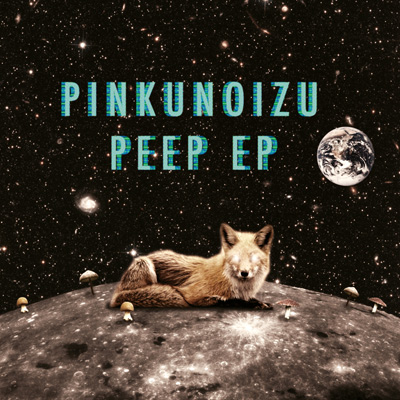
(Artwork care of Karen Ramsay (www.karenramsay.com), profile photo care of brianlackeyphotography.com)

Monday, October 24, 2011

CD review - Pinkunoizu, Peep (2011)

More dreamlike than dreamy...how did I get here?

Pinkunoizu's EP, Peep, is not so much dreamy as dreamlike. The band manages to create and capture the sense of a free ranging subconsciousness throughout the course of the EP. Like any night's dreamscapes, Peep doesn't start out that strangely.

The fade-in intro of Time Is Like a Melody suggests a thousand other dreamy pop bands. The drifting vibe blends bubbling synths, washes, and a simple guitar strum. As the song finds its structure, this is where other dream pop bands would settle into the groove. But Pinkunoizu takes it further. Swirling around, they build a rich rhythmic complexity as the tune circles. Jarring shards of guitar are just as welcome as water drop kalimba tones.

These looping layers jumble together. When the song fades down into an a capella finish, the vocal stratas maintain the interwoven rhythms of the main song. A little outside the box for dream pop, Time Is a Melody serves as the first step down into dreamland.

The second track, Everything is Broken or Stolen, takes us further afield. It establishes a poly-rythmic groove as initial passing sounds give way to a meandering synth melody. There's a great moment where the trippy music drops out briefly to accent the beginning of the detached and disconnected vocal.

Soon, though, the song falls back into an instrumental exploration that starts collecting unrelated sounds over the main groove. After a number of twists, a new set of repetitive vocals comes in. It seems unclear how we've arrived here, but, as in a dream, we accept it. The theme mutates and is slowly overtaken by the earlier meandering keyboard line. Eventually, the track settles back into polyrythm before collapsing into a strange clockwork finish.

Now that we're deeply anchored in sleep, Pinkunoizu lays out the strangest track. Dairy Queen's ominous start -- a tone and a tolling beat -- sets up a feeling of powerlessness. Sounding like parts of The Wall, the song moves forward. But it opens up and shifts into a more reflective mood before dissolving into surrealism.

This is where Peep crosses into the seemingly random logic of dreamspace. Like the slow unwinding of the subconscious, the flow is not so clear. One moment slides into the next, but cause and effect seem suspended. This surrealistic meltdown proceeds until, out of the void, an element emerges.

The classic Irish folk song, Red is the Rose, provides a touchstone for this dream to latch onto like a lifeline. The melody becomes an organizing motif as the track becomes more song-like. As the psychedelic jam extends the theme, it's hard to remember just how we got here.

The end of the song is a confused awakening, The tatters of the last 22 and a half minutes slip through the fingers and any summary is elusive.

Friday, October 21, 2011

Essay: Musical feng shui

Whether you believe in feng shui or not, it's a useful concept to apply a set of rules to bring things into balance. Things like the balance of parts within a song, the flow of songs in a setlist or album, or even the emergent collective arising from the members of a band -- all of these can fit together or fall apart. Like feng shui may be used to improve an environment, I believe there are tools that can be applied to making better music.

Feng shui relies on a few basic ideas such as energy, polarity, and direction. In the musical setting, energy can be anything from an attitude (of a song or player) to tempo or dynamics. Polarity provides context for that energy: loud or soft? structured or chaotic? passive or aggressive? Finally, direction adds an element of relativity -- going from here to there -- that creates flow.

Just as feng shui builds rules upon these foundation concepts, we can invent rules for our musical world. One of the core rules I've internalized is cooperation and contrast. I came to understand this with my reggae band, Cool Runnings. There were seven of us playing and we each needed to create our place in the song.

Cooperation comes first: what can I play that fits together with another part to support it? This could be matching a rhythm or echoing a melodic line. By supporting another musical element, it validates my part. But cooperation is not enough. Without contrast, my duplication is pointless because it can't be heard. I need to add an element of contrast that justifies my part and helps create complexity. So, if I echo a melodic line, I can expand upon it. At a higher level, if everything else in the song is pure harmony or strongly structured, it might be appropriate to contrast that with controlled discord or a little chaos.

Another rule is to work for dynamic balance. A situation that shifts but holds together is more interesting for the players and for the audience. A static balance can be challenging to achieve, but ultimately it's less interesting because it can't offer the novelty that arises from disparate parts coming together without settling into predictable ruts.

This rule pushes me into band and jam situations, because it's harder to create a dynamic balance alone. Playing with other musicians not only forces me outside my comfort zone to become a better player, it also creates another musical context to display my playing in a new light.

The power of dynamic balance can be seen when comparing solo artists with the bands they arose from. A single solo album may be great, but the lone player doesn't often hit the heights they reached in their band. The Beatles' post-breakup work serves as a great example. A richly artistic solo career is often dependent on the musician partnering with the right people to maintain that dynamic balance. So, David Bowie has collaborated with Mick Ronson and Brian Eno. Likewise, Peter Gabriel has worked with a variety of strong producers like Bob Ezrin, Robert Fripp, and Daniel Lanois, as well as iconic musicians like Tony Levin.

Other rules I've used include dedication to the groove, which is about following flow rather than driving it, and swapping figure and ground as a technique for emphasizing elements with low dynamics. But like feng shui, the challenge isn't learning the rules, it's figuring out how to apply them.

Wednesday, October 19, 2011

CD review - Hugh Laurie, Let Them Talk (2011)

"House" shares his musical true love

I became a Hugh Laurie fan through British comedy. Even though his occasional musical numbers during A Bit of Fry and Laurie showed off his talent, his wit was always central. Part of the pleasure of watching Laurie in House is the cognitive dissonance of seeing him play a dramatic American, but this probably laid the groundwork to appreciate his work on Let Them Talk.

Rootsy tribute albums like Let Them Talk succeed or fail on the abilities of the artist. John Doe and Sadies' Country Club showed their love of classic country and they had the skill to sell the songs and give them relevance. On the other hand, Elvis Costello's attempt, Almost Blue, largely missed the mark. Hugh Laurie takes his shot at classic blues and jazz and largely succeeds, in part because of the solid musical help he brought along to the project.

As St. James Infirmary started with a solo piano, it seemed like a repositioning of the tune, especially when the cadenza built into a heavy weight, almost classical treatment. Laurie shifted to a straighter bluesy piano style, though and worked his way through the changes. The arrangement turned out impressively. The song runs through as an instrumental, taking it to conclusion. Then, the walking bass rises from fading piano to start the song over again, this time as a moodier jazz arrangement with vocals. The shift to a fuller sound -- horns, slide guitar, etc - supports the vocals nicely.

Laurie's voice is the only weak link. He holds a tune fairly well, but his vocals are strained and a little tight. With Fry and Laurie, he'd often affect a singing style to match the song and that sense of affectation permeates Let Them Talk. When guest singers step in, like Dr. John on After You're Gone, there's a fluidity that Laurie misses. That said, his love of the material shines through the project and his playing is superb.

One of my favorite tracks was the Professor Longhair classic, Tipitina. Laurie's piano intro is has some tasteful fills, but the song hits its stride when the funky groove gets underway. The instrument arrangement is loose, allowing for a mix of interaction between the players in the midst of the bluesy, New Orleans style chaos. Laurie's vocals are more relaxed here than some of the other tracks and the emphasis is more on the music anyway.

Another pleasant surprise was Tom Jones' soulful singing on Baby, Please Make a Change. Powerful and emotional, Jones' testifies over the gaunt arrangement. A mournful fiddle vies with a clarinet and slide guitar for "best solo" bragging rights. The shuffle picks up tempo to drive the song to its righteous conclusion. Amen.

Let Them Talk meshes nicely with Hugh Laurie's recent Great Performances appearance on PBS. In addition to sharing music from the album and some live sets, Laurie had the chance to talk about his discovery of the blues. The show and the album demonstrate the passion he brings to this music.

Sunday, October 16, 2011

Concert review - Cymbals Eat Guitars with Hooray For Earth, A Mouthful of Thunder

15 October 2011 (Hi-Dive, Denver CO)

Cymbals Eat Guitars played the Hi-Dive a year and a half ago. At the time, I was amazed by their stage energy compared their album, Why There Are Mountains. Now they're making the rounds again after their latest release, Lenses Alien. Their touring support act, Hooray For Earth was a good fit with CEG's live sound. Local openers, A Mouthful of Thunder had a more mainstream indie rock sound, but they certainly did their part to warm up the crowd.

A Mouthful of Thunder
A Mouthful of Thunder's indie rock set led off with an earnest, poppy sound. Stephen Till worked hard to show how invested he is in his lyrics, keeping his focus turned inward. The band was tight, sticking together through all song shifts. In particular, their dynamic changes were a treat as they could create a stripped down sound to fit the earnest mood of the vocals; then they could slowly build that up into a thick, more aggressive vibe.

The bass player's harmony vocals filled out the vocal range and balanced well with some of Till's plaintive singing. I wish I knew his name, because he brought a great attitude to the stage. While all of the guys were very competent musicians, the bass player's spontaneous smiles and engagement injected some much needed personality to the act.

Till did a fine job of singing, often bringing a dreamy quality to the songs. I also liked their guitar player. He had a stiff, awkward stage presence, looking a bit like Clark Kent, but his solos and fills were precise and interesting.

The most interesting song of the set was centered on percussion. The guitar player took over the keys and the keyboard player switched to a standing tom. He and the drummer set up a call and response that anchored the song. Trading rhythmic lines and paradiddles, their foundation supported a folky indie rock groove with moody keys and then propelled the song into a more intense space.

Hooray For Earth
Kicking off with a synth driven electro pop sound, Hooray for Earth quickly added enough grind to sabotage any thoughts of dreamy bounce. Instead, the sound thickened with heavy overtones that bordered on mind control.

Just like the synth pop start that seemed like a feint, the group's appearance was deceiving, too. A typical indie rock line up: guitar and drums and one guy pulling double duty on bass and keys. But the sound was anything but typical. First of all, the guitar was much more synth-like, using an octaver, harmonizer, and sampling to build brain burrowing synth textures. The vocals are also heavily processed with the harmonizer. Together, they show a lot of Adrian Belew influence, especially some of the heavier King Crimson work.

This was tempered by Peter Gabriel style world-beat drumming. Emphasizing the kick drum over toms or snare, the beats melded with the ringing musical noise to create a hypnotic trance effect. With synth melting into looped guitar feedback or octaved guitar adding its own bass, Hooray for Earth had a surprisingly huge sound for a mere three piece band.

Despite the volume that treated my ear plugs with contempt, the effect of all this loud noise was not a cacophony. Instead, it channeled a cathartic intensity like an effective rolfing session. At the end of the set, I was drained, but satisfied.

Cymbals Eat Guitars
Cymbals Eat Guitars started off the set with Indiana from Why There Are Mountains. Where the album version builds an anticipatory cloud of sound to launch the dreamy vocal start, the live version developed more slowly. A scattering of opening guitar notes was overcome by a wave of discordant keyboard angst. Swells of sound rose and fell for a good minute and a half before Joe D'Agostino started the vocals, letting the mood fully permeate. The texture of sound and longing in those first words touched me just like Trail of Dead.

They followed this up with an emotionally raw version of Plainclothes. D'Agostino's face locked tight as he forced the vocals out. Where Hooray for Earth built a thick wall of sound, CEG laid out a shimmery curtain of sparkling elements. Subtle tones resonated and echoed, acting as a conduit to transfer the band's intensity to the audience.

It was easy to focus on D'Agostino as he twisted and spastically jerked, then held himself tight to squeeze out more lyrics. But the rest of the band each contribute their necessary elements, whether it's Matt Whipple's melodic bass work, Brian Hamilton's noise manipulation behind the keys, or Matthew Miller's tight dynamic control on drums. D'Agostino and his songs are the centerpiece, but they wouldn't work without the well organized work of the the others.

As noisy and overwhelming that CEG's sound could get, it was always a controlled chaos. Mission critical to the songs and the mood, the band would demonstrate this when they dropped the dynamics to give focus to a particular section or lyric. That intensity is like splicing high tension wires. After a full hour's set, Cymbals Eat Guitars left the stage, drained but triumphant.


More photos on my Flickr.