(Artwork care of Karen Ramsay (www.karenramsay.com), profile photo care of brianlackeyphotography.com)

Monday, September 26, 2011

Concert review - Me and Heath

25 September 2011 (Hodi's Half Note, Ft. Collins CO)

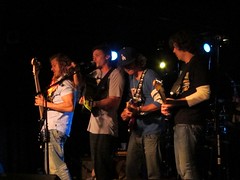
Man, it must be awesome to be a rock star. Cruise into town with your crew, hang out at bars, and lay out some tunes for the adoring fans...earning big bucks along the way. Pretty much everybody who's ever toured is laughing cynically at this point. The guys in Me & Heath know the reality of cancelled gigs, long drives, odd venues, and small audiences. Sunday night at Hodi's Half Note was lightly attended, but that didn't keep the band from making the most of it and playing a couple of great sets.
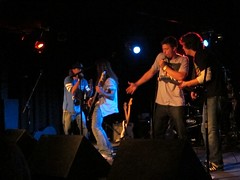
It helped that they pulled some enthusiastic hometown fans. Front man TJ and guitarist Heath are both from Greeley. They moved out to Los Angeles, where they connected with the rest of the band. This tour through Loveland, Ft. Collins, and Denver is the first time they've made it back to Colorado in a few years. The band seemed happy to reconnect with old fans and meet some new ones. The show had good energy and the band spent most of their breaks out with the crowd.
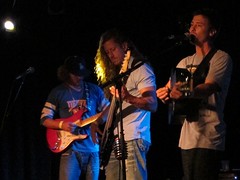
With no opening act, Me & Heath played two full sets before wrapping up a little after midnight. Their music blended a number genres: laid back funky beats, soulful singing, strong indie rock grooves, and a little bit of rapping. With the exception of a small set of crowd pleaser covers, they focused on their original music, including the songs from their EP, 3X a Charm.
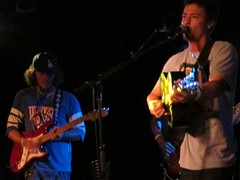
L.A. is a tough music scene and Me & Heath showed the kind of polish a band needs to compete there. TJ had a riveting stage personality as he played acoustic guitar and provided most of the vocals. He was in constant motion as he mugged for the crowd or threw himself fully into each song. His voice was a key part of their sound, with a touch of Michael Jackson soul and G. Love's funk. At the same time, his playing anchored the three guitar line up. He and Heath setup counter rhythm strums while Jaxon laid down lead. Other times, he let Heath and Jaxon both stretch out. Between songs, TJ came across as a class clown, generally keeping the mood light.
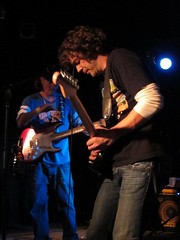
The rest of the band didn't surrender the stage to TJ, though. In particular, Jaxon's easy going banter meshed well with TJ and his lead work was solid with a little flash. The bass player, Nick, contrasted with other guys with his hair metal look and high attitude rock posing. But it added to the show and his bass playing was very strong, both up front on Wise Crack or supporting on Call Me Out. Aside from playing guitar, Heath laid down the occasional rap vocal. He had good flow and I'd like to hear them slip more of that into their mix.
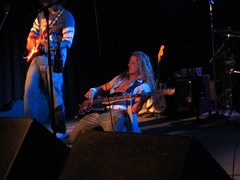
Me and Heath had a sound that evoked Maroon 5, Dave Matthews Band, and even a bit of older Red Hot Chili Peppers, but the vocals were more rooted in the kind of tightly controlled, tense Michael Jackson soul. With a touch of rap to update the vibe, it was a good sound with enough room to fill out the two sets without getting stale.


More photos on my Flickr.

Friday, September 23, 2011

CD review - Opeth, Heritage (2011)

Opeth rejects metal roots for prog rock exploration

Opeth frontman Mikael Ã…kerfeldt has spoken about his mindset leading into Heritage: I don't think I could have written another metal Opeth record right now. I was done. I had saturated that style. With Watershed and Ghost Reveries, (it) was as good as it gets in that style. It was time to move on. And the new album has proven to be challenging to hardcore Opeth fans.

Heritage
is much more keyboard focused than their earlier work and the music seems rooted in retro prog rock/art rock. While many of the songs retain the signature harmonic tension of classic Opeth, the death metal growled vocals are gone. These changes force the listener to decide whether to contrast it with "classic" Opeth or to judge the album on its own terms. While it's not a cultural touchstone like Dylan going electric, Heritage has proven to be Opeth's most polarizing release.

The album opens with the title cut, Heritage. It's a moody piano-centered piece that explores a simple melody. Understated and jazzy, it unwinds slowly, creating a thoughtful reverie. The progression features a nice pause that adds a touch of tension. When it comes around at 1:24, the song just hangs in space, defying gravity. It's a beautiful moment that sets the tone for the rest of the album.

Fitting with the dynamics of the album, Opeth follows this soft moment with something edgier. Rather than diving into metal, though, The Devil's Orchard is anchored in an early King Crimson sound. Steven Wilson's production work shows that he's been immersed in King Crimson's back catalog. The winding riffage and rhythmic drive set off a theatrical vocal. The opening section settles into a dynamic shift into a spooky instrumental segment. Where the older Opeth material would have focused on guitar, the keyboard shines instead. There are still plenty of guitar textures, but they're in a supporting role.

The rest of the album has plenty of interesting explorations, some of which click like I Feel the Dark's journey from thoughtful trippiness to harder edged post rock (some strong Camel moments). Others are less successful, like Famine's sound sculpture start that evolves into a series of shifts. This latter is promising, but the sections don't coalesce. The ambient start is overtaken by a rising percussion that sets a groove, but then the groove is abandoned for a tentative piano line. This in turn is overtaken by a frantic guitar riff that sets up a driving progressive rock groove reminiscent of Yes or Styx. The song continues to run through other changes before returning to the opening sound sculpture sound. Many of the parts sound interesting alone or even in contrast to another section, but the collection feels haphazard and unplanned.

Even if Heritage overreaches, Opeth should be commended for taking the risky step away from everyone's expectations. On it's own terms, the album largely succeeds. I'll leave it to the fanboys to argue about how Heritage fits into Opeth's larger body of work. I'll raise a goblet of smoky chipotle mead in their honor, though.

Monday, September 19, 2011

CD review - Various Artists, Reggae's Gone Country (2011)

Reggae covers classic country but plays it safe

Crazy cross-genre mashups used to be surprising, but now they're common. From Shockabilly covering Thelonious Monk on That's the Way I Feel Now to Pickin' on Led Zeppelin's bluegrass version of classic rock, almost everything's been done before. We're becoming so jaded that it's getting harder to even make an impression.

On the surface, Reggae's Gone Country looks like another novelty attempt to shock the public. Modern Jamaican singers covering classic country hits? Why not, we've had reggae-fied Radiohead. Despite seeming like a gimmick, this album is rooted in an enthusiastic vision. Cristy Barber, Vice President of Marketing and Promotions at VP Records, championed this idea to bridge two of her favorite musical worlds: the country music she grew up with and the reggae vibe she's immersed in with her record label.

The label makes their pitch that it's not as strange a match as it sounds. Both genres are rooted in regular people making a voice for their experience and the songs can range from relationships and loss to spiritual devotion. Additionally, country music is fairly popular in Jamaica, so the songs were already familiar to many of the artists. Barber, along with John Rich (Big & Rich), laid out a strategy: select the set of classic country songs, pair them up with modern reggae singers, lay down a solid backing track with a "dream team reggae band", and then add a veneer of country sound to sweeten the tracks.

For the most part the songs qualify as country classics, although I would have traded out the Statler Brothers' Flowers on the Wall for Hank Williams Sr. or Johnny Cash. Still, it's a solid starting point. I wasn't familiar with the reggae singers that Barber selected, but it seemed like a nice range of vocal styles.

Some of the songs, like George Strait's The Chair or Crazy naturally slipped into a reggae beat. Maybe it's because the cut time country beat is not so far from a chank. While that is part of the vision behind the album, those songs didn't stand out as strong new interpretations.

By contrast, Duane Stephenson's work on Eddie Rabbit's Suspicians emphasized the R&B feel of the song. The lazy groove has a loose jamming feel and Stephenson's phrasing is soulful. He occasionally uses falsetto to push the tune. Luciano's take on Jim Reeve's He'll Have to Go is another of the more interesting songs. Luciano's rich warm voice is smoother and cheerier than Reeve's deep baritone, but the looser delivery suits the song. The reggae arrangement stands out more strongly on this track, too.

It's clear, though, that Barber and the singers she's selected are too respectful of these classics to push any boundaries. This means that the songs are solid, but fairly predictable. Another weakness was the decision to paste in the pedal steel, fiddle, and banjo parts. Adding the country embellishments softened any impact of the reggae reimagining of the songs. For example, the steel and fiddle on He Stopped Loving Her Today pulled the song firmly back into country despite the chank beat. It's still a good song, just less interesting than it could have been.

Country fans will find plenty of touchstone moments to enjoy. Reggae fans might be disappointed that the reggae vibe wasn't given a freer hand.Link

Thursday, September 15, 2011

CD review - David Bromberg, Use Me (2011)

Friends help a classic player show his range

David Bromberg is one of America's greatest secret guitarists. While he hasn't achieved public superstardom, Bromberg is well known among blues/bluegrass aficionados and his fellow musicians. Comfortable on guitar, fiddle, mandolin, and steel guitar, he has been a prolific session player for a wide variety of players since the '60s. Musically, he's most rooted in the blues and American folk traditions, but these never box him in.

I've been a huge fan ever since I discovered his first album (David Bromberg) which included a collaboration with George Harrison (The Holdup). His playing and vocal phrasing enthralled me and he became one of my big influences on both guitar and singing. Use Me is Bromberg's latest album and it shows both how far and how short a distance he's come over the last four decades.

It's been a short trip, because his roots as a session side man are in full display and, like those recording sessions, the song always comes first for Bromberg. His playing has always been top notch and that continues on Use Me. At the same time, he's matured like a fine wine over the years, as he's developed the voice to rise above his well-spring genres. This makes him better at bridging the gap between traditional folk, blues, and country.

Beyond naming the album after the Bill Withers tune he covers, the conceit behind Use Me is that Bromberg partnered with a number of his friends, asking them to "use him". Each artist flavored a track within their own aesthetic, inviting Bromberg to step in and add his seasoning. The line up of famous performers is impressive: Levon Helm (the Band), John Hiatt, bluegrass master Tim O'Brien, Dr. John, Keb' Mo', Los Lobos, Widespread Panic, Linda Ronstadt, Vince Gill, and producers the Butcher Brothers (Phil and Joe Nicolo).

The range of styles from blues to funk to traditional folk give the album an eclectic feel, but together they form a mosaic of David Bromberg's work. Whether it's the Mexican folk waltz of The Long Goodbye or the funky groove of Old Neighborhood, each song offers a perspective on his playing. Old Neighborhood was particularly interesting as Bromberg trades licks with Jimmy Herring and Widespread Panic. Hearing him fit into the interplay of a jam band was a joy.

Bromberg's playing is always tasteful above all else. The bluesy country of Ride Out a Ways, with John Hiatt, shows off a perfect touch. Hiatt's playing is solid and hearing the guitar float above the blanket of organ creates a churchy moment. Bromberg's voice is weary but strong. I love his phrasing, as he can loosen up and drag out the lyrics, then slip in a tight package of words a couple of lines later. Elvis Costello has some similar tricks, but he never makes it sound as effortless as Bromberg.

Despite its moody funk, Dr. John's track, You Don't Wanna Make Me Mad has a loose feel. It's a great NOLA-inspired groove. The laid back bass and syncopated percussion drive the song with Bromberg's wicked slide guitar and Dr. John's piano filling out the sound. Bromberg's vocals are casual and he tosses off some great asides: "Everybody needs a little bit of space every now and then. And this is my now and this is my then." It's interesting to compare how Dr. John might have sung this to Bromberg's performance. Bromberg exaggerates the attitude, giving it a touch of humor.

By contrast, the track with Keb' Mo', Digging in the Deep Blue Sea, is dark and heavy. The looming bass and drums build a down and dirty framework, while the keyboards and guitar fill out the structure. Spooky keyboard swells flash from side to side, fine-tuning the tension. The reflective solo is less a centerpiece than an interlude in the song. The lyrics seem inspired by the BP oil spill, but look to the bigger picture of oil dependency. Never getting strident, the conflict is clear:
What are we gonna do about all the mess we made?
You can't run an 18-wheeler, child, on lemonade
David Bromberg is a timeless artist. Use Me's mix of older artists like Helm and Ronstadt with younger players like Keb' Mo' and Widespread Panic demonstrates the reach of Bromberg's career. Whether you're familiar with him or not, Use Me is a worthwhile new step in Bromberg's path.