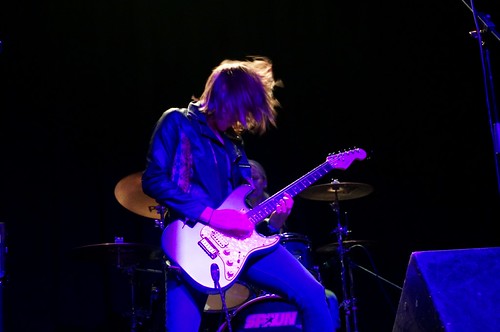
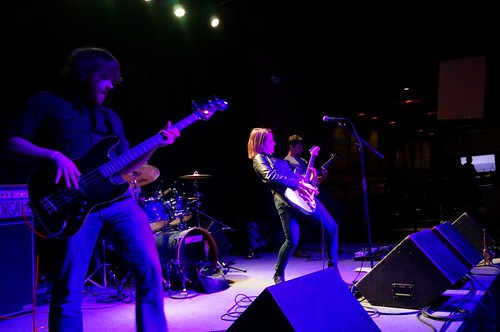
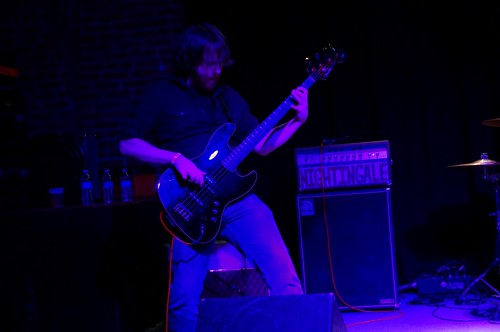
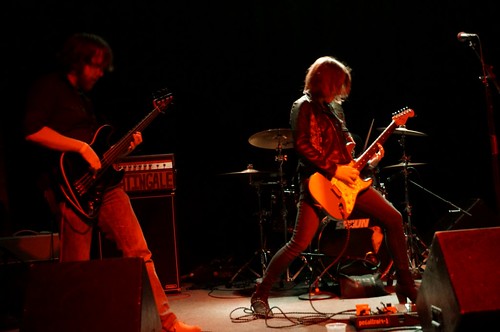
(Artwork care of Karen Ramsay (www.karenramsay.com), profile photo care of brianlackeyphotography.com)
Showing posts with label post-rock. Show all posts

Wednesday, August 12, 2015

Recording review - The Fierce and the Dead, Magnet

The total package of physical and mental gymnastics

4.0/5.0

One of the things I love about Matt Steven's music is that he doesn't just alternate between visceral guitar expression and intellectually satisfying geometric balance. Instead, he blends them together into a spicy melange that milks excitement and intensity from that dichotomy. Even in a short 1:41 piece like "Magnet in Your Face", he can find the space to surprise. That tune jump starts The Fierce and the Dead’s Magnet EP with a furious assault of thick, head-banging guitar. The simple thrashy vamp sinks straight into your reptile brain like some kind of insistent, metal-flaked drug. While the rhythm obsessively circles this compelling focal point, the lead comes in and prods the song forward with an angular pentatonic line. The song is a third of the way into its brief run and if it were any other band, that Neanderthal DNA would make the song as predictable as a simple mathematical series. Sure enough, the one-two of the opening leads to the obvious three of a slightly introspective bridge, but then that bridge melts away, leaving a clean, disarming interlude that suggests fractal reflections with a playful bounce. While the tune does settle back into the adrenal punch of the main riff, that post-rock side trip colors the rest of the song. It makes you wonder how far afield the band would take it if they gave themselves the luxury of five or six minutes to develop it further.

The following track, ''Palm Trees", takes the opposite tack, starting with a crystalline guitar that feels like a Cubist sketch: a static scene visualized from different angles. But Kevin Feazy's throbbing bass joins in and triggers more rambunctious play. Relatively soon, though, the two approaches reach a detente of coexistence , each complementing the other. The song still has some tricks though, with a final Gothic crescendo that collapses into the chaotic echoes of a hornets nest.

Magnet gets off to a strong start with these two new pieces, but the band also mixes in a retrospective set of tunes. Two of these are rehearsal recordings of songs from their last release, Spooky Action (review): "Let's Start a Cult" and the title track. It's not immediately clear whether these were demos or if the band was working out how to perform them live. I'd guess the latter because the arrangements seem fairly clearly planned out. Neither of these enjoy the sweet production of the album versions, but the Stuart Marshall's drumming is expressive and vibrant, and each gives a sense of how TFatD's songs are built from sections to form a coherent whole.

They round out the reissued tunes with a version of "Flint", originally from 2011's If It Carries on Like This We Are Moving to Morecambe (review). This take is more focused, dropping the original's extended space echo intro. Without that trippy start or the edgier production choices, Magnet's version shifts the perspective from a tentative search for solid ground that grows in confidence to one that starts with a clearer sense of self-possession and hidden resources. That feels right because it reflects how much TFatD have evolved.

EPs are usually stopgap moves to tide fans over between meatier releases, seldom turning out to be essential listening, but between the solid new material and the revisited songs, Magnet is a good snapshot of TFatD's development as well as their enduring talent. They cram a lot into 20 minutes and it's a treat to bask in that yin yang of delicate crunch, of distorted introspection, of The Fierce and the Dead.

Magnet is available from the group's Bandcamp page.

Thursday, June 11, 2015

Recording review - Steven Wilson, Hand. Cannot. Erase. (2015)

Music vs. narrative: take your pick

3.5/5.0


Context is often the key to appreciation. I prefer to approach new music with as little baggage as possible, so I came to Steven Wilson's Hand. Cannot. Erase. as a blank slate, ready to see where it led me. His music usually has an ambiance that is best experienced without any preconceived notions. This time, though, I had a hard time getting a grasp on the album; I couldn't find the context. The bigger, more progressive moments were beautiful and moving, but the first two tracks seemed emblematic of the project as a whole. There was a discontinuity between the slow fade-in amorphousness of the first piece and the dynamic expansion of the song that followed.

Normally, Wilson helps his listeners keep that tabula rasa mindset by offering little commentary about his music. Even though he isn't too fond of putting his work under a microscope, this time he’s had several interviews where he’s discussed the story of Joyce Carol Vincent that inspired Hand. Cannot. Erase. She was a young woman who dropped away from her friends and family sometime around 2000. What made this newsworthy is that she died in her London apartment in 2003, but her body wasn't discovered until 2006. Wilson came across the documentary/drama, Dreams of a Life and found both the movie and the real story compelling.

It's a good starting point for a concept album: aside from the poignant ending, there's a fundamental mystery that gives an artist room to speculate and expand upon. Fittingly, the songs on Hand. Cannot. Erase. are fairly indirect, offering their own oblique signals as they outline the woman's gradual abdication from her community, punctuated by kernels of loss and pain. Wilson doesn’t tie himself to the details, but steps into his own parallel narrative. For example, his ending expands on a minor factual detail to suggest a final hope for reconnection that comes too late. With a freer hand, he positions his character at the center of a self-imposed conflict. The songs are full of ambivalence, sometimes repurposing or reframing the same words to offer cross meanings. The music is similarly hard to pin down. Sparse simplicity lurches into stormy surges of emotion, and electronic elements are juxtaposed against warm analog instruments.

Knowing the inspiration clarifies things a bit, but ultimately, it’s not quite enough.The larger musical gestures like “Ancestral” fall outside the project's conceptual arc because their scale dwarfs the delicacy of the story. It’s a tough trap for Wilson to avoid. The indirect approach lets him leave room for interpretation, but that subtlety can't compete with the scope of his musical expressiveness. If that’s the downside, the upside is that he is continuing his creative growth and expanding his palette by integrating more sampling and electronic sounds as well as bringing in a female singer, Ninet Tayeb, to represent his lead character.

The album starts slow and thoughtful, but the second, longer track, “Three Years Older”, picks up the pace with the energy of The Who spliced with flashes of Rush. The instrumental section spins out for a solid three minutes before the first words come in. The song is effectively an overture prologue that sets the stage for the album’s story. Wilson sings with a gentle sympathy, sketching out a chain of disengagement that, by the end, suggests a suicidal solution. Once the vocals are out of the way, the remaining three minutes launch into a series of diverse themes that range from pensive introspection to a frantic King Crimson style break. These sections try to bridge the polar ends of his character’s solitude and her seething social anxiety.

The music is a good reflection of Wilson’s usual style, and the.loneliness is clear, but the roiling emotion feels out of proportion. Later, “Home Invasion” and “Ancestral” will evoke a similar reaction: the music is among his strongest writing, but they seem tied to his own perspective rather than relating to the tale he’s trying to tell. Despite the tenuous connection to the album’s narrative arc, “Ancestral” turned out to be my favorite track on Hand. Cannot. Erase. The rich textures swing through extremes, from the sparse beat and brooding guitar at the start, accented by a jazzy flute, to the fluid, expressive post-rock shred on the solo. A mix of old and contemporary influences adds to the melange, creating a blend of Radiohead with Gentle Giant.

Even if the album has trouble balancing its song arrangements with the narrative, Wilson has done a good job of echoing the unknowns of Vincent’s life with lyrics that hinge on ambiguity. On the title track, “Hand cannot erase this love,” is an assertion of connectedness, but there’s also an undertone of co-dependence and a hint of domestic violence. On “Transience”, the line, “It’s only the start” initially seems optimistic, but then it turns around to represent the dark fate that’s coming. If there’s a moral here at all, it’s tied to how we should understand Vincent’s life choices. There’s a fundamental paradox: it seems she chose this path as a coping mechanism in reaction to social pressure and disappointment, but ultimately it led to her destruction as she faded from life and memory.

Wilson succeeds at using the bare bones of Vincent’s story to explore the nuances of this conflict. At the same time, his music writing and performance are as strong as ever. I just wish I didn’t have to pick between the two when I listen to Hand. Cannot. Erase.

Saturday, November 8, 2014

Recording review - Megafauna, Maximalist (2014)

Languid vocals and razor-edged guitar in a powerhouse setting

Calm, slowly evolving musical mantras and crisp, fractal reflections: the minimalist music of Steve Reich and Philip Glass seeks transcendence rooted in an intellectual purity. From the urgently thrashing opening moments of the lead-off track, “Eggs”, Megafauna stakes out an antithetical position on Maximalist. The band rejects measured movement and icy clarity for a visceral punch and a swirling confusion of moods. They draw on a jumble of inspirations: the classic hard rock guitar of Led Zeppelin and Deep Purple crosses swords with progressive complexity reminiscent of Trail of Dead and El Ten Eleven, while the vocals waver between Björk’s breathy oddness and Amanda Palmer’s theatrical insistence. Bandleader Dani Neff also has a rich tonal range that recalls Annie Haslam’s work with Renaissance. Her versatile voice is adept at veering from soft vulnerability to no-nonsense sternness. Regardless of whether she’s preserving her distance or coming on ragged and strong, Neff has a sweet girlish tone, but there’s nothing dreamy or vague about her guitar playing. This creates a delicious contrast between her languid vocals and razor-edged guitar work. Those hard rock riffs anchor the tunes and show off both her technical chops and how she controls the mood with dynamic shifts.

The songwriting on Maximalist is also top-notch. The tracks mutate and twist in interesting directions, rising above their initial perspectives. Take a tune like “Precious Blood”. It starts with a lazy, descending guitar line that paints a sense of midnight ruminations. The echoes on Neff’s voice become ghostly whispers to accompany her through the darkness. As she sings the line, “We are still waiting/ For something big,” it foreshadows the sharp punch of ringing guitar that follows. Driving power chords set up the next transition to a Black Sabbath inspired bit of flaming metallic melody. As this climbs into a heavier version of the chorus, it’s hard to recall the haunting feel at the start, but Megafauna flawlessly negotiates the dynamic drop to take us back there, this time ratcheting up the pressure. Neff’s solo is an evocative bit of shred that embodies a fight against inertia and an inevitable end. “Precious Blood” is a treat, not just for the balance between soft and loud, pensive steps and headlong rush, but also for the way Megafauna works together to encapsulate those swings into a narrative flow.

As front and center as Neff is to Megafauna’s sound, she couldn’t pull this off without the strong support she gets from her rhythm section. Like all power trios, they walk a fine line between backing the song and stepping forward to fill it out so the guitar can break loose. Greg Yancey’s bass lines fall into unison with Neff’s riffs to lock them into the pocket, but he also brings a thick thundering tone that stands in for rhythm guitar when that’s necessary. Zack Humphrey’s drumming is phenomenal. He’s fairly busy, with lots of syncopation and fills, rarely dropping into straight time. But where a lot of flash drummers lack an appreciation of nuance, Humphrey’s ear is impeccable and he can maintain the energy as he drops back to leave enough space for the vocals to step up.

Retro hard rock and metal form the foundation of Maximalist’s spirit -- listen to the “Immigrant Song” vibe on “Hug From a Robot” -- but their progressive side opens up many of these pieces for wider explorations and stranger sonic palettes. From the desperate angular guitar of “Haunted Factory” to the rich post-rock dissonance on “Chromatic Fantasy”, Megafauna expands well beyond mere head banging and impressive shred without slipping into self-indulgence. Maximalist lives up to its name, incorporating these wild musical gestures to create a bridging world where fans from all over can find something to love.

As an added treat, here's the video for the earlier release of "Precious Blood" on 2012's Surreal Estate:

Tuesday, September 23, 2014

Recording review - Cymbals Eat Guitars, LOSE (2014)

Growing up is serious work

Cymbals Eat Guitars filled their 2009 debut Why There Are Mountains with a tangled jumble of musical interests. Despite the roller coaster ride, the album worked, maybe because of how the shorter tunes broke up the more sweeping tracks. Since then, the band has tried to tame their urge to run off in a hundred different directions and LOSE generally provides something closer to pop structure than they’ve managed before. That said, the opening track, “Jackson”, is a callback to their debut even as it attempts to reach a wider audience. It’s catchy, with soaring pop vocals, but it also juxtaposes a grab bag of ideas into its sprawling six and a quarter minutes.

Initially, it sounds like a big Trail of Dead setup: a dreamy opening dissolves into a circling wave of loudness. Percussion drives the tension while tiers of guitar infuse it with epic intent. But where Lenses Alien (2011) would have milked that into a full-blown exploration, “Jackson” intentionally lets the power slip away, leaving behind a thoughtful post-punk progression. Frontman Joe D’Agostino sounds calm but strained as he starts, “You’re taking two Klonopin/ So you can quit flippin’ and face our friends.” His voice is a bit ragged, which fits the sense of loss that permeates this whole project. The new wave simplicity of this section is eventually buried under thicker walls of indie pop guitar. He catalogs a headful of experiences with wistful poignancy as his falsetto is backed with guitar jangle, but before it tips into maudlin self-pity, clashing discord reveals the underlying angst with fluttering horns and waves of distortion. The meandering lead jam resurrects the original Trail of Dead feel to close out the piece.

The backstory is that LOSE is effectively D’Agostino’s music therapy for working through his grief of a good friend’s untimely death. Looming larger than that, though, is a more universal theme of growing up. Like the rest of the album, ”Jackson” wrestles with nostalgia, mortality and the painful clarity that comes with adulthood. Some tracks may explicitly refer to D’Agostino’s friend, Benjamin High, but that loss is really just the trigger for trying to make sense of a long overdue post-adolescence. From song to song, the lyrics vary in their degree of obliqueness – Cymbals Eat Guitars have always held their cards close to their chests – but they all circle around random recollections, tales of self and substance abuse and the niggling survivor’s guilt that can kick in as the years pile on and the friends slip away.

If that seems to hit harder than you’re ready for, that’s okay, because the band has worked out the math so that listeners can choose how deeply to immerse themselves. Tease out the words from D’Agostino’s raw vocals or visit the lyrics link on their website and you can soak in all the darkness you can handle. But plenty of the songs juxtapose music that contrasts with the cathartic lines, from the mellow wistfulness of “Child Bride” to the cool Berlin-style new wave pop of “Chambers”. A shallow ear will still catch ominous phrases – “‘Til your dad slapped the living shit out of you,” or “The panic sets in, cause nothing’s happening,” – but it’s easy to surrender to the rhythmic drive and interlocked layers of guitar so they glance off.

It’s hard to pick a favorite track, but it comes down to “Place Names” or “Laramie”. The former is a moody Jane’s Addiction set piece. D’Agostino’s swooping proclamations capture Perry Farrell’s lazy falsetto and the song is filled with shimmering swirls of feedback static. Cymbals Eat Guitars have had this sound in their arsenal since the beginning, but the frayed thread of lyrical logic fills it with sacred poetry and profane pronouncements. “Laramie”, on the other hand, is another nomadic journey across genres, like “Jackson”. It starts with a dreamy glam glory, but manages to blend in a weird post-rock experimentalism. The latter half heads off into other directions, turning from driving rocker to indie acid rock meltdown. Despite the gear-stripping changes, there’s an internal logic that keeps the piece on track.

Cymbals Eat Guitars have come a long way since their debut and LOSE is certainly their strongest release yet. The challenge will come with their next album. Now that they’ve confronted adulthood, will they actually grow up or will they linger in this shadowy twilight? If they do step forward, will they find something interesting and new to say? Based on their growth to date, I’m betting that they will.

(This review first appeared on Spectrum Culture)

Tuesday, July 8, 2014

Recording review - Trans Am, Volume X (2014)

A whirlwind tour with little chance settle into appreciation

If there was ever a band to demonstrate that labels are meaningless, it would be the long-lived but under-the-radar band Trans Am. Wikipedia sticks them under the vague umbrella of post-rock, but their tongue in cheek web site declares their sound as “heavy American electro rock”. Whatever you call them, over the years, they’ve been happy to appropriate elements of just about everything they’ve ever heard: classic rock, electronica, new wave, heavy metal and Krautrock just begin the list. Volume X, their appropriately named 10th release, tries to shoehorn in all of these into a single muddled heap of songs. While the plaid and polka dots juxtaposition is clearly intentional, it’s hard to tackle the album as a coherent whole, even though the individual tracks are pretty good.
Trans Am kicks off with “Anthropocene”, where an ethereal wash of synth heralds in a grinding psychedelic excursion into the middle of some arcane rite. Saw wave guitars set a plodding zombie pace, accented by the band’s trademark savant drum work, full of flourishes and hyperactive fills. Echoed and twisted shreds of keyboard provide a hint of relief to the otherwise oppressive heaviness. It’s a solid start, promising further journeys through heady darkness and brooding obsession. Rather than build on this intensity, they springboard into an unexpected direction. “Reevaluations” lives up to its title, calling the last five and a half minutes into question. Where the previous track trudged through a thick grungy miasma, the one percolates, blending Devo style new wave with Ozric Tentacles space rock. As a standalone piece, the crystalline structure and repressed tension work together to lure the listener in deeper, but in context it’s just a jarring transition. Even though the next couple of tracks gesture towards continuity, with synthesizers and syncopation, they don’t actually mesh either. By the time we persevere through these additional flavors of electronica to reach the fifth track, the band seems afraid that we’re getting complacent. So they decide to reshuffle the deck and dive into a metallic shredfest for “Backflash”, locking into a repetitive fan-blade rhythm vamp. We’re halfway through the tracklist and it feels more like a well-shuffled iPod playlist than a planned series of songs by a single band.

Trans Am’s established fan base may well be used to the short attention span. In any case, they’ll find plenty of familiar elements on Volume X, like the tight drum work, twisted electronics and processed vocals. But it’s hard to imagine the group winning many new converts with this grab bag collection. It’s frustrating, because I can find things to like about most of the multiple personalities they try on and discard on this album. Still, it’s telling that my favorite track is probably the least representative. That should be a high bar to pass, but “Insufficiently Breathless” has little to do with any of the other tunes. Rich flourishes of 12-string acoustic guitar provide a stately canvas for a variety of melodic additions. Where most of Volume X favors unsettled tension if not overtly stressful moods, the album closes out with a gentle psychedelic tip of the hat to short-lived progressive rockers, Captain Beyond. Trans Am does a decent job of referencing more than just the title, falling into the same introspective meandering that their inspiration delighted in.

As pleasant a finish as this is, it still leaves me a bit dazed. Almost any step along this winding path could serve as a jumping off point for a whole record’s worth of creative exploration. By trying to hit them all, Trans Am barely manages to look out their window at the possibilities.


Trans Am - I'll Never from Thrill Jockey Records on Vimeo.

(This review first appeared on Spectrum Culture)

Saturday, June 21, 2014

Concert review - Megafauna, with Instant Empire, Bear., Hillary Hand & the Roseliers

19 June 2014 (Moon Room at Summit Music Hall, Denver CO)
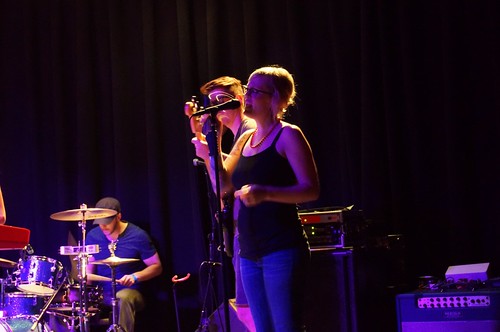
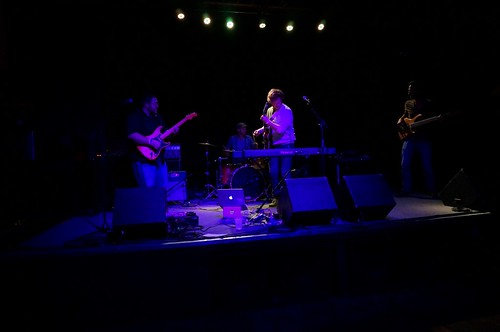
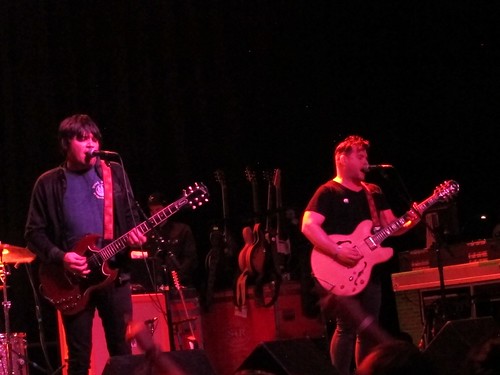
Sometimes, there's no justice. Thursday night in Denver couldn't seem to summon up enough interest to go out and catch some music, so the crowd was disappointingly sparse. That wasn't fair for wait staff or the bands, but all four acts on the bill took it in stride and summoned up their enthusiasm so the lucky few of us there got a full night of energetic and entertaining performances. It's just a shame there weren't more people there to appreciate Megafauna's show along with the three regional bands that opened.

005 Hillary Hand
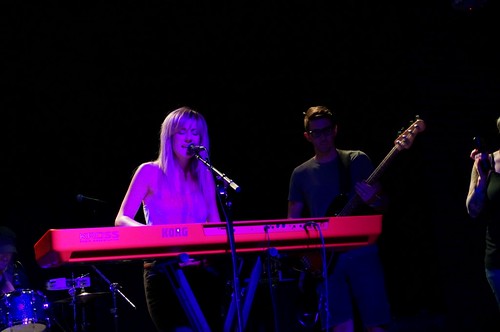
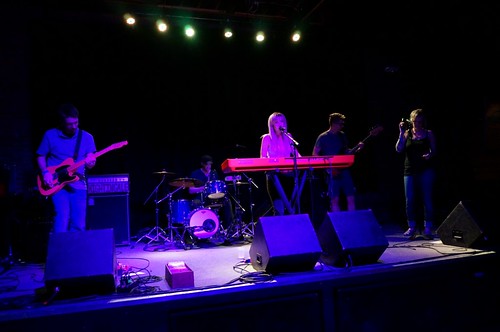
Hillary Hand & the Roseliers from Colorado Springs opened the show. Like most ampersand bands, "somebody & the somethings", the Roseliers provide a showcase for Hillary Hand's songs and voice. That's not an indictment of the band's ability; they were talented set of musicians. But they muted their own personalities and playing so that Hillary Hand was never eclipsed.

011 Hillary Hand
Most of the time, the players seemed caught up in their own parts, although the backup singer, Melinda Hand, did interact a bit with rest of the band and with us. Where the others either checked in with Hillary or stared down at their instruments, Melinda looked around more, smiled, and made eye contact. Unfortunately Hillary came across as fairly shy and a bit nervous, so she didn't command all the attention that she could have.

009 Hillary Hand
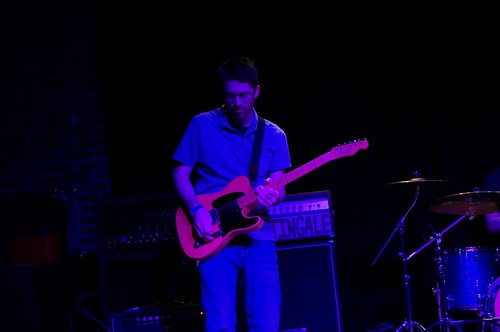
Despite that, she and Roseliers had some very good material, with interesting structures and contrasting soft and loud moments. The tunes varied a bit in style, from a light country feel reminiscent of Emmylou Harris backed by a more modern rock band to dreamy pop songs. Hand had the vocal versatility to follow along, from a subtle twanged folk to ethereal fragility. She also seemed adept at finding a harder edge under the velvet. The guitarist, Joseph Degalia, stood out the most musically, with some nice chops. He had a good ear and a subtle touch, especially on slide. He never upstaged Hand, but his fills added some complexity against her keyboard lines.

007 Hillary Hand
By the end of their set, I appreciated their nuanced style. Then they threw a real curve ball. "Run Like A Rabbit" launched with a synth-pop/electro-pop feel that didn't mesh with their earlier sound. The band was more than competent enough to pull it off, but it was a weird outlier. The rest of the songs had a kind of eclectic continuity, but this felt a bit odd.

020 Bear
If the Roseliers had a handle on soft to loud transitions, Bear. took that a couple of levels further, playing a good set of indie rock that featured plenty of thrashy breaks. Songs would settle into a solid drive, driven by the syncopated drums and punchy bass, but then interludes of cathartic frenzy would erupt as if the band couldn't withhold any longer.

038 Bear
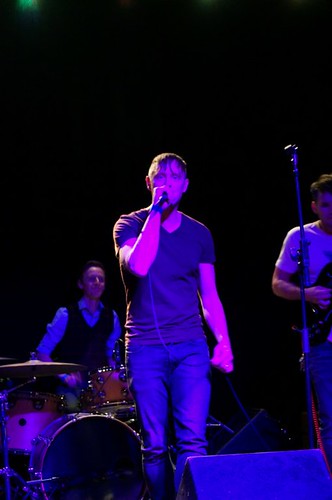
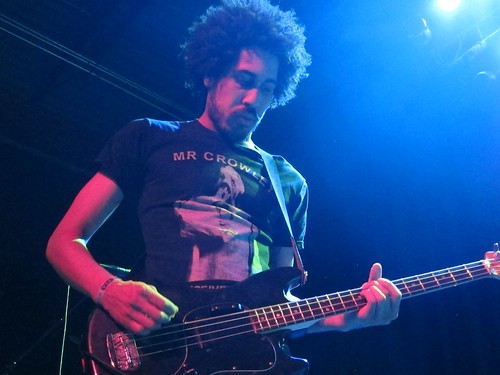
Frontman Will Livingston dominated the stage with a huge personality and big movements. With his unpredictable shifts of persona, he was entertaining like somebody's drunk uncle. He was personable and clearly meant well, but he was mercurial as he surrendered himself to the music and acted out. When he was seriously engaged in the song, he radiated an intensity, but he could flip and be fairly meta and "ironic" too. Livingston spent most of the set on guitar but switched to keys for the last couple of tunes. He flailed around less on keyboards, but he still bounced in his seat.

023 Bear
The second guitarist, Bruce Butler, didn't try to compete with Livingston. He was quiet on stage, but he was an excellent player, laying down some metallic riffage and memorable fills. Bass player Dylan Camacho was also quite focused on his playing, but had a good physical presence with constant movement as he effortlessly held the bottom end. Rather than random motion, though, he favored more choreographed moves.

042 Bear
Most of their songs had a quick hard edge, but they also played a new tune that was poppy and uplifting. At the end of that final song, Livingston thanked us as it seemed to wind down, but then he ran to grab his guitar for the final chord. I'm not sure if this was a stunt or reaction to the sound problems he had had with his keyboard, but it was just another bit of sudden movement to cap their set

044 Instant Empire
Watching Instant Empire on stage, I have no sense of how these six guys ever met and came together. Various pairs appeared reasonably matched, but overall, they seemed to come from different ages, core musical backgrounds, and fashion styles. Despite that, their music was very well-executed, with each player knowing his role and smoothly covering his part. They played a mix of punk and post-punk rock, but they had a very immediate sound, without much sense of retro aspirations.

047 Instant Empire
In general, I really enjoyed them, although the horrible fuzzed out keys on the first song were fairly off-putting. Imagine something like a staticky loose cable, but tuned, and you'll have an idea of what I mean. Fortunately, he picked some more complementary patches later in the set.

045 Instant Empire
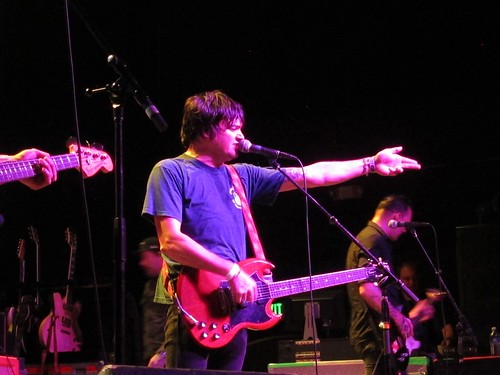
Lead singer Scotty Saunders owned the stage with his theatrical flair. Every moment had the perfect stylized gesture and facial expression. He'd prance one moment, then lunge forward menacingly in another. At times, his over-emoting got right up to the edge of campy, but never crossed over, in large part because it seemed like a natural part of his personality. It also helped that his vocals showed some diversity as they ranged from shout rap-singing to tight new wave crooning to punk proclamation. Most of the band let Saunders take the spotlight, but bass player Aaron Stone challenged him in his bid for the crowd's attention. The interaction was positive, though, with Stone being more exuberant than attention-starved.

058 Instant Empire
It's also worth noting that this was the first show for Instant Empire's new drummer. He did a great job keeping up with the rest of the band as they flew through the tunes in tight formation. Their show was an energetic springboard to set up Megafauna's performance.

088 Megafauna
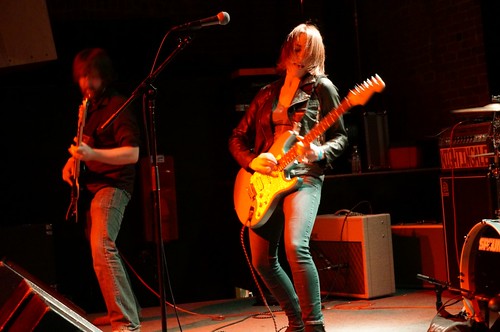
Megafauna's Dani Neff is not one of the most impressive female guitarists around, she's just one of the best guitarists period. She has enough jaw-dropping talent to sidestep the whole question of gender. Where many strong women players are forced to either trade on their sexuality or try to out-butch the boys, Neff doesn't acknowledge either of those paths as necessary or interesting. Taking in her performance at the Moon Room, I didn't miss that kind of posturing, because it was all about the music and face-melting, ear-shredding tone that Neff could wring out of her guitar.

080 Megafauna
I'll confess that, like most guitarists, when I watch another player, I often think about how I would approach the piece myself and judge their skills. Someone might be a little quicker than me, but I might still feel that my phrasing or tone are better. Neff's mastery of the guitar left me nothing but humbled and grateful to witness it.

085 Megafauna
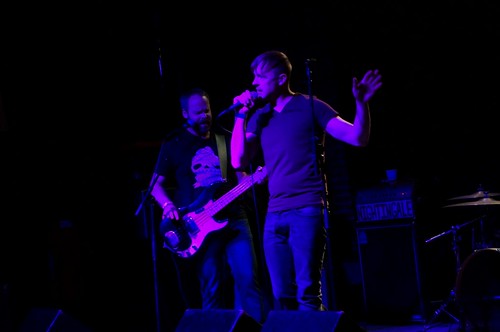
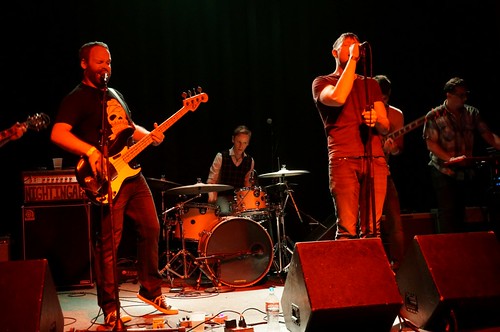
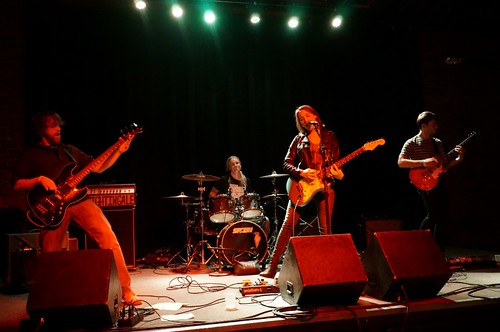
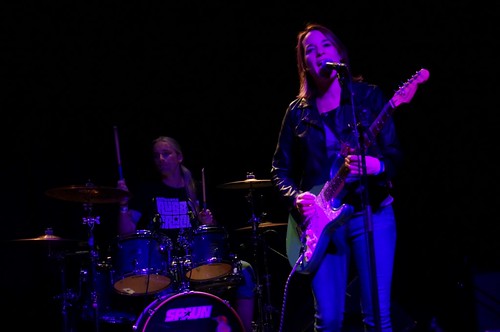
While she could have carried the show completely on her own, the rest of her band rose to the challenge, showing off their own significant technical skills. Bass player Bryan Wright was a second focal point, both musically and visually. Reflecting the band's earlier lineup as a trio, he took over some of the rhythm guitar duty, easily tracking all of the twists and turns to these songs. Drummer Zach Humphrey was a busy player, building up syncopated complexity on the straight rock sections, but also driving the more interesting time signature changes. He had a dramatic sense of dynamics; he could knock the shit out of the drums, then drop back to cymbal work when the tune called for it. I did feel a little sorry for John Musci, the rhythm guitar player, because he spent most of the set completely in Neff's shadow, but his contribution to the foundation was important.

077 Megafauna
Megafauna led off with tribal drum beat and guitar whine of "Hug From A Robot," which set the stage for the rest of the night. The song borrowed heavily from classic rock, with a bit of Led Zeppelin's "Immigrant Song" crossed with Jimi Hendrix's "Crosstown Traffic". They mine some of the same veins as Earl Greyhound, juxtaposing an insistent rhythmic drive with more thoughtfully paced vocals. Like many songs in their set, the band could dissolve from a throaty roar of fuzz to shredding out a flurry of notes.

089 Megafauna
After staking out their claim to classic hard rock and then edging into early heavy metal, they quickly expanded their musical sensibility and became harder to pigeonhole. Songs might incorporate blues, then fusiony jazz. They usually stayed centered on that dark heaviness, but even if they were locked in a psychedelic grind, they could turn into utterly unique directions. This constant possibility of surprise held the audience enthralled. Hypnotized by the groove, we were carried along, whether they leaped into hardcore thrash or shifted into El Ten Eleven or Trail of Dead style post-rock. Although Megafauna favored these lightning quick stylistic jumps, they were always in service to the song, much like their surprising time or key changes.

093 Megafauna
Through it all, Neff retained a rock star presence, knowing how to pose for effect, but never letting up her guitar assault. She'd casually slash at her guitar, but the sound was anything but sloppy. Even at the ecstatic height of a solo, she struck with precise control. The band's forays out from their hard rock core gave her plenty of room to vary her playing from wicked minor pentatonic runs to outside, chromatic riffs that naturally interlocked with the bass. More than just a guitarist, though, Neff adroitly covered vocals, changing character to fit each tune. One song might feature a less twangy version of X's Exene Cervenka style punk, but she could also summon a good gothy darkness like Siouxsie Sioux and a haunting, ethereal tone that suggested Björk in her saner moments. Of course, her singing didn't diminish her playing at all.

076 Megafauna
Bottom line: if talent ruled the world, we would be Dani Neff's loyal subjects. Barring that, we'll have to settle for worshipping her and Megafauna by buying their album on Bandcamp.

More photos on my Flickr.

Thursday, April 10, 2014

Concert review - ...And You Will Know Us By The Trail Of Dead, with La Femme, Silver Snakes, and Git Some

3 April 2014 (Summit Music Hall, Denver CO)

Good intentions and all of that... I wanted to make it down to Denver in time to catch all of the acts, but I ran quite late, arriving just in time to catch La Femme's extended soundcheck. I was disappointed to miss Silver Snakes and Git Some, but I wasn't alone; most of crowd showed up sometime during La Femme's frantic set..

032 La Femme
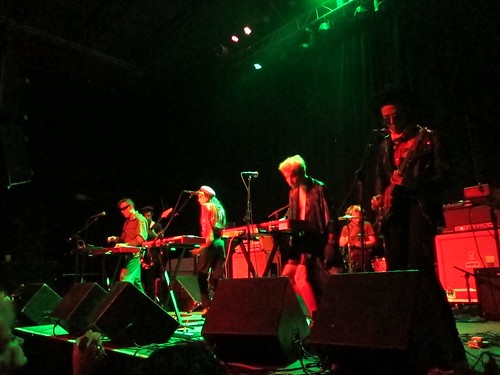
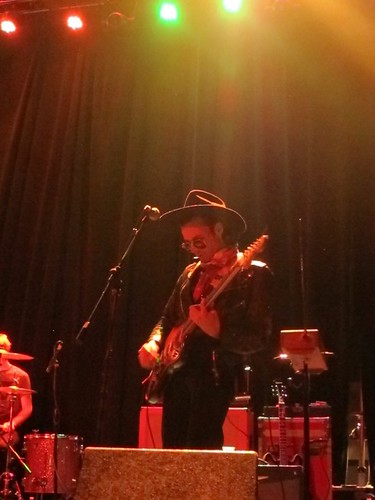
It seemed to take a long time for La Femme to get their monitors and mics correctly set up, but that gave us plenty of time to take in the band members and appreciate each one's unique style, from pseudo-vaquero panache to metrosexual boxer chic. Think Adam Ant, but organized by an ADHD costumer. But the random mix of looks was central to band's artistic sense of theatre: it's not a show unless it's a spectacle. It didn't matter, though, whether the band's appearance aligned because they played in such close formation.

031 La Femme
Back in 2010, I reviewed La Femme's EP, Le Podium # 1, appreciating the way they grafted surf guitar tonality onto new wave. Over the last several years, they've honed that style, pulling in punk and synth pop influences. The blend of reverbed surf twang and synth textures -- call it noir wave -- occasionally recalled bands like The Cure, but generally La Femme was in a class all their own. The dark energy was great and, although almost all the lyrics were in French, everyone could appreciate the side trips into Krautrock trippiness and Velvet Underground psychedelic drone.

011 La Femme
The music worked, but the band's visuals were even better. The front edge of the stage was fenced with keyboards, with only the guitarist going without. His consolation prize accessory was a wonderfully retro theremin. They engaged the audience with stylized dance moves and ironic poses. Frontman Marlon Magnée was chaotically charismatic, whether offering a campy come-ons
to the crowd or sexually assaulting his keyboard. It was crazy fun, but also a little bewildering for some in the audience. Afterwards, I heard someone asking, "What the hell was that?"

024 La Femme
By the time their set ended in a trainwreck celebration of noise and dancing, they had played enough punk thrash to lay the groundwork for Trail of Dead’s set.


092 Trail of Dead
Contradictions are at the heart of what powers …And You Will Know Us By The Trail Of Dead. They ambitiously create rich, concept-heavy post-rock albums that are executed with raw punk rock intensity. Their music spans from fragile, wispy psychedelic patterns to peaks of roaring chaos. But the biggest contrast is between the serious, focused tone they find in the studio and the unfiltered range of emotions they bring to the stage. This tour is all the more intriguing because it’s a brief pause before resuming work on a new album that’s scheduled for later this year. With their most recent release being 2012’s Lost Songs, they may have thought it would be hard to motivate a good turn out, so this tour reaches back to what is regarded as the band’s breakout album, Source Tags & Codes.

099 Trail of Dead
After La Femme's wild finale, it didn't take long for roadies to clear their equipment and power up Trail of Dead’s gear. So, after this brief break, the band came out and launched immediately into “It Was There That I Saw You”. The opening vamp passed quickly and they soared into the driving swirl of the song. The dynamics of the album version were preserved, but the band was wired and pounded through the tunes. Conrad Keely seemed to swap out guitars for almost every song and Jason Reece often traded instruments with Jamie Miller, but these transitions never slowed the flow of their performance.

078 Trail of Dead
Even stripped of their studio production nuances – like the ambient crowd sound and free jazz noodling at the end of “Baudelaire” – the tunes lost none of their power or presence. Trail of Dead nailed the punk foundations of the songs and made them as cathartic and moving as ever.

089 Trail of Dead
It was clear that the crowd was intimately familiar with Source Tags & Codes, sometimes feeling torn between singing along and surrendering to the visceral punch of the music. For all the meaning that we imbued these songs with, Keely and Reece were even more invested. They played like they were tapping into their younger selves with the hindsight of all the changes they had seen. The personnel shifts and bulkier configurations of the past seemed to melt away and this four piece group channeled the epic scope of that earlier incarnation. Like guitarist/drummer Miller, bass player Autry Fulbright II has only been with Trail of Dead for three years, but his charismatic presence was a strong part of the stage chemistry. Both men seemed just as committed to these songs as Keely and Reece.

059 Trail of Dead
All too soon, Keely marked the end of the series, noting “This is the last song,” and then he sighed, “It’s a short album.” The wistful sound of “Source Tags & Codes” was perfectly appropriate and it was even shorter without the string coda of the album version. As the final notes faded, the audience seemed drained for a moment before the band kicked into “Mistakes & Regrets” from 1999’s Madonna. It captured the retrospective mood in the wake of Source Tags & Codes and then dismissed it.

115 Trail of Dead
The crowd settled in as Trail of Dead wandered through another five songs from their back catalog, with particularly strong performances on “Catatonic” (Lost Songs) and “Would You Smile Again” (Worlds Apart, 2005). For this latter tune, Reece reached into the crowd, giving people a chance to sing along and participate in the ritual. After wrapping up the main set, they came back out for a single encore, a version of “Richter Scale Madness” from the band’s first album. The nihilistic flail of the tune energized us all for the late night ride home.

More photos on my Flickr.

Monday, March 31, 2014

Recording review - Matt Stevens, Lucid (2014)

Musical tiles coalesce into a more complicated mosaic

Matt Stevens’ latest solo sketchbook borrows cubist techniques to deconstruct his musical aesthetic and juxtapose all of the perspectives into a single work. Any given point has its locus of continuity and the songs flow into one another in a meaningful way, but on first impression, the project as a whole seems scattershot as it slides from driving post-rock through acoustic art rock to jazzy interludes. But it turns out that Lucid is well-titled, after all. Step back and take a look at the album in toto and you'll see that Stevens draws on the looped guitar experiments of his early work and the more intense exploration of his recent work with The Fierce and the Dead to assert himself. Like Walt Whitman, he is large, he contains multitudes. And although he lets all of these musical personas loose, he’s also invited a host of talented players to join Any given angle or track provides a different window on Stevens’ development as a player.

My first introduction to Stevens was his 2010 solo album Ghost (review), with its wonderfully evocative acoustic guitar loops and jazzy touches. Some of the new tunes call back to Ghost’s sound, like the Beatlesque jazz of “KEA” or the Latin-tinged post-rock of “The Other Side”, which is reminiscent of Ghost’s “Burnt Out Car”. At the same time, Stevens’ heavier tone with The Fierce and the Dead is also well represented, especially on standout tracks like “Unsettled”. Bandmate Stuart Marshall provides the phenomenal drum work that locks the tune down with taut rhythms and tight flourishes. Marshall’s cage barely holds the flailing tantrum of guitar in check. That discipline supports the raw chaotic expression, creating a dynamo of energy that sounds like some kind of head-banging King Crimson mutant. Speaking of Crimson, drummer Pat Mastelotto lends his solid, open-fill drumming to the angular guitar exercise of “The Ascent”. The progression is torn from the Robert Fripp handbook, but the metallic guitar borrows more from players like Steve Vai. Stevens channels a vein of pure emotion and vents out against the mathematical structure of the piece.

That passion and flair set up the sharp transition to my favorite track on Lucid, “Coulrophobia”. “The Ascent” drops away, leaving a vacuum. Tentative, moody notes drip softly into a starlit pool, like Porcupine Tree covering “Echoes” by Pink Floyd. A nervous shimmer of tension lurks at the edges, but never quite comes into focus. Like a dream, there is no control as the tune slowly unfolds at a calculated pace. The nervous energy can’t shake the calm lack of volition and it builds towards a thin trickle of terror. The piece summons more of a sense of sleep paralysis than scary clowns for me, but the savory element of fear certainly comes through. Unfortunately, the song is over all too quickly, moving on to the moody drive of the title track.

In fact, with the exception of the epic piece, “The Bridge”, which runs almost 12 minutes, most of these songs are shorter vignettes. This is what gives Lucid its sketchbook feel, but this, too, is part of Stevens' artistic sense. Where many of his post-rock peers drag out their songs into long-running feasts, he prefers to make instrumental tapas, which showcase a idea with clarity and then set up the next exciting flavor. Lucid collects all of these into strange collection of contrasts and surprises, but the net result is a great musical meal.

Thursday, March 6, 2014

Recording review - Sleepy Sun, Maui Tears (2014)

Concept album? Only beguiling distortion and balanced jams

Too many neo-psychedelic bands mistake freeform anarchy for true psychedelia, thinking that a confused and disoriented listener is functionally equivalent to one who’s been transported. Others assume that they can alchemically transform formulaic progressions into gold if they wrap them in enough distortion and echo. On Maui Tears, Sleepy Sun rises above their lesser peers, delivering a phenomenal album that invites hours of quality replay time. Pick your favorite headphones or, better yet, let it shine out through a good set of mains and share it with your neighbors. The songs are built upon interesting structures, offering plenty of depth to support open-ended jams that never become untethered or trapped in their own bubble. The band has also honed their dynamic sense over the last couple of years to accommodate cathartic growls and ringing highs, but also open spaces with nuanced details. The individual songs offer plenty of opportunities for sonic indulgence, but the pacing and variety across the tracks make this a wonderful collection. The musical feel is consistent even if the tunes vary quite a bit, which uncovers another wise decision—Sleepy Sun also avoids a third trap common to the genre: relying on a simple unifying theme. Concept albums are cool, but the risk of cliché or pomposity is daunting.

The album opens with “The Lane”, a tune that the band has had in their live set for a while now. Jangling guitars channel exultant sunshine and show off the core of Sleepy Sun’s sound. Matt Holliman and Evan Reiss harmonize their two guitars, blending melodic lines into a shifting current of warm fuzz and overdriven tubes. The two parts lock into formation and then split apart before finding common ground again. Underneath, the bass takes on a skeletal hint of rhythm guitar to round out the aural spectrum. The Velvet Underground influence is there in the droning undertones, but Sleepy Sun favors a sweeter balance. The echoing juxtaposition of competing parts is filtered through a distorted shimmer and then stuffed into a thoroughly saturated mix. Frontman Bret Constantino’s vocals contribute to the VU comparison, sunk deep within the mix and draped with slapback echo like Nico’s parts. Distant and buried, it can be hard to wrench the lyrics free, but when they come through, the imagery is heady. On the thoughtful bridge, Constantino sings, “In a pool of roses, we could swim/ It’s only a grand illusion of our earthly whim, a glimpse.” Glimpses are enough to beguile.

The second track demonstrates the power of contrasts. After “The Lane” crashes down, “Words” rises immediately. This time, the twin guitars are clean and acoustic, each one fingerpicking its own chord voicings to build the gentle interlocked structure. The stereo separation splits the two, making it easy to distinguish them. A slab of electric guitar surfs in with the vocal, crackling with buzzing overtones, but, despite the crunch, the acoustics are still clear and strong. The combination leaves the song open for interpretations: a delicate surface can’t quite hide the grind of doubt and conflict. Or maybe the structure is what keeps the negativity in check. Either way, the complexity offers enough distortion to connect to the earlier track but this song finds its own direction.

Part of the album’s appeal also lies in the band’s development. This slacker psychedelia phase has bloomed since singer Rachel Fannan left the band in 2010. Fannan contributed a folk-rock flavor and her voice could be haunted or playfully innocent. Losing her forced Constantino’s personality to the surface: a raw need for a grand gesture, swaddled in oblivion-seeking waves of sound. Where 2012’s Spine Hits (review) set the foundation for the band’s evolution, Maui Tears solidifies the aesthetic while expanding their palette and control. Songs like “11:32” may start with a chaotic snarl of feedback, full of thunder and whine, but they harness that energy with a solid, mid-tempo drumbeat that powers a guitar riff that’s as unswerving as a fixated three-year-old. The verses punch like Jack White sitting in with a no-name garage-psych outfit. The music swirls before dipping into the mellow bridge, redolent with melting whammy bar detune. The spacy interlude celebrates a moment of hang time before falling back into the drive. It’s a tribute to the band’s collective vision that they can pull off these shifts without losing coherence or momentum.

The album closes with a climactic opus. The title track runs well over 10 minutes and channels Pink Floyd’s “Careful with That Axe, Eugene” along with fragments of early King Crimson, Led Zeppelin and Porcupine Tree. From the simple bass line at the start, accompanied by light stickwork rhythm, to the acid-burned guitar jam in the middle, it’s a long, meandering trek along the fringes of a questionable head-trip that culminates in a tribal rite finish, mediated by hallucinogens. Complete with flute solo. It’s the perfect bit of excess to wrap up the album and inspire yet another round with the demons.

(This review first appeared on Spectrum Culture)

Saturday, February 22, 2014

Concert review - El Ten Eleven with Bronze Whale

Friday, 21 February 2014 (Fox Theatre, Boulder CO)

Having a favorite band is often like walking a tightrope. You want them to stay comfortably the same, but not stagnant. You want them to offer up surprises without reinventing themselves into something unrecognizable. The bands often feel that pressure from the fans and it shows in their performance, either by going through the motions with a predictable set or in their frustration as they confront the audience with their "new sound".

El Ten Eleven seems oblivious to the challenge. Over the years, their music has evolved, but they've maintained a creative edge without complacency or belligerence. Having seen the band several times and reviewing their albums and show, it's a challenge to talk about their performance without plagiarizing myself: the duo continues to amaze with a savant blend of technical ability, enthusiastic stage presence, and moving music. 

015 Bronze Whale Regardless of whether you think of El Ten Eleven as math-rock, post-rock, or its own intense flavor of instrumental music, it's hard to see a synergetic connection between their set and an electro-dance opening act. Austin's Bronze Whale offered little to help draw that connection. The two DJs were mostly absorbed by their MacBook and the collection of mixers and other toys they brought along. If the pair had sonically played off one another or created any sense of interaction, it would have registered as more of a performance. Instead, their heavily layered tracks sounded like most of the work had happened long before this evening and their role was to hang back and admire what they had already done. 

001 Bronze Whale
The remix grooves themselves weren't bad, especially if you like electronic dance music, but their only effort to connect with the audience was to step back occasionally and move to the beat. The crowd responded autonomically to the rhythm with nods and swaying, but a fair number of the people who danced were carefully ironic. Late in these set, one of the DJs finally spoke and greeted the audience, but still offered little of his own personality. 

023 El Ten Eleven
As I mentioned, everything I've written about an El Ten Eleven show could be copied verbatim here and it would capture the essence of the band's performance. Even though two years has passed, all of the high points remain the same: Kristian Dunn's enthusiastically physical stage presence, the layered complexity of the music, Dunn's dexterous manipulation of guitar, bass, effects, and loops, and Tim Fogarty's intuitive drum work. That continuity, while impressive, is only the surface. The band has continued to evolve and refine their show. They've tweaked arrangements and added some new tunes -- "Nove Scotia" from their recent EP For emily was in the setlist -- and they've improved their stage lighting.

057 El Ten Eleven
Lighting is often taken for granted; it's ignored when things go well and only noticed when there's a problem. In this case, though, the musical mood changes were accentuated by the combination of on-stage lighting trees and overhead spots along with a delicate hand at transitions. 

037 El Ten Eleven
This performance also emphasized the real-time, live nature of El Ten Eleven's stage show. The songs can be quite complex with simultaneous bass and guitar as well as on-the-fly knob twisting on the effects. While the studio versions are all polished, it can be very challenging for the band to pull it all together. Plenty of improvisational players are adept at rising to the occasion and transforming "mistakes" into magic, often without the audience knowing. El Ten Eleven shares that skill, but they don't mind letting us in on the secrets. At one point, as Dunn was adjusting the end points for a short loop of percussive bass growl, he twisted it into a jerky beat (Fogarty followed along on the drums). Dunn toyed with it for a moment, then smiled out to the crowd, "This is an accident, but I like it." 

050 El Ten Eleven
The setlist bounced around the band's catalog: aside from "Nova Scotia" and opening song "Transitions" from their last album, they also played early tunes like "Fanshawe". Their cover of Radiohead's "Paranoid Android" was particularly fun, sounding tighter and richer than the version they released on 2008's These Promises Are Being Videotaped. Dunn was every bit as dynamic as the musical selections. His boyish exuberance and flamboyant expressiveness contrasted nicely with Fogarty's tight focus. 

067 El Ten Eleven
After explaining the open secret of rock band "fake" encores, Dunn warned us that there were only two songs left. After finishing "My Only Swerving", they prepared to leave the stage, but couldn't resist giving us one last song. Despite some teasing from the audience the band closed with their standard finale, with Fogarty coming out from his kit to play Dunn's bass strings with his drumsticks while Dunn tossed in some guitar arpeggios. Every time I see this I smile.

078 El Ten Eleven
More photos on my Flickr.