(Artwork care of Karen Ramsay (www.karenramsay.com), profile photo care of brianlackeyphotography.com)

Tuesday, January 22, 2013

Recording review - Massive Attack, Blue Lines (1991, reissue 2012)

The birth of trip hop is still fresh and relevant

Blue Lines was a seed crystal dropped into a super-saturated British music scene back in 1991. A new band with the unlikely name of Massive Attack first released a couple of singles: the spacy hip hop of "DayDreamer" and then the game-changing "Unfinished Sympathy". Soon, the band's unique mix of down tempo beats, trippy interludes, and introspective soul became the standard bearer for the new genre of trip hop. The slower rhythms provided an open structure where contrasting parts could be juxtaposed into innovative combinations, inspiring a generation of producers. Although it seemed like Massive Attack appeared out of nowhere, they were an outgrowth of Bristol's Wild Bunch soundsystem, who developed the foundation of the style by blending Jamaican dub, electronic grooves, and American hip hop.

Coming into adulthood at 21 years old, Blue Lines shows some age with old school beats, turntable scratching, and lower fidelity samples. But this reissue is not just a history lesson or faded memory; the album still sounds fresh and relevant. Its mashup mix of soulful vocals and dub rhythms continues to be a mainstay in modern pop music and several of the tracks foreshadow the lasting trends that would follow. The lazy, bass-driven funk of "Safe From Harm" could turn up on a recent release without sounding overly dated. The band would continue to develop in this direction, layering ever more complex combinations of soft synth fills over deep, moody riffs and soulful vocals.

Similarly, that early hit, "Unfinished Sympathy" may rely on an older style of rhythm loop, but the string swells and dreamy R&B groove feel timeless. It's easy to see why this did so well on the charts of the day. Turntable scratching and sampling provide a hip hop vibe, while the keys and strings pull the song towards synth pop. The combination has a chilled distance with an undercurrent of nervous tension. Shara Nelson's warm voice cements the two contrasting elements into a compelling track that works as well in the club as with headphones.

Massive Attack would later edge away from the more direct reggae dub feel of tracks like "One Love", but the tune packs a powerful punch. The sparse rhythm is stripped down to its barest essentials, lightly accented with scratching and a light organ riff. It casts a disquieting shadow on the lyrics. In another setting, "It's you I love, and not another/ And I know our love will last forever," might be just a pretty sentiment, but the dark music and Horace Andy's reedy quaver create a sense of menace.

Listening to that menace leads to understanding, both of the album and Massive Attack's name. Bluster is just wasted energy. Better instead to harness the power of inertia, set something big into motion, and watch the momentum bury everything. Just as the universe is dominated by dark matter and dark energy, Blue Lines is filled with a massive, unseen threat. We can only perceive the understated tension and breathless silence that gives each layered part a hefty weight.

The sole respite from the darkness is the cover of William DeVaughn's "Be Thankful for What You Got", which preserves the original's Curtis Mayfield soul sound under a patina of electronic percussion fills. The arrangement follows the same minimalist aesthetic of the other songs, but the more uplifting lyrics and Tony Bryan's warm vocals create an eye of comfort. In a world of conflict and threat, this reflective moment is sweet. Robert "3D" Del Naja later suggested that the song was too soft and retro for the album, but that contrast makes it all the more valuable. "Five Man Army" follows up with a rich 2Tone sound and trade-off raps, easing us back into the rest of Blue Lines' chill groove.

This reissue respects the band's stripped down approach by not tacking on any distractions. There are no remixes or other extra tracks. Aside from some mixing tweaks, the message is clear: "why mess up a good thing?"

(This review originally appeared on Spectrum Culture)

Thursday, January 17, 2013

Recording Review - Macklemore & Ryan Lewis, The Heist (2012)

Keeping it real on a positive tip

Almost four short years ago, Seattle rapper Macklemore was just an out of town opener for a pair of local bands in Colorado. Even though he was a solo act with prerecorded beats, he was riveting. He blended humor, tackled serious philosophical dilemmas and showcased his radical honesty. This mix flowed from his 2005 album, The Language of my World, which defined his voice. Willing to address tough questions like cultural appropriation on "White Privilege", Macklemore didn't settle for platitudes or oversimplification. Although his sound was stripped down, his backing tracks sampled some occasionally surprising artists like Chris De Burgh.

Moving forward from those early days, he's partnered with producer Ryan Lewis and built a huge grassroots following. His latest album, The Heist, highlights the tight connection with Lewis and serves as their introduction to a larger audience. Macklemore's raps still hit a sweet spot with shifting rhythmic flow, clever rhymes and heartfelt sincerity, but Lewis brings a pop aesthetic that fine tunes the songs, hitting the perfect accompaniment to emphasize the core messages. As the pair step into national distribution, they bring along a host of fellow Seattle artists as guest collaborators to further round out their sound.

The album starts strong with the title track, which shows what the band is all about: deeply personal lyrics, clever lines to lighten the mood, a solid positive message, a smooth flow that incorporates occasional off-beat rhythmic punches, and a tasteful musical backing. Macklemore's soft-sell ego rap carries a message of perseverance . He lays out his successes, but attributes it to the hard work that got him there. With a confessional tone, he links his own struggles to a universal theme and elevates his rap aspirations to a noble artistic pursuit.
Got an iTunes check, shit, man, I'm payin' rent
'Bout  damn time I moved outta my basement
'Bout damn time I got around the country and I hit these stages
I was made to slay them
10, 000 hours, I'm so damn close, I can taste it
On some Malcolm Gladwell
David Bowie meets Kanye - shit
This is dedication
A life lived for art is never a life wasted
Ten thousand
Meanwhile, Lewis' electro-pop groove contributes to the elevation. The chorus, "10,000 hours felt like 10,000 hands/ 10,000 hands, they carry me," distills the song's message to its purest essence. Later, when the lyrics turn darker and introspective during a breakdown section, the music shifts to a starker beat and piano line.

Continuing the positive tip, The Heist serves up a social action track, "Same Love". Tied to support of Washington State's Referendum 74 to allow same-sex marriage, Macklemore tackles the issue head on with a focus on his own personal connection. Mentioning his gay uncle and his own stereotypical assumptions as a kid, he keeps it lowkey, stating the obvious without getting preachy. It's refreshing that nobody gets a free pass; Macklemore even takes rap music to task: "If I was gay, I would think that hip hop hates me." Still, he offers understanding and a path forward. Lewis shows a subtle hand on his arrangement. The music references Curtis Mayfield's "People Get Ready", building a gospel feel on the chorus that suits Mary Lambert's soulful voice

Usually, the rapper gets all of the attention while the producer can be taken for granted. Lewis' skillful accentuation means he's hardly flamboyant, but he does get one track to cut loose and take center stage. "BomBom" progresses through a suite of sections, starting with a minimalist piano jam that merges with a punchy dance beat. Blending samples, beats, and original contributions from The Teaching, the mood wanders between jazzy inward reflection and assertive carnival rhythm. Live drums from the band trade off with looped beats. The track mutates with an improvisational feel.

Aside from that one instrumental, The Heist covers all of Macklemore's favorite topics, from his own sobriety to choosing self-dignity over commercialism. At his strongest, like the heavy personal admissions in "Starting Over", he is raw and revealing without histrionics. Even "Jimmy Iovine", a relatively weak track which plays out as a cartoon revenge fantasy against the music industry, offers some humor and smart lines. Throughout it all, Macklemore seems approachable in a way that rappers like Kanye and R. Kelly never could be, largely because his stage persona is less of a mask.

(This review originally appeared on Spectrum Culture)

Wednesday, January 16, 2013

Diary: Engaging with "Disengage"

In my recent resolutions post, I talked about wanting to record more of my own songs. One of the barriers to that is trying to make everything perfect and fully developed. This song, "Disengage", is my attempt to shift my thinking and just create a simple demo quality song without all the details that might go into a full arrangement. I also forced myself not to sweat the minor flaws and rough mixing. I thought it would be interesting to talk about the song itself and my recording process.


The key riff in "Disengage" is a little chord run I came up with several years ago. It's a song fragment that I've never been able to build into a complete song until now. I kept it around because I loved the descending run, taking a D7 (no 3rd) and stepping the 7th down, note by note. In recent years, I've had trouble working out lyrics until I get the music figured out. As I was noodling a couple of months ago and I came up with the chorus changes, which it motivated me to start thinking about a lyrical theme. Those descending notes suggested regret while the drone D gave it a more objective perspective. The soothing chords of the chorus felt like well-meaning advice.

This combination reminded me of some friends who deal with depression. On the one hand, I sympathize with them, but there's also an element of frustration because I can't seem to help and
every overture is rejected. The words for the first verse grew quickly from this idea. The chorus still seems a little weak to me. The sentiment is a bit too Pollyanna and the words feel too simplistic.

Recording this proved a bit challenging. Singing in the original key hit the lowest end of my vocal range. After taking a couple of shots at it, I decided to start over with a capo, moving the song to E, which is a more nature fit. My voice worked better, but the guitar sounded thin and jangly. This is one of the reasons I really don't like capos. After I recorded the song with the capo, I got the idea of adding a second guitar to emphasize the E chord in the open position, which added some depth.

I taped the main guitar first, along with a click track to keep the tempo constant. I placed the vocals next and added the second guitar as a final track. I dropped the click track when I bounced to a stereo mix. Since I forced myself to get this recorded quickly, I made some snap judgments about the effects that I'd probably change in a final version. The primary guitar is run through a chorus and EQ's to add a little bottom end. That's not bad, but I threw a slightly dirty distortion on the second guitar that I hate now. Keeping that simpler and cleaner would let the parts mesh more smoothly.

I hope this was interesting. I'd be interested in any comments: both about the song and this idea of posting an explanation of my writing and recording process.

Monday, January 14, 2013

Concert review - Reel Big Fish with Pilfers and DanP

12 January 2013 (Aggie Theatre, Ft. Collins CO)

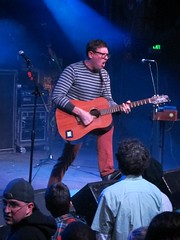
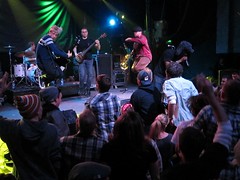
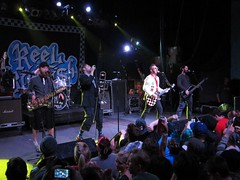
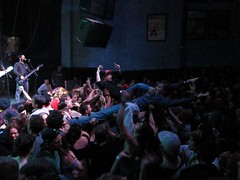
My son joined me for this show. We waited in the freezing line outside the Aggie so we could get a good vantage point. Despite the bitter cold outside, the dancing crowd kept it cozy warm inside once the show began. All three bands were on the national tour and that seems to have drawn a good sized crowd, even for the opening acts.


In band mode, Dan Potthast plays with ska punkers MU330 as well as Dan P and the Bricks. On this tour, though, it was just him and his guitar. As a solo act, his set was heavy on acoustic punk and light on chank & skank. This could have set him up for a tough set, but he managed to win over the crowd with a mix of boyish charm, high energy, and humor.


His 20 minute set moved along quickly, with short, mostly funny songs. Between the single joke tunes and self-deprecating stage patter, it felt like a cross between an open mike night and a standup routine. For example, the first verse of "KKK Highway" (from MU330's Ultra Panic") set up the punchline second verse:
I guess they dress up in sheets and they pick up the trash
...
They should know it when they see it
They get a good look every day in the mirror 
Sure, targeting racists and homophobes (as in "Don't Say Gay") were easy crowd-pleasers here in Ft. Collins, but his earnest attitude and geek style just clicked. In many ways, Potthast was the opposite of Reel Big Fish's Aaron Barrett: cheery, sincere, and optimistic.


If you know your ska history, you're familiar with the Jamaican first wave, the 2 Tone second wave, and the punk/alt-rock third wave. Fans and critics argue about fourth wave ska, debating whether it exists or what the sonic definition will be. Pilfers' set was a strong argument that they're at that leading edge. Starting with a punk/ska-core foundation, they extended the sound with hip hop attitude and stage style as well as a strong element of headbanging metal. 


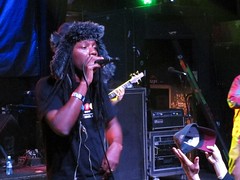
Front man Coolie Ranx was a monster. He owned the stage with an animal charisma, trading heavily on hip hop stagecraft. He stalked the stage like a lion, goading the band one moment, then turning to confront the crowd. He taught us our cues to participate: "Elevation!" to pogo dance or "Wipers!" for arm waving. This engagement took the easy going party of the first set and channeled it into a visceral tribal feel, uniting the audience.


In another page from the hip hop manual, touring trombonist Billy Kottage tag-teamed Ranx, acting as hype man. Their twin delivery, with Kottage emphasizing Ranx' lines, kicked up the energy and whipsawed the stage flow.


They started off with an older track, "Chawalaleng". The guitar started too low in the mix, but the bass heavy groove gave the song momentum. While the dark grind of the melody snaked around, Ranx tossed out comments with a speedy toasting rhythm. Kottage's trombone added the perfect fills. The audience joined with the chanted chorus. They followed up with a more classic ska jam to chill the mood, then Ranx started working the crowd.


He walked us through our parts for "Yakuza", explaining our lines and cues. Then band kicked into the punk thrash of the tune. Along the way, Nick Bacon's guitar shred led the song back and forth between punk and metal, setting the mood for the following songs. The ska beat would slide in and out depending on how hard the band pushed it, but Ranx' coiled tension was a constant challenge, urging us on.


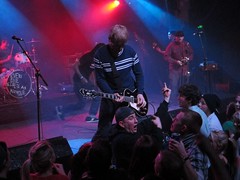
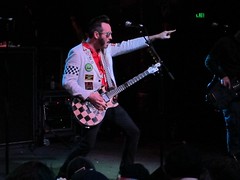
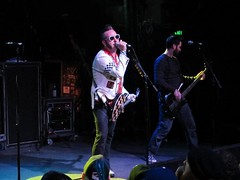
Reel Big Fish did their best to assure that nothing has changed since their heyday in the late '90s. Aaron Barrett's sly sarcasm, the whip-smart arrangements, great musical chops, and an irreverent attitude -- all the standard ingredients of a Reel Big Fish show were there. The setlist included a lot of songs from last year's Candy Coated Fury (review here), which meshed perfectly with the classic older material. Everybody at the show must already have the new album because they happily sang along when the band opened with "Everyone Else is an Asshole". In fact, as dedicated fans, the crowd joined in on every song.


The band fed off that energy and delivered a fantastic performance. Barrett, trombone player Dan Regan, and Matt Appleton on sax provided most of the patter and direct interaction, but the whole band was disciplined, zipping from song to song. It's paradoxical, a kind of organized anarchy. They maintained a tight sound that followed the studio arrangements, but the stage show felt very loose. The clowning was fairly choreographed, but like the Three Stooges, Reel Big Fish had great comedic timing and a dedication to getting the laughs.


Much of the humor was already there in the songs. "I Know You Too Well To Like You Anymore", "She Has a Girlfriend Now", "Your Guts (I Hate 'em)": the band plowed through the songs with venomous joy and the occasional snarky aside. Even on a more sincere cut, like the upbeat "Good Thing", Barrett acknowledged, "That song was the nicest song I ever wrote...I was in a good mood one time. For a minute and I wrote a song. Anyway, here's another mean song."


Regan and Barrett in particular had great chemistry here. On "Where Have You Been", Barrett danced around with his guitar during the break while Regan worked Barrett's wah-wah pedal. Near the end, the song shifted into a head cutting session between the guitar and the trombone. After Barrett shredded out a wicked solo, Regan responded with a trombone version of "The Imperial Death March" from Star Wars to win the contest.


They also had fun with a bait-and-switch set up. They announced that the next tune would be about their favorite beverage. They launched into "Tequila" , with Barrett vocally covering the bridge horn line before giving it up. Then they tried "Red Red Wine" and "Margaritaville" before settling into "Beer" from Turn the Radio Off.


The funniest moment came during the encore. Their Madness-inspired ska jam "Don't Stop Skankin'" morphed into "S.R.", an early track decrying the break up of fellow ska band Suburban Rhythm. When the song wrapped up, they asked everybody to stop skankin', "Just for a minute. Take it easy...but don't stop circle spinning." Then they immediately whipped through "S.R." again, this time as a punk song. They used similar segues to shift into disco, country, and death metal. They finished with, "Don't stop clapping." They closed out the encore with a speedy, ironic cover of A-ha's "Take on Me".


More photos on my Flickr